Finn Brooks: Long week — but I found the thing that broke my brain, so I feel fine actually.
Clara Bennett: Okay, what broke it?
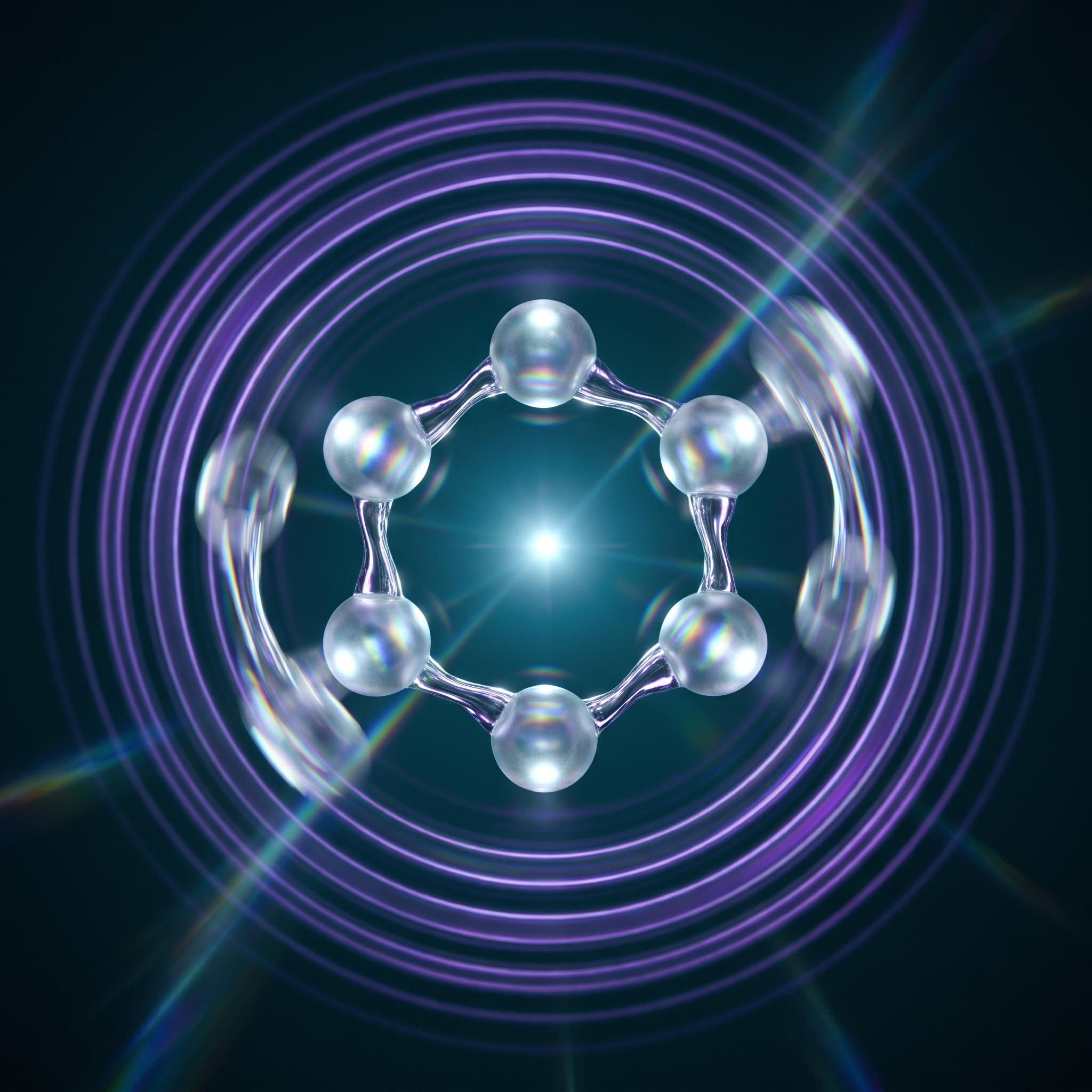
Finn Brooks: There is a single nitrogen molecular ion — like, one molecule, positive charge — suspended in a trap at the University of Basel, and Stefan Willitsch's team just measured its vibration. That alone is wild, but the vibration they caught is a billion times weaker than what normal molecular vibrations look like. And their readout in Nature Communications shows it. Clean.
Clara Bennett: Mm — and what does "caught" mean here, because that's the part that actually matters.
Finn Brooks: No, that's — wait, that IS the whole thing. They didn't destroy the molecule doing it. They had a calcium ion sitting right next to the N₂⁺, and the calcium ion reads the state without consuming the sample. The molecule survives the measurement.
Clara Bennett: A calcium ion as a non-destructive probe. In practice that means you've separated the act of measuring from the act of disturbing — which is not trivial at this scale.
Finn Brooks: It's like having a spy who can read your diary without opening it. And Willitsch's group at Basel's Department of Chemistry just did that. With one molecule.
Clara Bennett: Right — and the question we haven't answered yet is why that vibration is a billion times harder to see in the first place.
Finn Brooks: Okay but wait — a billion times weaker. Why is it so hard to see? Like, what makes this vibration basically invisible?
Clara Bennett: So quantum mechanics has selection rules — essentially a set of conditions a transition has to meet before light can trigger it. This particular vibration in N₂⁺ breaks those rules. Which sounds like it shouldn't happen at all, but it does — just extraordinarily rarely. Hence 'forbidden.'
Finn Brooks: The camera flash analogy — that's exactly it. You flash, the molecule's gone.
Clara Bennett: Exactly that. In 2014, Willitsch's group at Basel were the first to observe this — a genuine first. But their detection method was chemical, which meant every single measurement cycle destroyed the molecule. You got one data point, and then you started over. Fifty repetitions, fifty molecules consumed.
Finn Brooks: So the 2014 result was real, but basically a one-shot deal every time.
Clara Bennett: Precisely. They proved it was possible. What the 2026 Nature Communications paper actually delivers — and this is the 'global first' that matters — is non-destructive, repeatable measurement of the same single N₂⁺. Twelve years to close that gap. And the precision improvement isn't marginal, it's tenfold.
Finn Brooks: Tenfold. On one molecule. That's — yeah, okay, that actually reframes the whole thing.
Clara Bennett: And quantum-logic spectroscopy is what made it possible — borrowed straight from atomic clock techniques. The calcium ion sits adjacent to the N₂⁺, the reversible laser pulses trigger the forbidden transition, and then the calcium ion reads the resulting state and reports back. The nitrogen molecule is never consumed. You can do it again. And again.
Finn Brooks: So the breakthrough isn't seeing something new — it's being able to look at the same thing without it disappearing on you.
Clara Bennett: And that's exactly why the word 'forbidden' is doing so much damage in the coverage. Because the measurement surviving — that's only possible if you understand what 'forbidden' actually means. It's not impossible. It's suppressed by a factor of around a billion.
Finn Brooks: Wait — the northern lights broke my brain on this one.
Finn Brooks: That green shimmer — the aurora borealis — that color comes from forbidden quantum jumps. In atmospheric atoms and molecules. Right now, tonight, if the sky's clear, that is literally forbidden transitions firing overhead. It's not lab-exotic, it's just... sitting there above us.
Clara Bennett: That is — yes, and I love that you landed there because it makes the distinction concrete. The northern lights aren't breaking physics. The transition is simply so unlikely, so suppressed, that it needs the near-vacuum of the upper atmosphere — almost no collisions — to actually happen at a visible scale. Earth's atmosphere is thin enough up there to give those transitions the time they need.
Finn Brooks: So 'forbidden' means — what, 'really really slow to happen,' not 'against the rules.' The word is actively misleading people into thinking physicists broke something.
Clara Bennett: Precisely. And now — think about a materials researcher, say, sitting at a cryostat at two in the morning, trying to characterize a single trapped ion. Pre-2026, she gets one measurement, the molecule's gone, she rebuilds the trap. The transition was always there. The billion-times suppression meant her probe light essentially never triggered it. What quantum-logic spectroscopy gives her is a probe sensitive enough to catch something that faint — and the calcium ion reports back without consuming the sample. The suppression is the whole reason you need that level of precision in the first place.
Finn Brooks: And honestly — what I want to get into next is what this actually unlocks. Because every headline says molecular clocks, qubits, fundamental physics tests — and I'm not sure the 2026 paper actually demonstrated any of that yet.
Clara Bennett: It did not. And that's the correction I'd push on every headline I've seen this week. The Nature Communications paper is a proof-of-concept measurement technique. No working molecular clock. No qubit system running computation. What it establishes is the precision foundation — the measurement capability that those applications would need to exist.
Finn Brooks: So what can someone actually do with this right now? Like, today?
Clara Bennett: Picture a spectroscopist — say, someone mapping the vibrational fingerprint of a single candidate molecule for a new material. Pre-2026, she gets one interrogation, the measurement destroys the sample, she reloads. Now she can run the same N₂⁺ through repeated measurements, stacking data points on the exact same particle. That repeatability is what's new. Not the clock. Not the qubit.
Finn Brooks: Wait — so the actual deliverable is just... more data on one molecule?
Clara Bennett: More data on the same molecule — which sounds modest until you realize the subtle shifts in that vibrational fingerprint were completely invisible before, because you never got a second look. That's not small. That's the whole measurement bottleneck, removed.
Finn Brooks: Okay but the molecular clock framing — I mean, is that completely invented by press releases or is there actual substance to it?
Clara Bennett: There's substance — it's just... I mean, the pathway is real but it's not short. Molecular clocks, qubits encoded in rotational-vibrational states, precision tests of fundamental physics laws — those are all genuine downstream directions. Quantum-logic spectroscopy gives you the precision access to vibrational states that those applications require. But the paper doesn't get you there. The timeline from a lab milestone like this to a deployed technology is typically years to decades. Stefan Willitsch's team solved the measurement problem. The engineering problems after that are — they're a different mountain entirely.
Finn Brooks: Decades. That's the part that keeps getting quietly dropped from every write-up I've seen.
Clara Bennett: Because 'proof-of-concept measurement technique, applications to follow in an indeterminate number of years' doesn't get clicks. But that's the honest description of what the University of Basel published. And importantly — that's still a genuinely significant result. The tenfold precision improvement on a single forbidden transition in N₂⁺, non-destructively, repeatedly. That's the real advance. The applications coverage just ran ahead of what the paper says.
Finn Brooks: And I think this is the actual quiet thing at the center of all of it — Willitsch's team didn't break a rule. They just figured out how to listen to the molecule without silencing it.
Clara Bennett: And the more interesting question now, I think, is what we've been missing. Every time the measurement ended the thing we were measuring — that's not just a technical inconvenience. That's data that never existed. Properties we couldn't even ask about.
Finn Brooks: Twelve years between the first observation and actually being able to do it without destroying it. That gap is the story, I think.
Clara Bennett: It is. Good conversation — genuinely.