Lila Soto: Hugo, long week — I need to start with a contradiction, just hand it to you and watch your face. Ready?
Hugo Vance: I have no face on a podcast, but proceed.
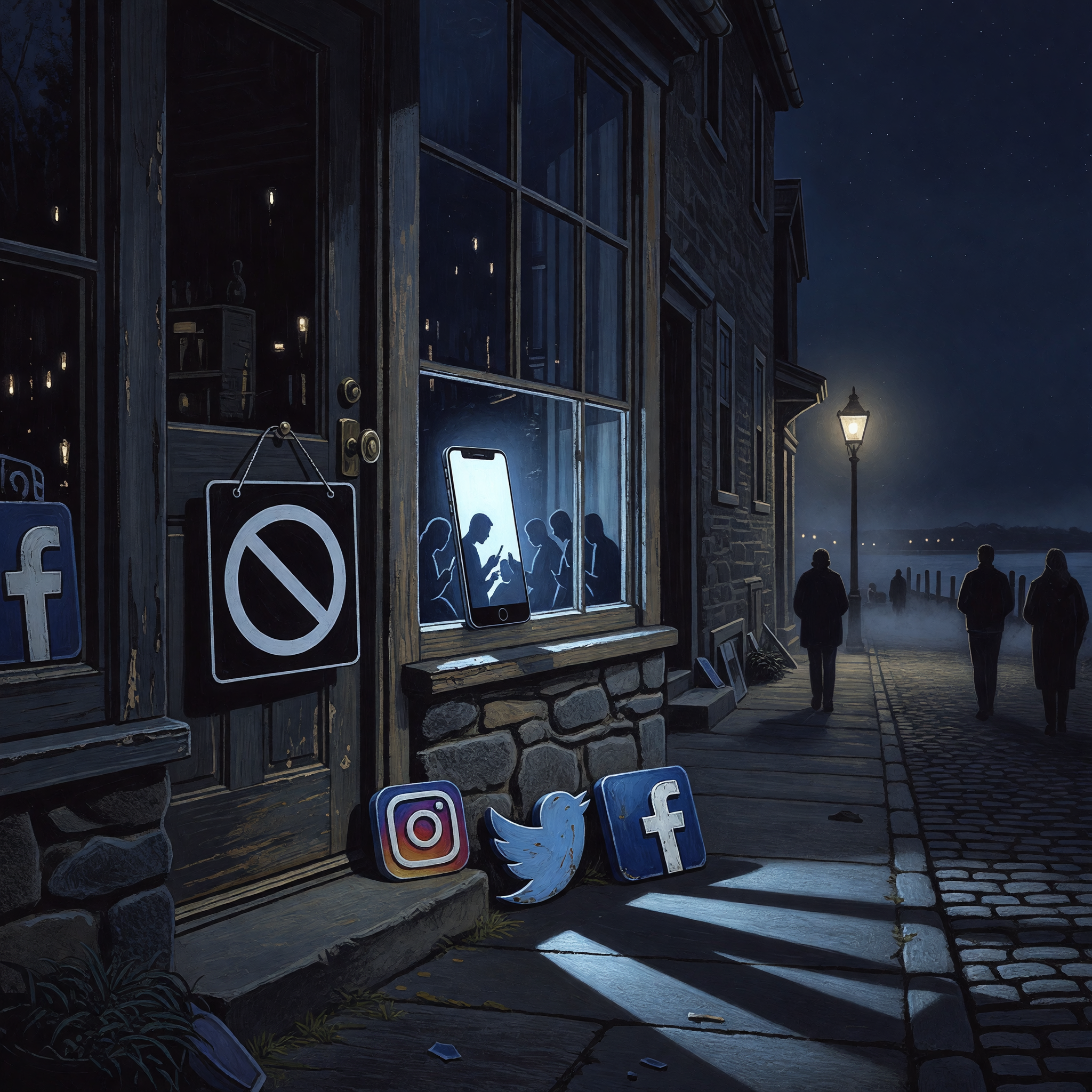
Lila Soto: John Sylvia, owner of Four Winds Craft Guild — a Nantucket shop that traces back to 1948 — makes a handmade 'No Influencers' sign in nautical gold script. Has a local artist make it. And the way the world finds out about it is: a shopkeeper named Jessica Jenkins puts a photo of it on Instagram in late July 2026. Instagram then removes the post. And that removal is what sends it to Reddit, makes it national news, BuzzFeed, People, Fox News, the works.
Hugo Vance: The removal is the amplifier. Yes.
Lila Soto: Which — okay, I get why you'd call that theater. But Sylvia went to the Times and said, pretty plainly, that visitors were treating his store as 'someone's background, a stage.' That's not a performance, that's someone naming exhaustion.
Hugo Vance: I don't doubt the exhaustion. What I'd want to know is whether the sign changed anything at the register. If Four Winds is actually turning away customers they've identified as content creators — that's policy. A sign posted to Instagram is something else. It's a statement about the problem dressed as a solution to the problem.
Lila Soto: Hm. Kind of like — you know how a restaurant puts a 'no photos' placard on the table, but nobody actually stops anyone?
Hugo Vance: Precisely. The placard tells you what the owner wishes were true. It does not enforce the wish. And in this case, the placard itself became the content — which is a very particular kind of irony.
Lila Soto: But the placard analogy kind of breaks down the second you get to Paige Lorenze, though — because she doesn't just post a comment. She puts up a counter-sign at her own Dairy Boy storefront. Which is in Nantucket.
Hugo Vance: She owns a Nantucket storefront. She is a local business operator. And she framed John Sylvia's sign as — what was the exact line — 'Mocking women when they become powerful in a new industry isn't new.' That is a feminist grievance. Filed by an insider.
Lila Soto: I mean — yeah, that's the contradiction. But does the contradiction actually kill the argument?
Hugo Vance: It doesn't kill the argument in the abstract. But it does make this particular deployment of it dishonest. She is not the outsider being excluded. She has a Nantucket storefront. She is the institution invoking anti-institutional language.
Lila Soto: Okay but — wait, actually I think the historical point she's gesturing at is real. Female-dominated industries do get dismissed. Blogging got mocked. Lifestyle content got mocked. That pattern is real even if Lorenze herself is a compromised messenger.
Hugo Vance: The pattern is real. The application here is wrong. Sylvia's complaint isn't about a female-dominated industry — it's about Nantucket lightship baskets, which start at eighteen hundred dollars, being used as backdrop without purchase. That's not misogyny. That's a man watching his inventory become someone's set design.
Lila Soto: And then her counter-sign at Dairy Boy goes viral. And draws counter-criticism. For lacking self-awareness.
Hugo Vance: Yes — because her counter-sign became content. Documented, posted, spread. She exited nothing. She proved the cycle is inescapable, and she did it from inside a Nantucket retail address. The husband being Tommy Paul gets mentioned in coverage almost as a footnote, but it underlines the profile — she is not an underdog.
Lila Soto: I don't think the messenger being flawed means the message is wrong — but I'll grant you this: when the protest becomes the thing it's protesting, that's not a coincidence. That's what the system does.
Hugo Vance: And that inescapability is exactly where I'd want to slow down — because a Georgia boutique reposting the sign in solidarity, NYC commentators saying 'bring this to New York' — that's not a community defending itself anymore. That's gatekeeping becoming a trend. Which is content.
Lila Soto: Wait — but isn't that how norms actually move? Like, a symbolic act spreads precisely because it names something people already felt.
Hugo Vance: Name a norm that shifted through virality and held.
Lila Soto: Oh, I mean — picture a creator walking in on a Tuesday, ring light in her bag. She's not thinking about any sign. She sees the lightship baskets, eighteen hundred dollars, the carved purses, the whole curated space — and she thinks, my followers will love this. She's not malicious. She's doing exactly what the platform rewards. And the sign cannot stop her. John Sylvia cannot identify her at the door — there's no legal category, no badge that says 'influencer.' So what does the sign actually do?
Hugo Vance: It tells her she's been seen. That's not nothing.
Lila Soto: Hm. Yeah — being seen matters. But the Georgia boutique reposting it, the New York wish-list — that's the gesture becoming aesthetic. It's separating from Four Winds entirely.
Hugo Vance: Well, yes — and I'd go further. The authenticity being defended at Four Winds was already a media construction. Elin Hilderbrand's Nantucket novels — that whole mythology, book after book — that's what put a certain aspirational image of the island into mass circulation. The very tourists Sylvia is exhausted by were, in part, reading their way there.
Lila Soto: Oh — that's a real problem for the authenticity argument.
Hugo Vance: It is. And there's a layer we haven't touched yet — the part about what Instagram's removal actually protected — that I think makes the whole gesture stranger than it looks.
Lila Soto: I mean, I still think Sylvia's exhaustion is real and the impulse was sincere — even if the infrastructure swallowed it whole. Both things stay true.
Hugo Vance: The sincerity — I'll grant you that, actually. The sign was made in nautical gold script on dark wood, by a local artist. John Sylvia didn't print that at Staples. That's a craft object. It speaks the same visual language as the lightship baskets. That's not manufactured outrage — that's a man using the shop's own aesthetic vocabulary to say something real.
Lila Soto: Oh — that detail actually changes how I read it. The form is the argument.
Hugo Vance: It is. And you were right — performance and sincerity aren't opposites. I'll concede that cleanly. But the moment BuzzFeed, People, Fox News, the Boston Globe, and KTLA all run it — that's five national outlets — the gesture is no longer John Sylvia's. It belongs to the content machine. The sincerity is preserved in the object. The intent is gone.
Lila Soto: Mm — but doesn't the fracture inside Nantucket itself push against your reading? I mean, locals split on the sign, influencers split on it — there's no clean 'community versus outsiders' here. If the content machine fully absorbed it, you'd expect a cleaner villain-and-hero shape.
Hugo Vance: The fracture is real. Yes. But I'd say it proves my point, not yours — because Four Winds and Sylvia Antiques together represent seventy-five years on that island. If a genuine, three-quarter-century business presence can't consolidate the community around a simple boundary, that tells you the boundary was already compromised before the sign went up.
Lila Soto: Huh. Or — wait, actually — the fracture is evidence the sign did something real. A gesture that lands without resistance doesn't fracture anything. It just disappears.
Hugo Vance: It landed. I won't dispute that. What I'd want shown is one thing: a content creator, identified, turned away at the register. Not the sign. Not the coverage. That.
Lila Soto: And that's — yeah, I don't think that happened. So the gap stays.
Hugo Vance: The gap stays. And I think that's actually the only honest place to leave it. Instagram removed the post, the story got bigger, other shops copied the gesture — the resistance became the content. I don't know what you do with that.
Lila Soto: Yeah. I mean — the only communities that successfully gatekeep are probably the ones we're not sitting here talking about. Because we haven't heard of them.
Lila Soto: I think that's where I live now. A little uncomfortable with it, but yeah.
Hugo Vance: Good conversation. I mean that.