Felix Ortiz: Tess — long week, I know, but I genuinely cannot stop thinking about something I watched this morning and I need you to tell me if I'm reading it wrong.
Tess Hollis: The SpaceX footage?
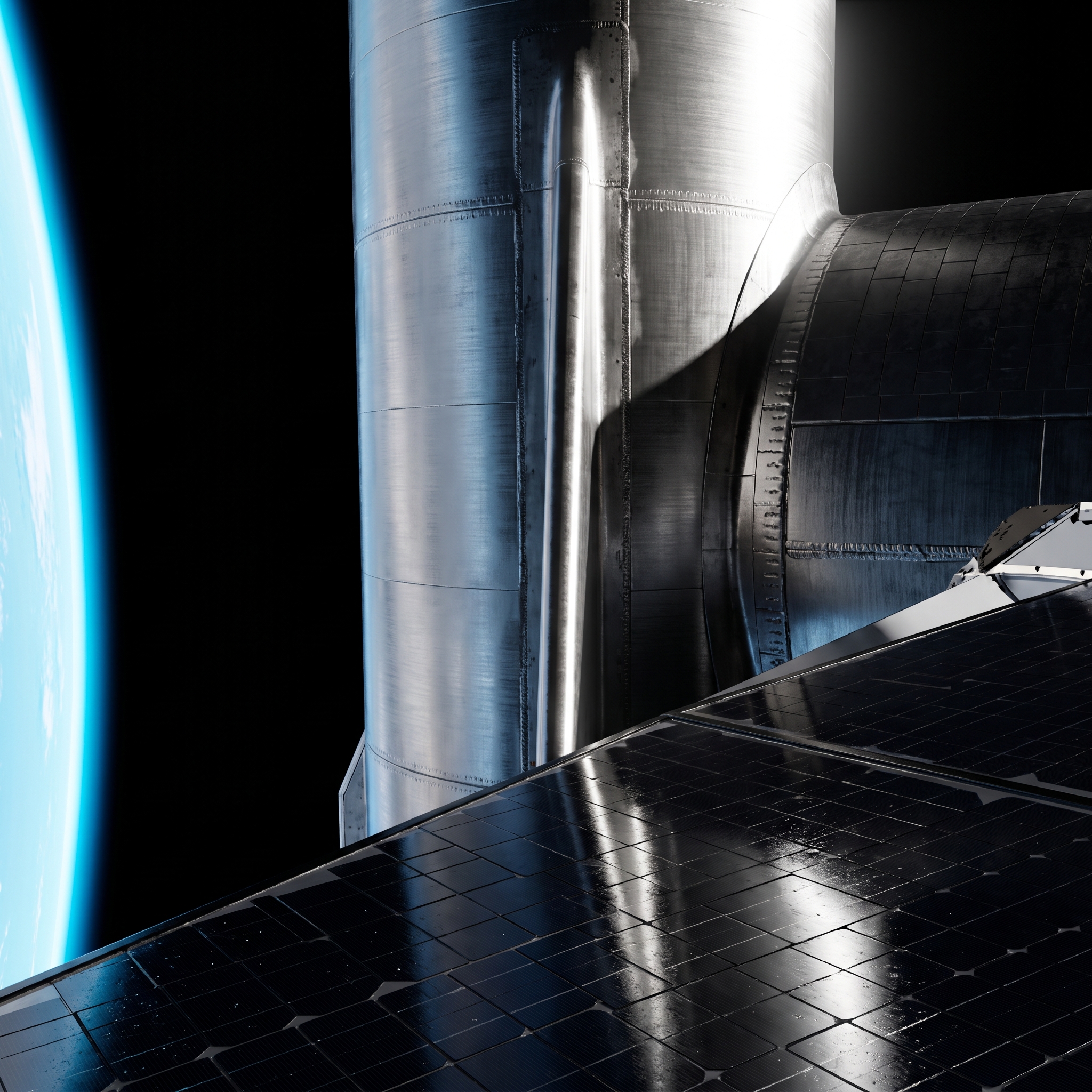
Felix Ortiz: The SpaceX footage. Sixty-five seconds. One Starlink V3 satellite, stitched from four onboard cameras, and you're watching Starship just drift away in orbit. First time that's ever been captured satellite-to-spacecraft. And it came from Flight 13 — July 24th out of Starbase — where Starship was literally carrying those satellites as cargo.
Tess Hollis: The payload documented its own launcher.
Felix Ortiz: That's — yeah, exactly. The inversion is what's wild to me. And SpaceX put the video out publicly, August 1st or 2nd, and the framing everywhere is Starlink V3 is now an observation network. Multi-role constellation. This changes what those 10,876 satellites in orbit actually are.
Tess Hollis: Huh. Okay, I want to push on that — because six camera-equipped satellites launched on a suborbital trajectory and burned up in twenty minutes is the data point. That's it. SpaceX released one video from one satellite. What happened to the other five?
Felix Ortiz: Oh. I actually — yeah, I don't know. I assumed they all got footage.
Tess Hollis: Nobody's said. And that question is sitting right underneath all the headline energy.
Felix Ortiz: Right — but the part that doesn't fit is, I was treating this like a deployment. Like SpaceX launched twenty Starlink V3 satellites and some of them also had cameras. That's not what happened, is it.
Tess Hollis: Not even close. All twenty were on a suborbital trajectory. They were designed to demise on reentry. None of them were ever going to join the constellation — they were built to burn.
Felix Ortiz: Wait — all twenty? Not just the camera ones?
Tess Hollis: All twenty. Here's the analogy that actually lands for me: imagine you hire a photographer for one event, they show up, they shoot, you confirm the photos are good — and then you bulldoze their entire studio before they leave the parking lot. That's the move SpaceX made. These satellites deployed solar arrays, fired thrusters, established laser-link connections with the existing constellation — roughly 10,876 satellites pinging back — and then, twenty minutes in, they're gone. Intentionally.
Felix Ortiz: The laser links are what I keep snagging on actually — wait, no, I mean — they connected to the live operational constellation and then just... ceased to exist as nodes.
Tess Hollis: Proved the hardware works. That's it. Proof is not persistence. An operational observation network requires satellites that stay up, fly recurring missions, build a pattern. What Flight 13 proved is that you can bolt cameras onto a V3, confirm the data pipeline closes, and then incinerate the evidence.
Felix Ortiz: So the headline — Starlink is becoming a multi-role constellation — that's getting way ahead of one twenty-minute hardware test.
Tess Hollis: One test, one released video, five satellites whose footage we've never seen. That's the actual data set. Whether this scales into anything operational — genuinely unclear, and I'd want SpaceX to say a lot more before I'd call it a network.
Felix Ortiz: But here's the part I think we've been sliding past — the footage everyone celebrated, Starship drifting in orbit, that's not actually what those six cameras were sent up to document. The job was heat shield tiles. Thermal protection system integrity during reentry. That's a completely different shot, different moment, different lighting condition. The orbital drift video is... before the hard part even starts.
Tess Hollis: That's the buried question.
Felix Ortiz: Right — so like, picture whoever was on data review at Starbase the morning after Flight 13, pulling up six camera feeds, and the question isn't "did we get beautiful footage" — it's "did we actually see the tiles under thermal stress." And we don't know if that answer was yes.
Tess Hollis: We don't. Sources don't confirm whether the heat shield inspection imagery was captured, whether it was usable, or whether SpaceX has even shared it internally beyond mission control. The video that went public shows Starship in orbit. That's real. That's a genuine first. But is it the deliverable?
Felix Ortiz: Okay — so the hot take does get a partial win though, right? Because satellite-to-spacecraft video from orbit is actually unprecedented. That part is real.
Tess Hollis: Yeah, it's real. And the V3 hardware performing — solar arrays, thrusters, laser links, data pipeline all closing before demise — that's the kernel that actually survives scrutiny. The milestone is genuine. The capability claim built on top of it is the part that outruns the evidence.
Felix Ortiz: And worth saying — Flight 13 almost didn't happen when it did. July 16th, four Raptor engines failed to ignite, full abort, one week delay. So this wasn't a smooth routine op. They scrubbed, they fixed, they flew on July 24th. Still a test program.
Tess Hollis: Which is why the inspection mission framing matters — you don't send a camera crew to a test flight and then celebrate the wrong reel.
Felix Ortiz: And the part that actually makes this whole thing more complicated — whether any of it becomes repeatable at all — I think that's where we end up next, because right now one suborbital burn-up doesn't move the needle on what the constellation can actually do long-term.
Tess Hollis: And that repeatability question is exactly where the verdict has to land — because Flight 13 did something real. Raptor relight in space. Controlled reentry, splashdown in the Indian Ocean, drone footage, buoy camera, the whole documented sequence. That's not a partial win. That's milestone compression — hardware deployment, camera systems, laser links, data downlink pipeline, all stress-tested in a single twenty-minute suborbital window under actual flight conditions.
Felix Ortiz: All of that in twenty minutes.
Tess Hollis: Simultaneously. That's the part worth holding. But — and I want to be precise about this — the open question isn't whether Starlink V3 satellites can carry cameras and film Starship. Flight 13 answered that. The question is whether SpaceX actually deploys camera-equipped V3 units into permanent operational orbit. Those are not the same thing.
Felix Ortiz: Right, and — okay, the thing I can't shake is, the infrastructure is already there. Like, 10,876 satellites in orbit right now, the laser-link backbone exists, the V3 hardware proved it can carry cameras. SpaceX chose not to build persistence into this test. That's a decision, not a limitation.
Tess Hollis: Which is why the decision memo is the actual story.
Tess Hollis: Picture a SpaceX engineer at Starbase the morning after the footage drops, staring at a decision memo: do we build the next batch of V3s with cameras standard, or was this a one-off? That decision — that's what determines whether Flight 13 was a capability or a stunt. And it hasn't been made publicly. We don't know which way it goes.
Felix Ortiz: So the calibrated take is — Flight 13 was a genuine milestone, multiple subsystems validated at once, that part holds up. But 'Starlink is now a persistent multi-role observation network' is a future claim dressed as a present one, and nobody's made the call yet that would make it true.
Tess Hollis: That's the one. Evolving the Starlink constellation into long-duration observation requires satellites built for it and actually deployed that way — not one suborbital run that ends in reentry demise. Flight 13 proved the hardware works. Operational significance is still a memo waiting to be signed.
Felix Ortiz: And the memo might already be written, right? Like — okay, I'll half-concede the multi-role constellation framing. Maybe I got slightly ahead of the evidence on that one. But SpaceX proved in twenty minutes that Starlink V3 can carry cameras, close the laser-link pipeline to 10,876 operational satellites, and document Starship in orbit. That happened. The part that just... sits there unresolved is, who is the persistent version of this for? Commercial imaging? Military contract? Scientific observation? They're not saying.
Tess Hollis: That silence is the whole thing. SpaceX built a twenty-minute camera crew, confirmed it worked, and then said nothing about what comes next. That's either very deliberate or very unresolved — and I genuinely don't know which.
Felix Ortiz: Yeah. I mean — that's actually a decent place to land on this, I think. Uncomfortable but honest.
Tess Hollis: It is. Good watch, though. That sixty-five seconds is genuinely something.