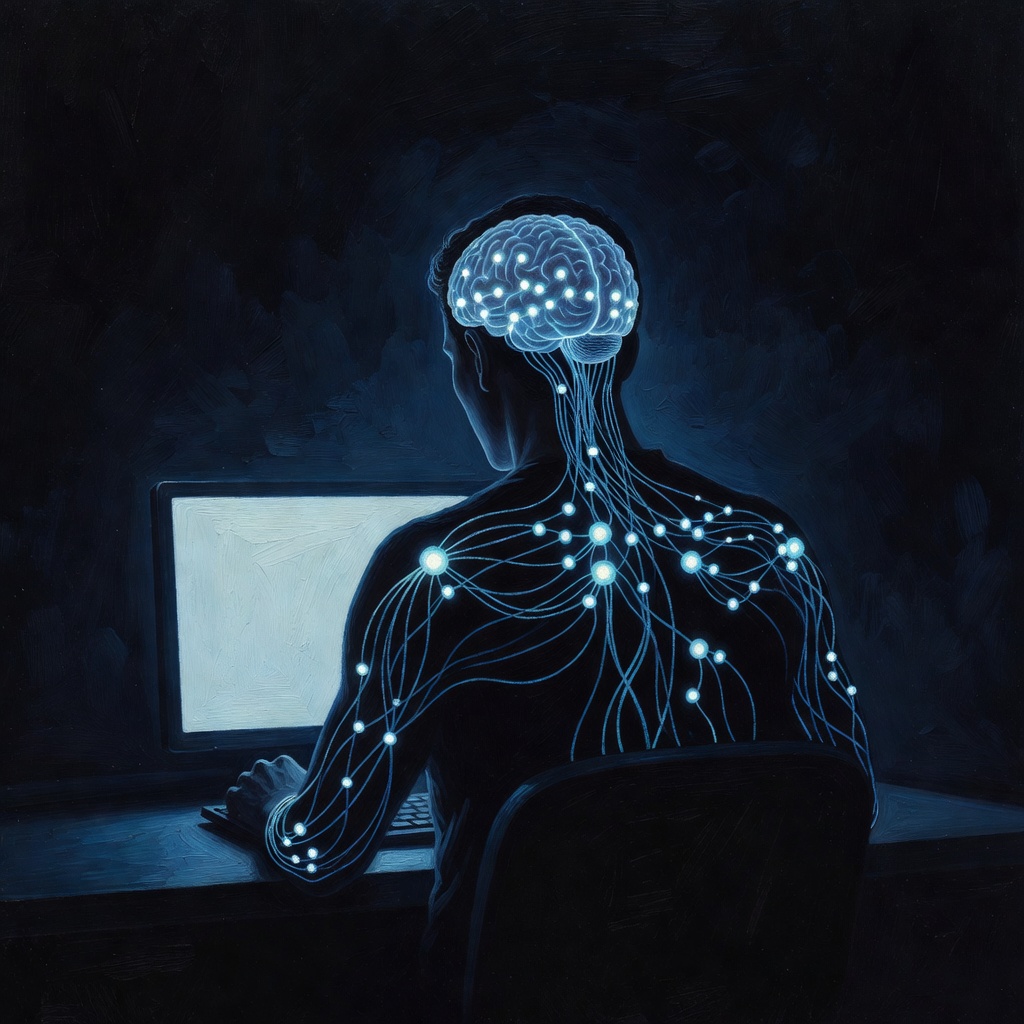
Jordan Hale: Tuesday morning. 8:47 a.m. A caregiver walks in, plugs four electrode arrays into Casey Harrell's skull, and five minutes later he's browsing the web. I need to just — sit with that for a second.
Alex Mercer: Huh. That's actually the right way to open this.
Jordan Hale: Right? Because we can talk numbers — and we will, 3,800 hours over 22.6 months, which is — I mean, that's not a demo — but I want people to actually picture what this looks like. He thinks about moving his hand. Words appear on screen. That's it. That's the whole thing.
Alex Mercer: So the four Utah microelectrode arrays are implanted in his left precentral gyrus — that happened in 2023, that's the BrainGate2 trial — and they're recording neural signals that get decoded in real time. Brain-to-text, cursor control. The thing MIT Technology Review is calling him the first power user of a brain implant for.
Jordan Hale: Stanford, UC Davis, Brown, Mass General Brigham — all of them are on this. And UC Davis published the results and said he's browsing the web and doing job-related tasks. Independently. That word matters.
Alex Mercer: It does. And I want to push on exactly what it means — but yeah, as a proof-of-concept moment for paralysis medicine, this is the one.
Alex Mercer: I mean — 'independently' is doing a lot of work in that sentence, and I think we should be honest about that. There's a CHI 2026 paper — Peracha, Iacobacci, Singer-Clark, Hochberg, Stavisky — that documents twenty-two months of iterative co-design just to build a personalized UI for one person. One participant. That's not a product rollout, that's — wait, that's basically a two-year research partnership between Casey and the team.
Jordan Hale: Two years to get one person there.
Alex Mercer: Two years. And a caregiver still physically connects the electrode arrays every morning. So the 'independence' is independence in communication — which is real, that matters — but it's not independence from infrastructure. That's a meaningful distinction.
Jordan Hale: Okay but is that — I don't know, is that the bar? Because no medical device is fully independent, right?
Alex Mercer: No, fair — but here's where it gets harder. TK Kozai at the BIONIC_Lab in Pittsburgh flagged on social platforms that the brain's immune system reacts to chronic implants over time. Degrades signal quality. And this is a bioRxiv preprint, not a completed peer-reviewed clinical study. n=1 cannot establish that this scales.
Jordan Hale: So we genuinely don't know if Casey's implant works in five years.
Jordan Hale: We don't. But — okay, wait, can I just actually push back on where we landed? Because I think we've been so focused on what this *isn't* that we're underselling what 3,800 hours actually means. Like, that number — that's not a lab demo. That's someone's life. That's Card, Singer-Clark, Peracha, the whole team publishing in that bioRxiv preprint saying this is the most extensive real-world demonstration of a speech-and-cursor BCI used independently. Ever. Full stop.
Alex Mercer: Yeah. That's fair.
Jordan Hale: The intracortical BCI is decoding motor cortex signals — like, attempted hand and speech movements — through machine learning, in real time, bypassing the damaged pathways entirely. And Casey Harrell is using that to browse the web and do job-related tasks. Daily. That's — I mean, that *is* the hot take holding up.
Alex Mercer: No, I think that's right. And actually — I want to add something here because it reframes this as more than one person's story. There's a separate trial, Tele BCI-FES, home-based BCI for stroke rehab. Eight chronic stroke patients. That's not implants, different mechanism, but the direction is identical — BCI deployment outside a lab, in people's actual homes.
Jordan Hale: Wait — eight patients? So this isn't just Casey?
Alex Mercer: That's — exactly the point. The field is moving toward home deployment on multiple fronts, not just BrainGate2. So the hot take lands *there* — the scale of real-world use is genuinely unprecedented, and there's parallel momentum that suggests this isn't a one-off. The path to broad therapy is still long, but the direction is real.
Alex Mercer: Fine. I'll say it. Casey Harrell is genuinely extraordinary. Leigh R. Hochberg and the BrainGate2 consortium have documented the most sustained home BCI deployment in history — that's real, that's not spin. But 'revolutionary' and 'available' are not the same sentence.
Jordan Hale: No, they're really not. And that gap — signal longevity, immune response, the cost of 22 months of personalized co-design, regulatory pathways — none of that is resolved. Like, none of it.
Alex Mercer: Not even close.
Jordan Hale: So if you actually solve the longevity problem, if you compress the co-design timeline somehow — then the question isn't whether this works. It's who decides which ALS patient gets a slot at Stanford first, and what that costs, and who's already been waiting four years by the time anyone figures that out.