Iris Holm: Hey, I'll admit I walked in skeptical, and you look far too pleased about a pill.
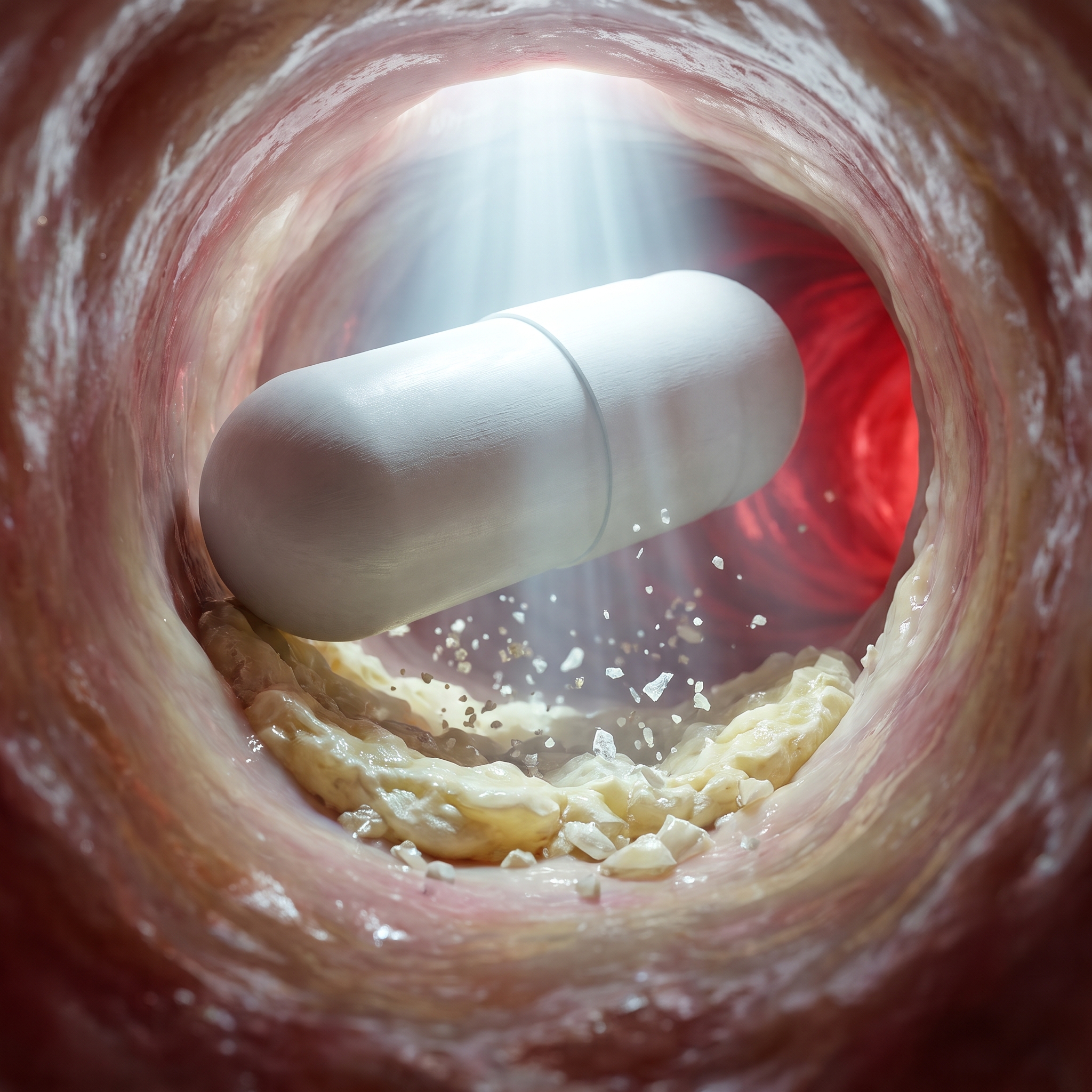
Cyrus Reed: Because it's a pill, that's the point! Okay, wait, picture a Tuesday, 7:15, coffee maker gurgling, and a 58-year-old with one stent. LDL 92 on atorvastatin, over goal. He swallows one extra tablet. That's the whole scene, and it used to need a fridge and a pen.
Iris Holm: Mechanism. Plain English. Go.
Cyrus Reed: Right, so the liver has catchers, little hooks grabbing cholesterol out of blood. A protein, PCSK9, keeps dumping catchers in the trash, so there are fewer of them. Block that protein and catchers get recycled, and more cholesterol gets pulled out. That's all it is.
Iris Holm: Huh. So the pill doesn't touch the cholesterol itself.
Cyrus Reed: No, it saves the catchers. Enlicitide, Lipfendra, FDA-approved July 16, 2026, the first oral PCSK9 inhibitor.
Iris Holm: Saved catchers, fine. So the mechanism was never the hard part. The hard part was getting it past the stomach. Then the trial. Merck's Phase 3 CORALreef, head-to-head, everyone on statins already. What happened?
Cyrus Reed: Okay, so March 30th, 2026, Merck, MSD, puts out a release. At eight weeks, enlicitide beats bempedoic acid, beats ezetimibe, beats the two of them together, all added on top of background statins. And the numbers, wait, they're not close. About 65 percent LDL drop. Ezetimibe, about 28. Bempedoic acid, about 6.
Cyrus Reed: Six! And a pooled analysis in the Annals of Pharmacotherapy, 24 weeks, lands at 57.1 to 64.6 percent. So it's not one lucky trial, it's a range that holds. Different weight class.
Iris Holm: Hold on. Antibodies and siRNA stayed injectable for a reason. Peptides get shredded in the gut. What's the trick?
Cyrus Reed: It's a macrocyclic peptide, a ring, sturdier than a floppy chain, plus permeation enhancers, a decanoate formulation, that loosen the gate just enough to slip across. Wait, that's, is that the same move as oral semaglutide? Where SNAC helps it absorb? Because if so, this isn't a cholesterol story, it's a platform story. What else is stuck behind that door?
Iris Holm: Maybe. But look at what we've actually watched. A blood number. LDL, at eight weeks, at 24 weeks. Statins stay the foundation, this is an add-on. And no one has shown fewer heart attacks yet. That gap bothers me.
Cyrus Reed: But that gap, wait, it's not hypothetical, is it? Something already fell into it. Pelacarsen, the Lp(a) drug. Lp(a)HORIZON. It cut Lp(a) by 78 percent, and, how do I even say this, the events came out 12.3 percent versus 12.1 on placebo.
Iris Holm: Primary endpoint missed. Seventy-eight percent, and nothing moved.
Cyrus Reed: Nothing! So how do I know 65 percent LDL isn't the same trap? I mean, the EAS put out a statement November 15th, still calling Lp(a) an independent risk modifier, and the National Lipid Association said keep researching. Nobody's walking away from the target.
Iris Holm: Right. Because LDL-C is a surrogate. A proxy. Not a heart attack, not a stroke, not death. Why would this proxy behave better?
Cyrus Reed: Okay, because LDL has the genetics. About 312,000 people, and lifelong lower LDL cuts risk roughly three times more than lowering it late. So that's, huh, that's a different kind of target. Decades of plaque is the mechanism.
Iris Holm: Fine. Then LDL is probably causal. Does that make this molecule work?
Cyrus Reed: No. Wait, no, that's the exact seam. "LDL is causal" is not the same claim as "this drug works." Off-target stuff, a different population, I can't wave that away. And enlicitide's outcomes trial is ongoing. Nothing reported.
Iris Holm: Then here's what bothers me. Injectable evolocumab, FOURIER. LDL down about 59 percent. Events down about 15 percent relative, over roughly two years.
Cyrus Reed: Fifteen? That's it? I assumed it'd track closer.
Iris Holm: A huge drop bought a modest benefit. So the ceiling may already be known. And the two-year extension data, and the injectables' underuse, change what we should expect. We'll get there.
Cyrus Reed: Fifteen percent, yeah, and that's exactly why the two-year number nags me. November 21st, Chicago, AHA Scientific Sessions. Christie Ballantyne, Baylor College of Medicine, presents the CORALreef Extension interim. LDL-C still down at 104 weeks. ApoB down, Lp(a) down, triglycerides, non-HDL-C, all of it.
Iris Holm: Open-label. Everyone knew they were on the drug.
Cyrus Reed: Sure, and Merck ran it, I'm not waving that off. But picture the artery. LDL particles slip under the lining, they oxidize, the immune cells show up, and plaque builds. Silent. Thirty years before the first chest pain. So two years is, wait, it's like judging a mortgage by the first two payments.
Iris Holm: Then give me your strongest case. Why isn't waiting for hard endpoints negligence?
Cyrus Reed: Oh, that's my line! Okay. Because the man with the stent doesn't have thirty years of waiting. Every year at 92 is another year of plaque, and the outcomes trial hasn't reported. Waiting sounds careful, but, I mean, it's also a decision.
Iris Holm: It's a decision with a cost on both sides. Pelacarsen was also a decision. Two years shows LDL stays down. Not that anyone lives longer. And the Journal of Clinical Lipidology review, November 20th, says positioning hinges on outcomes, adherence, access, long-term safety.
Cyrus Reed: Access. Huh. Okay, here's my surprise. Injectable PCSK9 inhibitors already did this. Potent, proven to lower LDL, and they sat underused for years. Cost, prior authorization. So the molecule was never the bottleneck.
Iris Holm: Hold on. Then the pill fixes the pen, not the denial letter.
Cyrus Reed: The pen, yeah, not the letter. And wait, I keep picturing him at the coffee maker, pillbox open, and nobody in that kitchen knows who approves what. He's just the guy whose LDL is over 70.
Iris Holm: Right. Over goal on a statin. Twice, prior authorization for an injectable came back denied. Now the cardiologist writes for a tablet. Does the payer read it differently?
Cyrus Reed: Honestly? I don't know. If the price is the same and the rules are the same, then it's the same letter.
Iris Holm: Same denial, smaller needle. Price and coverage rules have to move, not just the format. A tablet doesn't change a spreadsheet.
Cyrus Reed: Huh. And then it splits. If the outcomes trial confirms benefit, the whole question becomes access, who gets it, and how fast. But if it comes back neutral, like pelacarsen with its 78 percent and its 12.3 versus 12.1, then it's a lesson about what a biomarker can actually promise. Either way the pill is real. It's just not proof yet.
Iris Holm: Real, not proof. I can sit with that.
Cyrus Reed: Me too. Though I'll admit I'm still hoping his 7:15 tablet turns out to matter, quietly, over thirty years of Tuesdays.