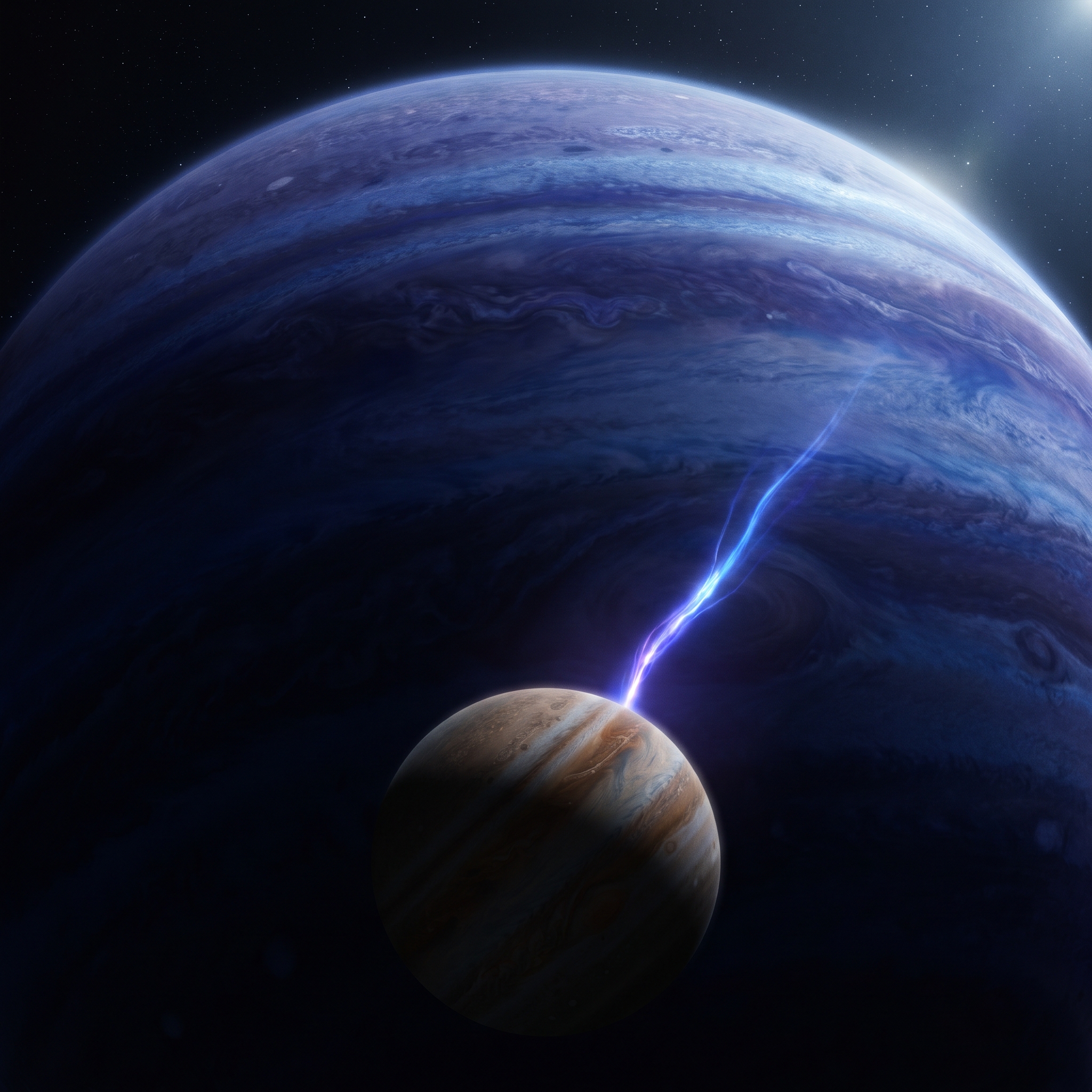
Max Rivera: Hey — so I have been trying to picture sixty billion miles and it's not going well.
Clara Bennett: That's HD 106906 b — which we'll get to — but let's start closer in, because there's a newer case that actually breaks the problem open in a cleaner way.
Max Rivera: Newer than a planet sixty billion miles from its star. I mean — okay, I'm listening.
Clara Bennett: A NASA space telescope called TESS — it watches stars for tiny dips in brightness, which is how you know something passed in front. It caught one single dip. One transit. And the planet on the other end of that measurement, now called TOI-6894b, comes out at approximately eleven Jupiter masses.
Max Rivera: Eleven. From one blip.
Clara Bennett: One blip. And imagine a data analyst staring at that light curve — there's this moment where you see the dip, you run the follow-up analysis, and you realize the two frameworks you have for how planets are born, core accretion and disk instability, neither one can cleanly produce this thing. That's the real itch here.
Max Rivera: Huh. It's like — planets form like snowballs rolling downhill, picking up material, right? And this one is somehow a boulder in a spot where there wasn't much snow.
Clara Bennett: Keep that image. We're going to need it.
Max Rivera: But TOI-6894b isn't even the oldest wound here — because that sixty billion miles I couldn't picture at the top? That's HD 106906 b, found eleven years earlier, and it's the same number. Eleven Jupiter masses. Same problem, different decade.
Clara Bennett: Discovered in 2013. Magellan Telescopes, Las Campanas Observatory in Chile. And the distance is — 650 AU. That's not just far. That's so far that the protoplanetary disk, the raw material belt, would have been too thin, too dispersed out there to build anything that size.
Max Rivera: Wait — so the stuff to make it just... wasn't there?
Clara Bennett: Not in sufficient density. Core accretion is already slow close in — at 650 AU the disk would dissipate before a core could accumulate ten Earth masses, let alone capture a gas envelope.
Max Rivera: Okay but — wait, disk instability is supposed to be faster, right? Like direct collapse, the disk just sort of... falls into itself?
Clara Bennett: It can be faster. But it requires the disk to be massive enough and cool fast enough to fragment. HD 106906's disk almost certainly didn't meet both conditions simultaneously at that separation. So you're stuck — core accretion is too slow, disk instability isn't guaranteed to trigger. Both theories arrive and both theories shrug.
Max Rivera: That's — I mean, that's not a footnote problem. That's the whole chapter.
Clara Bennett: And it's not isolated. HR 8799 hosts multiple super-Jupiters in wide orbits. MOA-2009-BLG-387Lb — a microlensing detection — is about 2.6 Jupiter masses around an M-dwarf, so the mass ratio there is extraordinary. These aren't three weird data points. They're a pattern that keeps asking the same question the models can't answer.
Max Rivera: So every time we look somewhere new we find another one that shouldn't be there.
Clara Bennett: And that's exactly when scientists said — okay, core accretion needs an upgrade. The fix they landed on is called pebble accretion. Developed in large part by Bertram Bitsch and Alessandro Morbidelli. The idea: instead of building a core through giant collisions, you sweep up centimeter-sized pebbles that are already drifting inward through the disk.
Max Rivera: Pebbles. The fix for 'can't explain eleven-Jupiter-mass planets' is... pebbles.
Clara Bennett: Picture a kid pushing a shopping cart through a grocery store — not picking up watermelons one at a time, just dragging the cart through a pile of loose grapes on the floor. Same mass accumulation, radically faster. The pebbles are already moving toward the core; the core doesn't have to chase them. That changes the timescale dramatically.
Max Rivera: Okay that actually — yeah, that makes the speed problem make sense. So does it solve it?
Clara Bennett: Partly. Bitsch et al. in 2019 showed there's a minimum pebble flux the disk has to maintain — if flux drops below that threshold, the embryo migrates inward and falls into the star before it's massive enough to hold an atmosphere. So pebble accretion has a floor, not just a ceiling.
Max Rivera: Wait — the ceiling being what?
Clara Bennett: Pebble isolation mass. The core eventually gets big enough to open a gap in the disk, and that gap cuts off the pebble supply. Growth stops. But the more uncomfortable result from those same simulations — embryos that start inside roughly five AU cannot grow into gas giants regardless of how many pebbles are available. The inward migration wins every time.
Max Rivera: But hot Jupiters are inside five AU. We've — I mean, those are the planets we find most easily.
Clara Bennett: Correct. And pebble accretion doesn't explain them. The upgrade that was supposed to rescue core accretion has its own known contradiction built right into it — and there's another layer where disk turbulence at wide separations kills efficiency even further, which makes HD 106906 b harder to explain, not easier. Though how we'd even test any of this gets complicated fast, because migration scrambles the record of where these planets actually formed. That part's worth sitting with.
Max Rivera: Migration scrambles the record — wait, that's the actual problem, isn't it. Not just that HD 106906 b is weirdly far out, but that it might not have formed there at all. Like, the leading idea is what, gravitational scattering? The binary stars or some other planet flung it outward?
Clara Bennett: That's the leading alternative. Dynamical scattering — ejection by the binary or by another massive body. And it's plausible. But the moment you accept that, you've also accepted that its current position at 650 AU tells you essentially nothing about where it was born.
Max Rivera: So the crime scene got — I mean, the evidence was moved. We're trying to reconstruct where something happened from a location that's completely irrelevant.
Clara Bennett: Exactly that. And it generalizes. Once a planet migrates inward or gets scattered outward, its orbital address is severed from its birth address. That's why testing formation theories against observed positions alone is — in practice — nearly impossible.
Max Rivera: Huh. So basically every exoplanet position we've catalogued is kind of a dead end as evidence.
Clara Bennett: For formation, yes — unless you catch something before it moves. Which is why TOI-6894b is different. TESS caught the transit geometry precisely enough that you can actually constrain its mass and orbital parameters now. It becomes a test case that bites back at the models rather than just sitting there passively.
Max Rivera: Right — but the disks themselves aren't clean either, yeah? Because ALMA imaging basically showed that protoplanetary disks have all these gaps and cavities in them already.
Clara Bennett: ALMA changed the picture completely. Those gaps and cavities suggest companions, pressure bumps, instabilities — things that complicate both core accretion and disk instability before a single planet has even finished forming. The input conditions are messier than either model assumed.
Max Rivera: So the disks are weird, the positions don't tell us anything, and turbulence at wide orbits kills pebble accretion efficiency anyway. I mean — we're not even failing to solve the problem. We're failing to find stable ground to stand on while we try.
Clara Bennett: And yet — core accretion and disk instability together still explain the vast majority of what we actually observe. That's the part that gets lost when you line up the anomalies. TOI-6894b, HD 106906 b, HR 8799, MOA-2009-BLG-387Lb — they're real, they're pointing at something, but they're not the whole catalog. What they suggest is that planet formation may run through multiple channels depending on context. Not one recipe. A branching process.
Max Rivera: So we thought — I mean, we had this map. And the map worked, mostly. We just thought it was finished.
Clara Bennett: It isn't. That's what younger systems are going to tell us — whether models need targeted patches or something structurally new. We don't know yet. That's an honest place to be.
Max Rivera: I started this trying to picture sixty billion miles and failing. Now I think the failure is — kind of the point? Like, the distance was always the data. We just didn't know what it was data for.
Clara Bennett: Good conversation. That landed somewhere real.