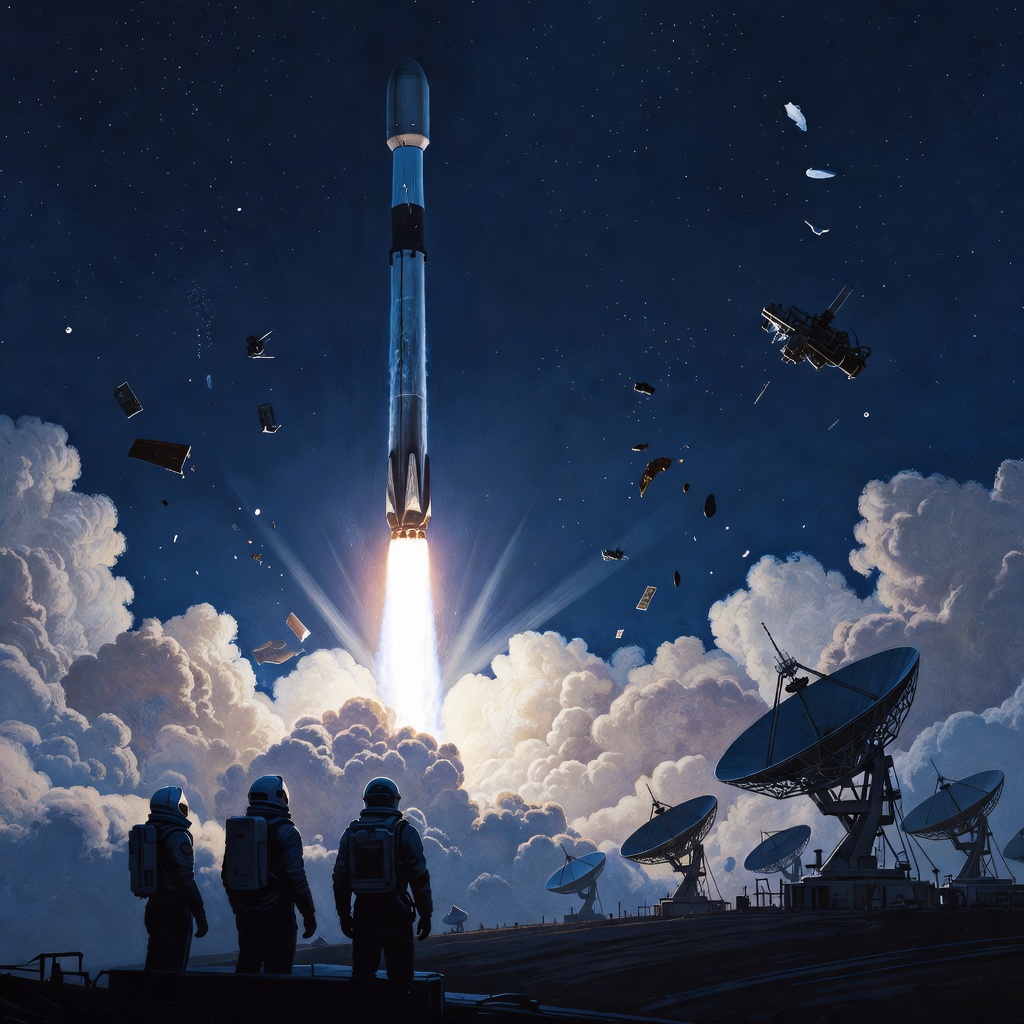
Hope Sterling: A booster that flew astronauts to the ISS, sent a lunar lander to the Moon, ran nine Starlink batch missions — just flew again. Seventeenth time.
Hope Sterling: That's B1085. And the 17th flight was June 28th, 2026 — carrying SXM-11, SiriusXM's massive 15,400-pound satellite, off Cape Canaveral Space Force Station at 10:25 p.m. EDT.
Hope Sterling: SXM-11 hit geosynchronous transfer orbit 34.5 minutes after liftoff.
Hope Sterling: Clean. Routine. Number seventy-five for SpaceX this year alone.
Hope Sterling: And then B1085 just — turned around, landed on A Shortfall of Gravitas, the drone ship, eight and a half minutes after launch.
Hope Sterling: Okay but wait — let me actually walk through what this booster has DONE, because the Crew-9 mission alone … that's humans, in a capsule, trusting this specific piece of hardware — and then it goes and does a lunar lander, Firefly Aerospace's Blue Ghost, toward the Moon — and then nine Starlink batches — and now satellite radio?
Hope Sterling: That's not a rocket. That's a whole career.
Hope Sterling: The Falcon 9 Block 5 was designed for exactly this — high reusability, again and again — and B1085 is out here proving the entire thesis every single flight.
Hope Sterling: The reusability story SpaceX tells is fundamentally an economics story. The first stage is roughly sixty percent of a Falcon 9's launch cost. Sixty. So if you can land it, refurbish it, fly it again — the math just changes completely.
Hope Sterling: But after seventeen flights? After all those inspections, all that refurbishment? SpaceX has not publicly disclosed what any of that actually costs. Like, the savings number, the inspection number — none of it. We're taking the thesis on faith.
Hope Sterling: Which is fine, maybe. Proprietary business information, whatever. But then you get to the part that actually sits with me —
Hope Sterling: B1085 carried HUMANS on Crew-9. Astronauts. To the ISS. And then at some point someone decided — okay, this booster, the one that carried people, cycles into commercial satellite runs now. And nobody publicly explained that transition. No announcement, no here's-our-clearance-process moment. It just … happened.
Hope Sterling: Does that bother you? Because it kind of bothers me. Not in a catastrophizing way — I'm not saying it's unsafe — but 'safe enough' is doing a LOT of work there and nobody's defining it out loud.
Hope Sterling: And then SXM-11 is sitting on top of this whole quiet mystery. Built by Lanteris Space Systems — formerly Maxar Space Systems, now under Intuitive Machines — this massive satellite designed to push SiriusXM coverage into Alaska and eventually replace XM-5 and Sirius FM-5, satellites that road-trippers across North America have been relying on for years. That's real. The stakes on the payload side are real.
Hope Sterling: First controlled Falcon 9 landing was December 22, 2015. That was the moment everyone gasped. Now it's just … Tuesday. A drone ship called A Shortfall of Gravitas catches a booster eight and a half minutes after launch and the coverage moves on.
Hope Sterling: The normalization is the whole point — SpaceX built it to feel routine. But routine doesn't mean resolved. It just means we stopped asking.
Hope Sterling: But like — watch where B1085 is going, though. Because the benchmark that actually matters here is B1067. Thirty-five flights. That's the record. That's the number B1085 is, right now, slowly chasing.
Hope Sterling: And I keep turning this over — at seventeen, you're less than halfway there. But the question nobody is publicly answering is what happens to the inspection costs as you get closer to thirty, thirty-five flights. Like, at some point the math could just … flip. The cost of tearing down a high-flight-count booster, inspecting every weld, every turbopump, every single thing — could that actually exceed the cost of flying a newer one? Maybe? SpaceX hasn't said. Of course they haven't.
Hope Sterling: That's the live thread right now.
Hope Sterling: Because if B1085 gets to thirty-five — if it matches B1067 — does SpaceX put humans on it again? Does a booster with that kind of mileage get cycled back into crewed rotation, the way it flew Crew-9 early in its life? Or does it quietly age out into Starlink runs forever, and nobody announces that either? The transition just … happens again.
Hope Sterling: That's what I'm watching. Not the next Starlink batch — the number. The flight count where the economics either hold or they don't, and whether SpaceX ever tells us which it is.
Hope Sterling: And I think that's actually it — that's the whole thing. SpaceX has published the milestone. Seventeen flights. B1085. The number is real. But the cost delta — what refurbishing that booster actually ran against flying a fresh one — they've never published that. Not once. We get the flight count. We don't get the receipt.
Hope Sterling: Which means 'routine' is doing enormous work here and nobody is defining it out loud. Like, routine for WHO? For SpaceX's balance sheet, maybe. For the people who put Crew-9 astronauts on this specific booster and then quietly cycled it into commercial satellite runs — maybe. But routine and PROVEN are not the same claim.
Hope Sterling: They're publishing one of those. Not the other.