Eliza Ward: Brian, hey — how's your week, genuinely asking, because mine involved reading about rivers and I cannot stop thinking about it.
Brian Reed: Rivers. Which rivers?
Eliza Ward: European ones. Specifically — the Vistula in Poland dropped so low this summer that coal plants shut down. Not nuclear, coal. And I thought, wait, if that's happening to coal, what's happening to nuclear?
Brian Reed: That's — yeah, that's the thread. And it leads somewhere genuinely uncomfortable. Because the short answer is: the same thing. Same problem, higher stakes.
Eliza Ward: Walk me through it — why does a low river shut down a nuclear plant?
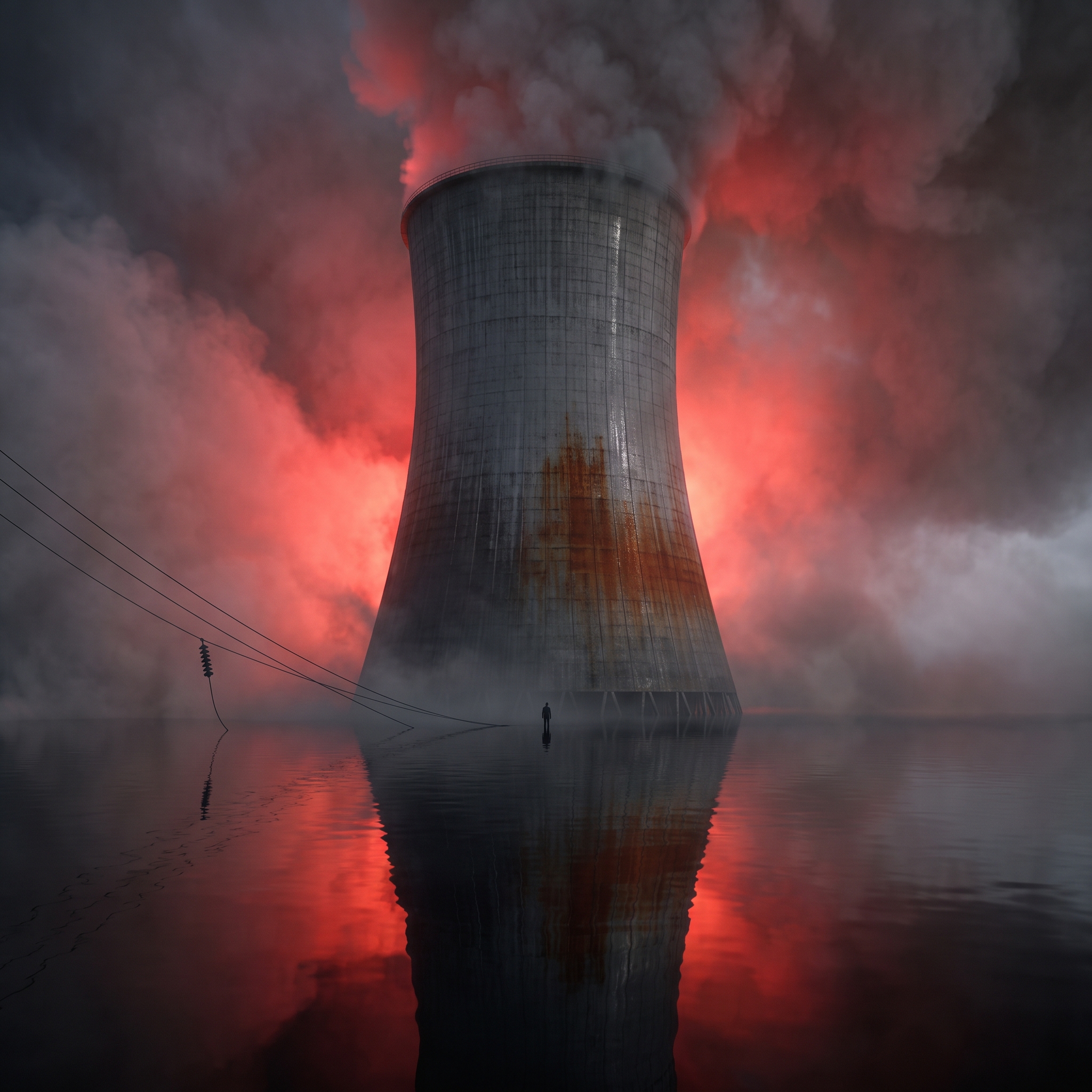
Brian Reed: So the core idea — and this is the thing I want to make really plain — a nuclear reactor runs hot. That's the point. You use the heat to make steam, steam spins a turbine, you get electricity. But the reactor itself has to stay within temperature limits, and the way you do that is you pull cold water from a nearby river, run it through a cooling circuit, and push warm water back out. The river is doing the work. It's the cooling system.
Eliza Ward: So if the river's too shallow or too warm — the plant can't operate.
Brian Reed: Right. And in summer 2026, Europe got both conditions at once — drought shrinking the volume, heat raising the temperature — and reactors were forced offline. That's not a model, that's what happened. And nuclear power is the thing we're supposed to use to fight climate change.
Eliza Ward: And we already ran that experiment in the U.S. — like, not theoretically. Nebraska, 2011. Fort Calhoun nuclear plant. The Missouri River flooded, equipment was threatened, they lost offsite power.
Brian Reed: Fort Calhoun. Yeah. And what's striking about that — the grid survived, the plant didn't melt down, so the story kind of... faded. But the mechanism was right there.
Eliza Ward: And what did we do with it?
Brian Reed: That's — this is uncomfortable. Thirteen years later, April 2, 2024, the GAO publishes GAO-24-106326. That's the Government Accountability Office telling the Nuclear Regulatory Commission, explicitly, that heat, drought, wildfires, flooding, hurricanes, sea-level rise — all of it — are escalating threats. And the NRC's method, the way it evaluates whether a plant can handle those conditions, is built on historical baselines. Past weather. Not projections of what's coming.
Eliza Ward: Wait — they're literally using old data to assess future risk.
Brian Reed: Right. And the GAO said: shift to forward-looking projections. Which — I mean, that's not a radical ask. That's just using the information that exists. But here's the scale of what they're actually talking about: 75 operational and shuttered U.S. plants in climate-vulnerable zones. Seventy-five.
Eliza Ward: Okay, 75 — that's not a handful of edge cases. That's basically the fleet.
Brian Reed: It's most of it. And these are plants whose cooling systems, whose flood barriers, whose heat tolerances were all engineered — let me think about how to say this — they were engineered for a climate that no longer exists. The same conditions that shut down European reactors in 2026? The GAO was describing exactly that mechanism for U.S. plants two years earlier.
Eliza Ward: So the GAO hands them the exact mechanism — two years ago — and what did the NRC actually do with it?
Brian Reed: That's — okay, so the honest answer is: the sources don't show it. I can't point to a completed rulemaking, a public commitment, a revised assessment framework. GAO-24-106326 sits there dated April 2024, and as of August 2026 the NRC's response is just... unresolved.
Brian Reed: Two years. And what really illustrates it — Dr. Paul Dorfman, he's a nuclear policy scholar at the Bennett institute, chairs the Nuclear Consulting Group — on August 7th, 2026, he's still posting the GAO report on social media trying to get people to notice it. One post gets 65 likes and 44 reposts. That's — I mean, that's not a policy response. That's a researcher waving his arms in a room where the acoustics are bad.
Eliza Ward: Wait — 65 likes. For a finding about critical infrastructure failing in a warming climate.
Brian Reed: That's the reach. And look, the part that actually compounds this — the Trump administration was reported to be considering loosening NRC safety rules. Not strengthening them, not accelerating the shift to projection-based assessments. The opposite direction. The GAO says you need more rigorous forward-looking regulation, and the political pressure is moving the other way.
Eliza Ward: Hold on. That's not just inaction — that's active counter-pressure on the exact agency the GAO said needs to do more.
Brian Reed: Right. And what makes this harder to untangle — there's an $80 billion Westinghouse deal sitting right next to it, the government deploying new reactors, and the average age of the existing fleet just hit 43 years. We're doubling down on nuclear as the climate answer at the exact moment climate is exposing what the existing plants can't handle. That's — we'll get to that, but it doesn't resolve cleanly.
Eliza Ward: That $80 billion — okay, so name the actual shape of this. October 2025, the U.S. government announces a strategic partnership with Westinghouse, Brookfield Asset Management, Cameco as co-owners, AP1000 and AP300 reactors, government-arranged financing, a 20% participation interest. That's a serious structural commitment. And sitting right underneath it is a fleet that averaged 43.2 years old at the end of 2024.
Brian Reed: The World Nuclear Industry Status Report — 2025 — puts that number in context: oldest among the top five nuclear-generating nations. Not just old. Comparatively old.
Eliza Ward: And those plants were engineered for what — the climate of the fifties and sixties? The baseline conditions of the decades before they were built?
Brian Reed: Exactly that. The tolerances — cooling capacity, flood barriers, temperature thresholds — baked in during design. So picture an actual grid operator, let's say she's sitting in a control room in Arizona, midsummer, and Palo Verde is the thing keeping the lights on for maybe 30% of the state. It's peak demand. And she's watching the cooling-water temperature numbers tick up. She's not choosing between good options. She's choosing between derating the reactor — reducing output — or pushing it closer to its thermal limit. And those limits were set for a climate that no longer exists.
Eliza Ward: Peak demand is exactly when you need the reactor most.
Brian Reed: That's — yeah, that's the whole paradox. The moment climate stress forces the plant to reduce output is the same moment the grid most needs it to be fully online. Those two curves converge at the worst possible point.
Eliza Ward: And if that happens visibly — a major outage during peak summer demand — the political case for nuclear as the decarbonization anchor doesn't just get complicated. It cracks.
Brian Reed: Right, and the thing is, the $80 billion is going toward new AP1000s, new AP300s — forward capacity. But the climate exposure is concentrated right now, in the existing fleet, the 43-year-old plants, built against conditions that — I mean, we're not projecting a different climate anymore. We're already in it.
Eliza Ward: The investment and the vulnerability are running on completely different timescales, and nobody's publicly resolved that.
Brian Reed: GAO-24-106326. April 2, 2024. That report is just — it's still there. Dated. Waiting. And the rivers in Europe ran low this summer, and the plants in Nebraska and Arizona and the Carolinas are a year older than they were when it came out. That's — I mean, that's not a projection anymore.
Eliza Ward: We started talking about rivers. You know — the Vistula, coal plants shutting down. And now it's the same image but it's not coal anymore.
Brian Reed: The same warming that nuclear is supposed to help arrest — that's the thing making it harder to run the plants. The report named it. The mechanism is confirmed. And the gap between knowing that and doing something about it is just... sitting there, dated April 2, 2024.