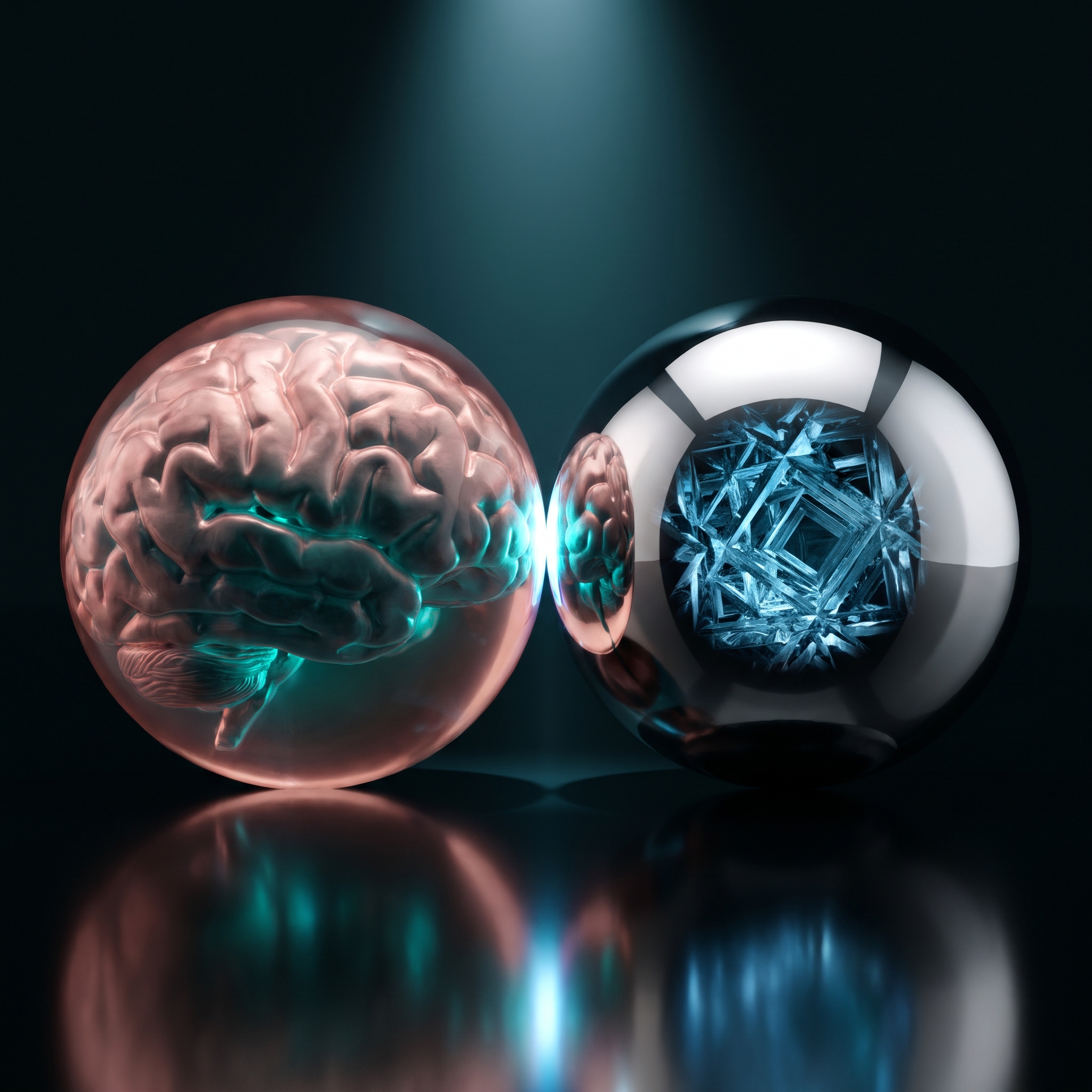
Max Rivera: Clara, hi, I have a confession before we start: I once trusted a friend's restaurant directions completely, and she'd never actually been there. She'd read a map. Totally confident, totally wrong about one closed road.
Clara Bennett: That's a good place to begin, because it's the same mistake a grad student could make in a vision lab. She picks the model with the best brain-prediction score and writes, 'the model captures how cortex processes faces.'
Max Rivera: Wait, that's the same thing? How?
Clara Bennett: Her model gives the right answers, like your friend gave the right directions. The question is whether it got them by the same route. What could go wrong with picking the top scorer?
Max Rivera: Huh. So, yeah, nothing looks wrong until the road's closed. The driver adapts, the map reader doesn't. And on normal days you can't tell them apart at all, right?
Clara Bennett: Right. Matching answers are called representational similarity. Matching internal routes are mechanistic similarity. Brain encoding and decoding models often treat predictive accuracy as a proxy for understanding the brain, and that's the shortcut.
Max Rivera: So the score is real. It just isn't the thing she wrote down.
Clara Bennett: That's why a team at York University didn't stop at the score. Kohitij Kar leads the study, and Sabine Muzellec, a postdoctoral fellow, is his co-author. They published in Nature Machine Intelligence. Their next move was to run the prediction backwards.
Max Rivera: Backwards how? Like, the neurons predict the model?
Clara Bennett: Yes. They showed primates 1,320 natural and synthetic images across ten categories, and recorded neurons. Then they asked two questions. Can the model's features predict the neurons? And can the neurons predict the model's features?
Max Rivera: And the answers match? I mean, I'd assume if A predicts B, B predicts A, but, yeah, I don't actually know that.
Clara Bennett: Between two brains, they do. Each recording predicted the other equally well. Symmetric. With the models, it wasn't. They predicted neural responses fairly well, but the neurons didn't predict the models' internal features equivalently.
Max Rivera: Wait, so the brains pass with each other? Then that's the ruler. The AI gap isn't just noise.
Clara Bennett: Exactly the point, and it means the test isn't impossibly strict. Biological systems clear it. The models are the ones that don't.
Max Rivera: Okay, the 300 stylized ones, the line drawings, outlines, artistic renderings. Is that where the cracks showed? Because a cartoon cat is exactly where I'd expect a model to fake it.
Clara Bennett: I can't tell you that. The stylized set was part of the design, but I don't have a result that says the asymmetry lived there, and I won't invent one. Also, I couldn't confirm the publication date, so don't call it fresh news.
Max Rivera: But hold on, because that's where the headline runs away with itself. "AI doesn't think like us." These are primate visual neurons. That's vision. That's a long way from thinking, yeah? Or consciousness, or whatever people picture.
Clara Bennett: Yes, and the study doesn't support that leap. The finding concerns primate visual neurons. It says nothing about human cognition in general, and nothing about consciousness.
Max Rivera: Because I think most people hear "brain-inspired" and they picture, like, a tiny brain inside the machine. And this knocks that over, but only a little.
Clara Bennett: Right. Now, the prior consensus was strong. Grace W. Lindsay's 2021 review in the Journal of Cognitive Neuroscience established CNNs as state-of-the-art models of biological vision. And Oota and colleagues' 2025 survey in Transactions on Machine Learning Research shows how routine it is now to use neural networks for brain encoding and decoding.
Max Rivera: So this is one study against a whole shelf of them. Does it refute that?
Clara Bennett: No. It's one data point. Prediction isn't suddenly worthless. What fails is a narrower claim: high prediction implies same mechanism. And "different mechanism" doesn't mean "inferior model." A model can be useful and still not be a copy.
Max Rivera: I saw some expert replies on X along those lines. That model-brain comparisons are approximations, not equivalences. And the generative-versus-discriminative thing is a false binary, so, I mean, if both ends of the slider are wrong, finding the middle isn't exactly shocking.
Clara Bennett: That's fair, and it's the right caution against overclaiming. The part that comes later is the grad student's sentence, and what a real test of mechanism would make her change in it.
Max Rivera: Okay, back to her draft, then. If the score is real but the sentence is too big, what does she actually type instead?
Clara Bennett: She crosses out 'captures how cortex processes faces.' She writes 'predicts responses.' That's all the score supports. Now, to keep the bigger sentence, she needs a second check: can the neural data predict the model's internal features?
Max Rivera: Huh. So she runs it backwards, like Kohitij Kar's team did.
Clara Bennett: Yes. In testing terms, it's a validity problem. The score is reliable. It just doesn't measure what she assumed it measured.
Max Rivera: Okay, but what would convince you the insides match? Like, I get the backwards check, but, I mean, if a listener asked me, 'what's the real test,' I'd, yeah, I'd stall.
Clara Bennett: Two-way prediction is the first filter. Then you compare internal structure directly. Nikolaus Kriegeskorte and Wei's 2021 Nature Reviews Neuroscience paper on neural tuning and representational geometry gives the framework for that. It asks whether the relationships among representations have the same shape in both systems.
Max Rivera: And if she skips all that, the failure is quiet, right? Some weird image she designs, the prediction misses, and she never traces it back to the model's insides.
Clara Bennett: Exactly that. So the takeaway is practical: validate brain-predictive models with two-way and mechanism-level tests, not prediction scores alone.
Max Rivera: Huh. I keep picturing my friend on the phone, giving me those directions so calmly. Nothing in her voice said she'd never driven it. And the score on the leaderboard sounds exactly that calm, yeah.
Clara Bennett: Right. Matching outputs is no longer enough evidence of matching mechanisms. And the open question is whether older results will survive a two-way test, with the neurons asked to predict the model too.
Max Rivera: So the road's still open for most of them, we just haven't driven it from the other side yet. Fair enough. I'd want to go check, I think.