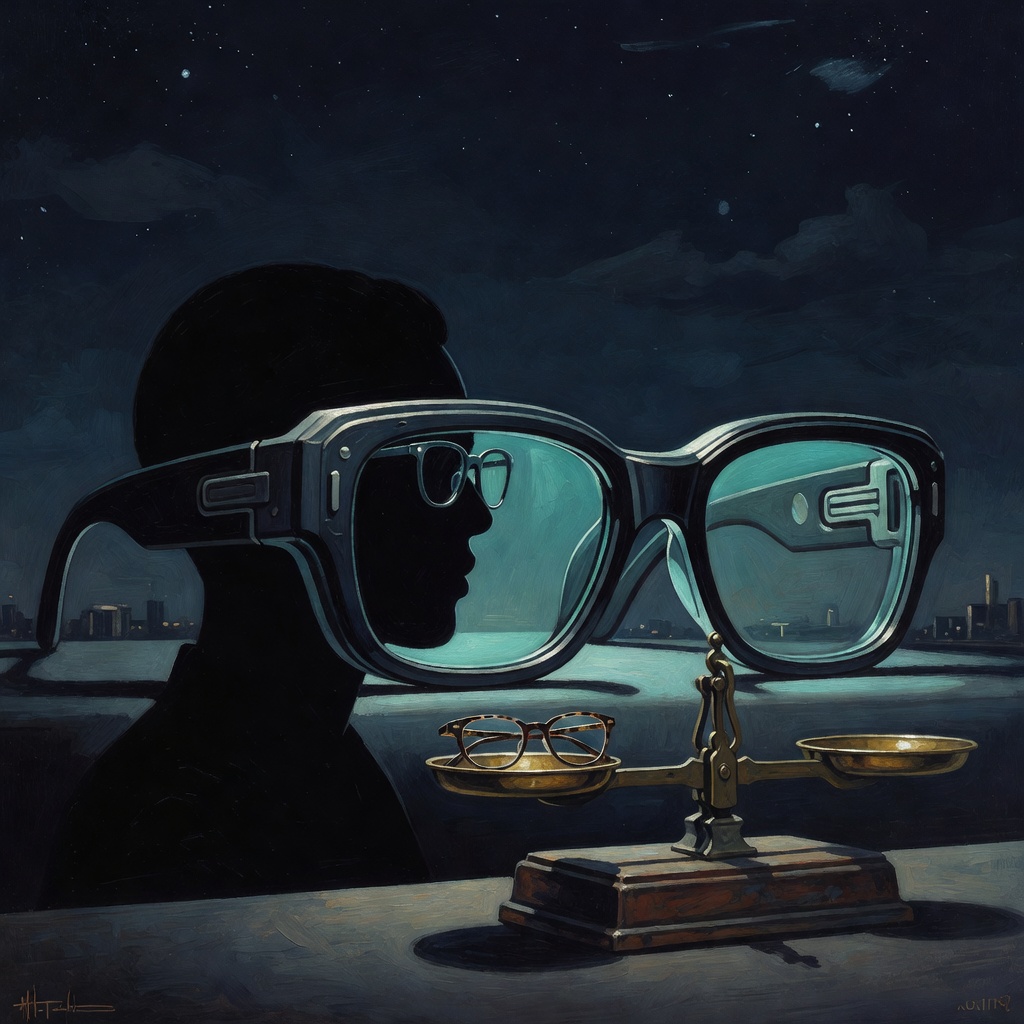
Hope Sterling: Evan Spiegel called his own glasses chunky and goofy — that's my hello, that's my how-are-you, we're already there.
Juniper Vale: Ha — good week, by the way, thanks for asking.
Hope Sterling: No but like — the CEO! Of Snap! Said out loud that Snap Spectacles are chunky. And they cost $2,195. So that's sort of the entire episode in one sentence.
Juniper Vale: It really is. Because on the other side you've got Meta launching Meta Glasses at $299 in June — three frame styles, there's even a Kylie Jenner Starfire edition — and they look like regular glasses.
Hope Sterling: Wait, a Kylie Jenner edition?
Juniper Vale: Yep. $399. We'll get there.
Hope Sterling: Okay I have so many thoughts — but my main one is that EssilorLuxottica moved seven million units in 2025 on glasses with no display at all. No AR overlay, nothing. And that number was only two million total across all of 2023 and 2024. So Meta's whole strategy is basically: skip the hard thing, sell the vibe, win the market. And it worked!
Juniper Vale: I want to pump the brakes on the 'skip the hard thing' framing though — because I don't think Meta actually skipped it. I think they hit the wall and made a different product. There's a cinema projector analogy that keeps coming to me. Like — the bigger the image you want to throw, the bigger the projector you need. That's field of view. Wider field of view means more immersive AR, but it physically requires larger optics. And then the battery has to power those optics. And then you need heat management for the battery. All of it fights the frame.
Hope Sterling: Wait — so the bulk isn't, like, a design choice they just haven't fixed yet?
Juniper Vale: No. That's what I want to be clear about. Meta's aesthetics-first strategy isn't a solution to that physics — it's a concession to it. They decided not to show the movie.
Hope Sterling: Which is sort of what Evan Spiegel did in reverse — he tried to show the movie and ended up with the chunky $2,195 ski goggle situation. And nobody bought it.
Juniper Vale: Exactly. And Google Glass — I mean, that was a decade ago and the exact same problem. Functionality versus actually being able to wear it in public without people treating you like you'd escaped from somewhere. The physics hasn't changed since then. What changed is that Meta just... stopped trying to solve it.
Hope Sterling: Okay that's kind of a devastating way to put it but also — yeah. No, I think that's right.
Hope Sterling: But wait — okay, because that's actually the part where I think the hot take holds up. Like, seven million people didn't buy a lie. They bought something real. It's just... the 'real thing' is not a heads-up display. It's audio and a camera and Alexa on your face.
Juniper Vale: Right, and that distinction — AI glasses versus true AR glasses — that's not splitting hairs. Those are genuinely different products.
Hope Sterling: And Meta knows that. Which is why they've got two tiers now — Ray-Ban Meta at $380-something, Meta Glasses at $299 — same core hardware, different logo on the frame. The premium isn't better specs. It's literally just the Ray-Ban name.
Juniper Vale: That's — yeah.
Hope Sterling: Which is either genius or — I don't know, actually, it's genius. But then Paul Meade left Apple. Like, Apple's VP who was literally running Vision Pro and their smart glasses project, and he left for OpenAI's hardware team. And I keep turning that over because — okay, if aesthetics-first already won, why is the best design talent in the world still running toward whoever promises a new angle on the form factor?
Juniper Vale: Because seven million units is a market signal, not a finish line. Meade leaving — that's not a victory lap for anybody. That's an admission that Apple, after years, never shipped something socially acceptable you'd actually wear to get coffee.
Hope Sterling: And OpenAI's io team is pulling in people from Jony Ive's LoveFrom collective — Evans Hankey, Tang Ten — like they're assembling the design Avengers specifically because nobody's cracked it yet. So the hot take survives, but it's... messier than I thought five minutes ago.
Juniper Vale: The design Avengers is a good line, but — I mean, here's what actually sits with me. Snap Spectacles have real displays. Actual AR overlays. Evan Spiegel knows they're chunky, he said so out loud, and they still cost $2,195. And the market bought 7 million of the ones that gave up on all of that for $299. So Meta might be right for completely the wrong reasons.
Hope Sterling: Fine. Yeah. They won by not playing. I hate that that's the sentence but — it's the sentence.
Juniper Vale: And the companies still hiring the best designers in the world — Paul Meade, everyone flowing into OpenAI's io — that's not confidence. That's a pretty expensive acknowledgment that design alone cannot solve this. The physics doesn't care who your celebrity collaborator is.
Hope Sterling: Kylie Jenner cannot bend light. Okay. I think that's genuinely where I needed to land on this — thank you for walking me through the wall.