Eliza Ward: Hey — where are you on the Greenland story? Because I've been trying to figure out what actually happened versus what's being performed.
Brian Reed: Hang on, let me make sure I have the sequence right. Von der Leyen arrives Sunday, September 6th. Announcements Monday. The whole visit framed as solidarity with Greenland and Denmark against Trump's push for US control.
Eliza Ward: That's it. And Trump's push is not vague — he said at the NATO summit in Ankara that Greenland should be controlled by the United States, not Denmark. Full stop.
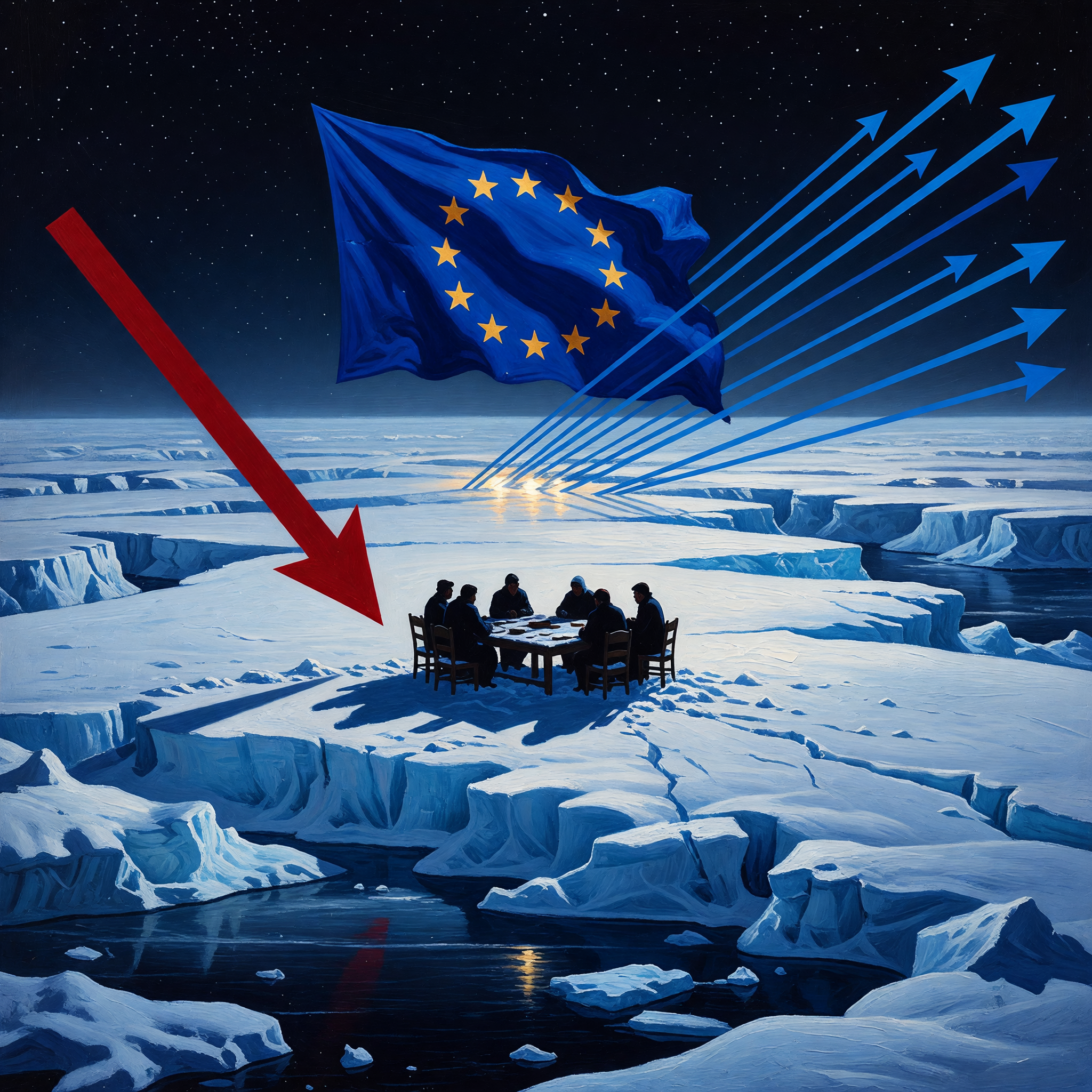
Brian Reed: So the EU — actual checkbook in hand, or at least the appearance of one — shows up the next day essentially saying 'we're the better partner.' Rare earths, lithium, uranium, satellite comms. The materials inside every battery and chip.
Eliza Ward: And Múte Egede Nielsen is there welcoming it. 'Close friendship and good partnership.' Which — I mean, that's not nothing. But it's also not 'yes we choose Brussels.'
Brian Reed: Right — but the part that doesn't fit is whether the package was actually locked down before she landed. What did von der Leyen actually arrive with?
Eliza Ward: That's the thing — she previewed this at Davos in early 2026. 'Massive European investment surge.' That was months ago. And then the January joint statement with António Costa, territorial integrity, sovereignty, full solidarity. So the political groundwork has been building. But the actual figures? Still unconfirmed at publication.
Brian Reed: So she's been announcing the announcement for like nine months.
Eliza Ward: Kind of, yeah. The European Commission is leading this outreach — that's the executive body, so it carries real weight — but the package details, the binding commitments, the specific numbers? Not verified.
Brian Reed: Okay, let me — actually, that's the part that makes me stop. Think about a mining executive in Copenhagen opening Monday's news expecting a contract figure attached to the EU pledge. And finding a press release with sectors but no euros. That's not solidarity. That's a letterhead.
Eliza Ward: Which might be enough symbolically — wait, no, I don't think it is, not with what Trump is doing on the pressure side.
Brian Reed: The tariff threat. That's economic coercion, not just rhetoric. He threatened new tariffs on NATO allies who don't allow the US to acquire Greenland. That's not vague.
Eliza Ward: Right — and if that's the actual pressure mechanism, then an unverified EU investment package is not a counterweight. It's a signal that a counterweight might eventually exist.
Brian Reed: So what do we actually know came out of Monday? Because I'll be honest — our sourcing here is thin.
Eliza Ward: We don't. That's the honest answer. Sectors, yes. Critical minerals, satellite comms, renewables. A number? We can't confirm it. The visit happened. The commitment language is there. The euros are not yet on the table in any verified form.
Brian Reed: And that's actually where the 'counterweight' framing falls apart for me — because money, even confirmed money, doesn't buy what Greenland actually needs up there.
Eliza Ward: The European Parliament said it directly. 2026 study. No realistic EU substitute for US Arctic military presence. That's not a critic saying it — that's the EU's own legislature.
Brian Reed: Is that study just — I mean, is it covering its bases legally, or is it the actual structural ceiling?
Eliza Ward: It's the ceiling. The EU can do maritime governance rules, mineral partnerships, satellite infrastructure — those are real. Hard security, deterrence, Arctic military capacity? That's NATO, which means practically speaking that's Washington. Danish and European forces have been reinforcing their presence in Greenland, but — wait, within the NATO framework. The same framework Trump is simultaneously squeezing.
Brian Reed: So the reinforcement is happening inside the structure he's already pressuring.
Eliza Ward: Right — which is a weird kind of solidarity.
Brian Reed: There's a Euronews quote that stuck with me. A source said — and this is direct — 'everyone that I've talked to in Greenland would love to see the US repopulate those bases,' and that Greenland 'needs the US.' That's not a Trump talking point. That's someone on the ground describing a security dependency that euros don't touch.
Eliza Ward: And that's the reframe, honestly. Denmark has rejected annexation. Greenlandic officials have rejected any sale. That's all real and asserted. But rejecting Trump's framing is — actually, no — it's not the same thing as not needing US military capacity. Those are two separate questions and everyone's collapsing them.
Brian Reed: Which makes 'counterweight' the wrong word. And the part we haven't touched yet — what Greenland is actually optimizing for, independence from Denmark, EU partnership, or something else entirely — that changes what this whole visit means. We'll get there.
Eliza Ward: And that's actually the thing I can't get past — because Múte Egede Nielsen's language is doing real work there. 'Close friendship and good partnership.' That's not 'we're with Brussels.' That's someone leaving every door open.
Brian Reed: Which is either very careful diplomacy or — I mean, it might be something more deliberate. What if EU investment isn't the destination for Greenland? What if it's the lever?
Eliza Ward: Leverage against Denmark.
Brian Reed: Right. Because the research genuinely doesn't resolve whether Greenland wants EU partnership as a path toward independence from Denmark, or whether it just wants the economic arrangement. Those are completely different games being played in the same room.
Eliza Ward: And if it's the first one — if Nielsen is using von der Leyen's visit to build a case that Greenland has options, real external partners, capital sources that aren't Copenhagen — then Brussels may have just accidentally handed Greenland an independence argument. That's not what the European Commission was trying to do.
Brian Reed: Denmark firmly rejects annexation, stands with Greenland publicly — and then the EU shows up and potentially accelerates a decoupling from Denmark itself. That's a strange place to land.
Eliza Ward: Wait — and then add the Venezuela piece, because this is where the risk calculus shifts. US forces captured Nicolás Maduro in early 2026. European analysts are citing that as a precedent. Not a perfect one, sources differ on how direct the analogy is, but the point is it's in the European risk assessment now. Trump acting unilaterally against a sovereign territory — that happened.
Brian Reed: And he used a NATO summit — Ankara — to pressure a NATO ally over that ally's own territory. That's the forum supposedly built on collective defense.
Eliza Ward: So the EU's position — oppose the annexation push, preserve NATO cooperation, don't force a rupture — that posture gets harder to hold every time Trump escalates inside the alliance itself. The concrete thing to watch is whether Nielsen's next public statement moves any closer to a formal independence position. That's the signal that would tell you what Greenland is actually optimizing for.
Brian Reed: And Nielsen's statement is the only thing that would actually tell us which game is being played. Because right now — I mean, 'close friendship and good partnership' works whether she wants EU patronage or whether she's building a case that Greenland doesn't need Copenhagen's permission to have a foreign policy.
Eliza Ward: Which is — wait, that's the thing the visit doesn't answer. Self-determination means Greenland's future is for Greenlanders to decide. Not Brussels, not Washington, not Copenhagen. That principle is explicit. But it doesn't tell you what Greenland is deciding toward.
Brian Reed: So we're left with: the visit happened, the signal landed, the figures are still unconfirmed. And the sequencing — announcing before the package is locked — that's either disciplined political theater or it's a liability the moment follow-through stalls.
Eliza Ward: That's where I am. Honestly. The symbolism carries weight right now — but only until Monday's numbers either show up or don't.
Brian Reed: And if they don't, we find out pretty fast whether von der Leyen handed Nuuk a lever or just a press release.