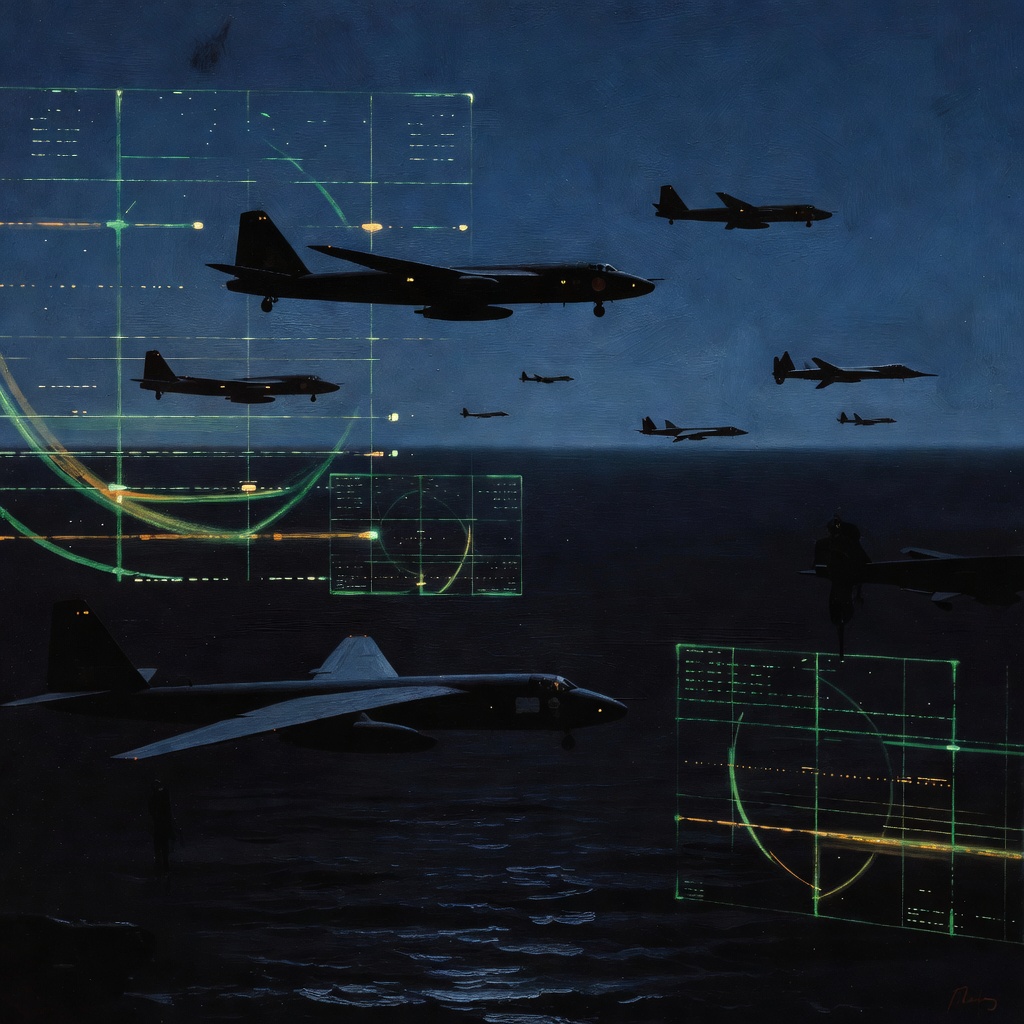
Miles Ashworth: The Tu-95MS is a turboprop. I just want to start there. Russia's contribution to the most recent Sino-Russian show of strength — the eleventh joint patrol, June 27th, 2026 — is an aircraft whose engine technology predates the moon landing. And everyone is treating this as a fundamental challenge to air dominance in the Indo-Pacific.
Megan Skiendel: Okay but Russia's Ministry of Defense said it was routine. So.
Miles Ashworth: Oh, routine. Routine — while simultaneously conducting what is reportedly Russia's heaviest drone bombardment of Ukraine in the same period. You don't call something routine when it is routine. You call it routine when you need it not to be examined.
Megan Skiendel: And China's Ministry of National Defense went the other direction entirely — 'resolve and capability to jointly safeguard regional peace.' So one side is playing it down, one side is playing it up.
Miles Ashworth: Which is what you get when two nations are doing the same patrol for completely different domestic reasons and calling it integration. The H-6K, also a derivative of a 1950s Soviet design by the way, flying alongside a Cold War turboprop over the Sea of Japan — and the story we're meant to absorb is: coordinated strategy. It's two neighbors turning up to the same party and claiming they planned it.
Megan Skiendel: Japan and South Korea scrambled jets for it regardless.
Megan Skiendel: Okay, but the YY-20 tanker didn't just show up by accident. That's — that's a specific institutional decision. Someone in a PLAAF planning room said: this iteration needs dedicated aerial refueling to extend fighter escort range. That's not theater.
Miles Ashworth: No, quite. I'll grant you the tanker.
Megan Skiendel: And alongside the YY-20 you've got the KJ-500A — that's airborne early warning and control, so now you have command and coordination layered across the whole formation. That's not two neighbors turning up to the same party. And the escort package — J-16, J-10C, J-11B, Su-30MKK alongside Russian Su-30SM and Su-35s — I mean, that's a full integrated package. Japan and South Korea don't scramble jets over a press release.
Miles Ashworth: The nuclear dimension is the part that actually changes the allied calculus, isn't it — because the H-6K and Tu-95MS both carry nuclear-armed cruise missiles. You can't simply intercept and go home. The response architecture is completely different.
Megan Skiendel: Exactly. And that's eleven iterations since 2019 — this program survived the Ukraine invasion friction, survived every political wobble. That's sustained institutional commitment, not a one-off.
Miles Ashworth: Right. The airframe age is real. The integration depth, frankly — also real. Those are not the same argument.
Miles Ashworth: And yet the geography tells you something the airframe age doesn't. Alaska. That's not East Asia theater posturing — that's U.S. and Canadian jets scrambling because two Russian and two Chinese bombers are approaching North American airspace. That happened. And before that, European airspace, NATO jets following them off the coast of Europe.
Megan Skiendel: The program has expanded from the Sea of Japan to Alaska to European airspace. That's geographic reach, not just repetition.
Miles Ashworth: Which is the partial win I'll take, yes. The kernel is real — it's just that the kernel is growing inside a dying tree. Because here's the constraint nobody prices in correctly: the Tu-95 has no active production line. Russia cannot replace these aircraft. If one goes down — mechanically, operationally, whatever — that's it. Gone. And Russia is simultaneously burning through assets in Ukraine at peak rate.
Megan Skiendel: The cadence hasn't broken yet, though. Tenth patrol December 9th last year, eleventh patrol June 27th — that's roughly six months apart. Still running.
Miles Ashworth: For now. But put a Japanese air defense planner at her console Tuesday morning — she's pulling the patrol track, she's seeing the YY-20 extending fighter escort range, the KJ-500A overhead coordinating the whole formation. She has to plan for capability, not for attrition she can't confirm. That's where Liu Pengyu's 'annual cooperation' framing to Newsweek does its actual work — it keeps the ambiguity live.
Megan Skiendel: And South Korea and Japan reaffirming denuclearization goals and defense ties on June 28th — the day after — that's the diplomatic read of exactly that ambiguity.
Miles Ashworth: Right. So the geographic expansion is real, the institutional commitment from Beijing is real — and Russia is quietly running out of aircraft to keep attending the party.
Megan Skiendel: And that's exactly what makes the 11th the one to watch — not the 12th, if there even is one. The YY-20, the KJ-500A, the full escort package with J-16s and Su-30MKKs — this is the most operationally complex iteration the program has ever produced. Which means allied planners have to sit with a genuinely uncomfortable question. Is this a capability ceiling — Russia's heaviest drone bombardment of Ukraine happening simultaneously, no replacement Tu-95s coming off any production line — or is this the floor that a 12th patrol builds from? Those are completely different threat assessments.
Miles Ashworth: Fine. The YY-20 tanker is real. I'll give you the tanker. But I'm watching for patrol twelve — because if Russia genuinely cannot regenerate long-range aviation capacity while burning through assets in Ukraine, then what the PLAAF just demonstrated on June 27th is not the opening of a new chapter. It's the high-water mark of a program whose Russian half is already receding.
Megan Skiendel: Which means the clock isn't running toward the next patrol. It's already been running since the Ukraine invasion started — and the 11th is what it looks like when time is almost up.