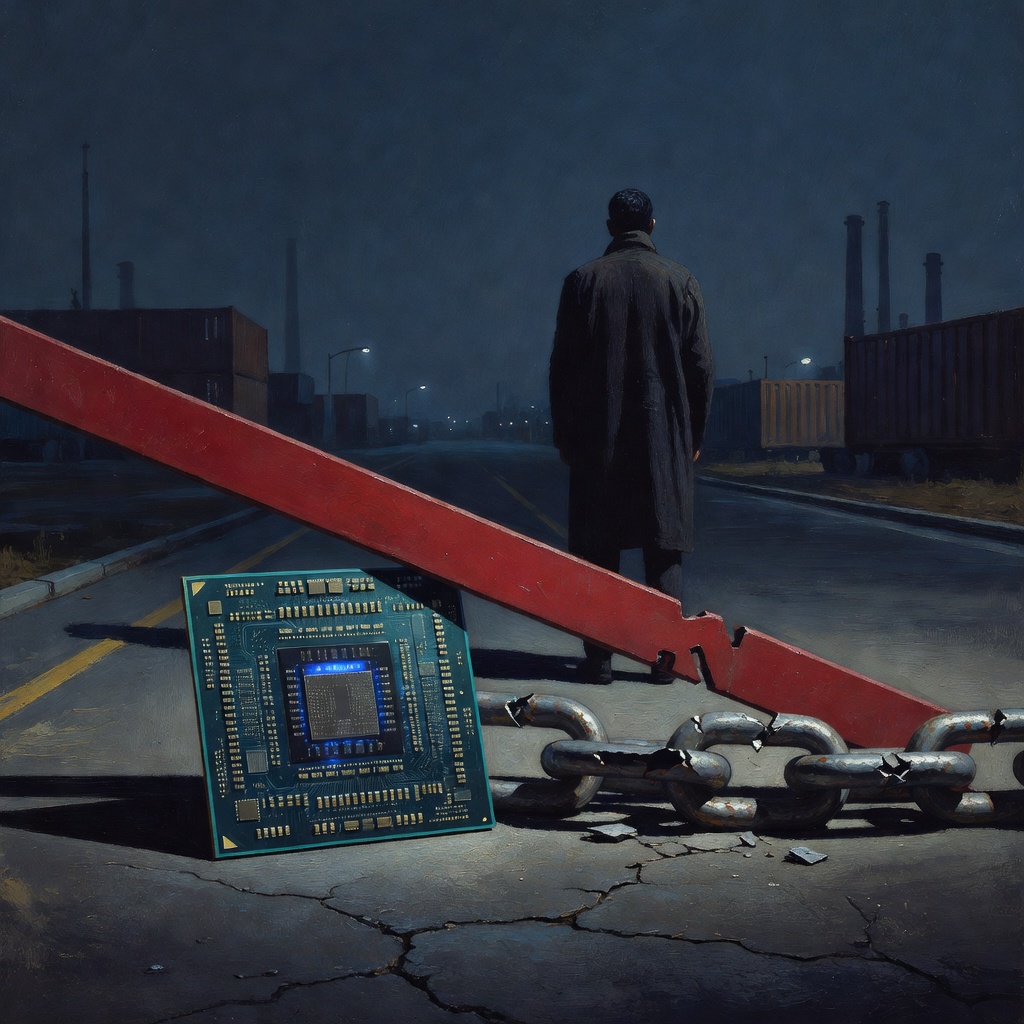
Jordan Hale: I've been sitting with this story for like three days and I still can't fully get my head around the sequence of events.
Ryan Castillo: The timeline.
Jordan Hale: The timeline! Like — okay, December 2025. The Trump administration says yes, H200s can go to China. There's a 25% export tariff, there's U.S.-based security screening, but the door is open. Jensen Huang lobbied for this, David Sacks backed it, it's a real policy decision. And then — you know, I keep trying to find the right word for what happens next and 'reversal' doesn't even cover it.
Ryan Castillo: Four weeks.
Jordan Hale: Give or take, yeah. Around January 7th, customs officials in Shenzhen start telling logistics firms — sorry, we can't accept declarations for H200 shipments. Not 'there's paperwork missing.' Not 'come back Tuesday.' Just: no.
Ryan Castillo: And Howard Lutnick — Commerce Secretary — confirmed zero H200 sales to China had actually gone through. Zero.
Jordan Hale: Right, so none of the chips that were — wait, actually that's the thing that gets me. Nvidia had already ramped production at TSMC in anticipation of this demand. Like, the capacity was real, the orders were real, over a million orders from Chinese clients. And then January 17th, H200 component suppliers just... halt production.
Ryan Castillo: So you've got two governments pointing at the same chip in opposite directions, and Nvidia's sitting in the middle holding stranded inventory.
Jordan Hale: Exactly. And the question nobody's fully answered yet — why would Beijing say no to a chip it was legally allowed to buy?
Ryan Castillo: That's the one.
Ryan Castillo: Look, January 13th — Commerce Department drops revised export rules. Formal approval. H200, AMD MI325X, conditions attached, fifty percent volume cap, military non-use certifications. That's the 13th. China starts blocking on the 17th. Four days. That's either suspiciously fast for coordinated policy, or too slow for bureaucratic confusion. Which is it?
Jordan Hale: I mean — okay, I've been going back and forth on this, and I think the framing of 'fast versus slow' kind of misses what actually happened. Because the question isn't whether Beijing drafted a new policy in four days. The question is whether someone already had a decision in a drawer waiting for the right moment to open it.
Ryan Castillo: That's a story. I need evidence of intent.
Jordan Hale: Okay, here's what's not a story — major domestic tech firms received formal instructions. Pause orders. Purchases only permitted in narrow cases, joint university R&D specifically, per The Information. That's not a customs agent having a bad Tuesday. That's directed policy landing on specific companies' desks.
Ryan Castillo: That's — yeah, that part I'll grant you.
Jordan Hale: And then you've got ByteDance — simultaneously, like in the same window — reported seeking fifty thousand plus domestic AI chips. That's not a company hedging. That's a company that already knew the H200 door was closing and started moving before it shut. You know, BradStanleyCFA called it Beijing 'maintaining the chip wall from its side,' and I think that framing is actually — wait, no, I don't want to just adopt someone's X take as analysis, but the circumstantial picture is really hard to wave away.
Ryan Castillo: No, I don't buy that ByteDance proves intent. Large Chinese tech firms pivot fast. Fifty thousand chip orders could be opportunistic, not coordinated.
Jordan Hale: Combined with the formal pause instructions?
Ryan Castillo: Combined with — okay, the formal instructions are harder to dismiss. But here's what I can't resolve. If this is deliberate chip substitution strategy, China needed a viable domestic alternative in place first. And DeepSeek V4 co-designed with Huawei's Ascend 950DT — SemiAnalysis confirmed this — that's the actual inflection point. That's not a benchmark on paper. That's a frontier-class model built on Chinese domestic semiconductor infrastructure. So did Beijing block H200 because it finally had something to substitute in?
Jordan Hale: That's — yes. That's exactly the sequencing that keeps me up.
Ryan Castillo: But we don't have internal Chinese government deliberations. We can't actually close that causal chain. The pattern is suggestive. The four-day window, the formal firm instructions, Biren on the Entity List while domestic alternatives ramp — it reads like strategy. But 'reads like' isn't the same as 'is.'
Jordan Hale: No, you're right. We can't call it. But I'd say the burden of proof has shifted — like, someone arguing this is just procedural confusion now needs to explain all of that simultaneously. The instructions, the ByteDance pivot, the Ascend 950DT timing. That's a lot of coincidence to carry.
Jordan Hale: But okay — I want to make this concrete because I think we keep hovering at the policy altitude. Picture a Tuesday morning at a Chinese cloud provider. Infrastructure team. They've got H200 orders in the pipeline, confirmed, they've been planning around this hardware for months, capacity projections, hiring, the whole thing. And then the instructions land. Orders cancelled. And someone — some engineer, some procurement lead — is being told, evaluate Ascend 950DT clusters instead. Like, that's not a policy discussion anymore. That's a workflow that just got destroyed.
Ryan Castillo: That person's quarterly targets just evaporated.
Jordan Hale: Exactly. And they don't get to appeal to geopolitics. They just have to figure out if the Ascend 950DT cluster can actually do what the H200 cluster was supposed to do. Which — this is where the DeepSeek V4 thing becomes really important to me. Because SemiAnalysis confirmed it was co-designed with the Huawei Ascend 950DT from the ground up. Not ported. Not adapted. Co-designed. That's the first frontier-class model built on Chinese domestic semiconductor infrastructure. And it achieved a 75% pricing reduction by eliminating inference bottlenecks through the co-design. So that procurement lead now has an actual answer to point to.
Ryan Castillo: Hold on. One model proving the architecture works isn't the same as the architecture being production-ready at scale.
Jordan Hale: No, totally — and I don't want to overstate it. Like, we don't have the full performance picture yet even from SemiAnalysis. But the pricing reduction is real. That's not a benchmark number someone cooked up, that's a cost outcome from a shipped product.
Ryan Castillo: The gap is still roughly 5x. Nvidia's B300 versus Chinese domestic chips — that's not a rounding error. That's a generational delta.
Jordan Hale: Yeah, but — wait, this is the thing that keeps tripping me up. DeepSeek already proved you can win at the frontier with less. The specs gap doesn't map cleanly onto the capability gap. That's the whole lesson from their earlier releases. So if a 5x performance difference produces, what, a 20% capability difference in practice? That's a much easier gap to live with than the raw numbers suggest.
Ryan Castillo: That math isn't established. That's an analogy, not a data point.
Jordan Hale: I mean — you're right, I can't quantify it cleanly. But Biren is in this too, right? They're developing domestic alternatives, they're on the U.S. Entity List now which tells you the U.S. government takes the threat seriously. It's not just Huawei Ascend 950DT as a one-off.
Ryan Castillo: The Entity List placement is actually the tell. That's not defensive policy. That's the U.S. saying Biren is close enough to matter.
Jordan Hale: Which brings me to the uncomfortable question I can't answer. Is China blocking H200 because it's genuinely confident the Ascend 950DT co-design gives it enough — or is it blocking H200 specifically to force the transition before the gap widens again? Because those are very different strategic bets.
Ryan Castillo: And we can't tell from outside. But the $4.5 billion H20 charge tells you Nvidia already learned this lesson once and didn't structurally change the exposure. I can't get past that.
Ryan Castillo: That $4.5 billion charge was filed May 28th, Q1 FY2026. That's not ancient history. That's nine months before Nvidia is now watching the same dynamic play out with H200. So the question I can't shake is: what did Nvidia actually change in how they structured China exposure between April 2025 and December 2025? Because if the answer is 'nothing, they just lobbied for a new chip to sell in,' that's a structural problem, not a trade policy problem.
Jordan Hale: Wait, you think they didn't change anything?
Ryan Castillo: Jensen Huang lobbied the Trump administration to allow H200 sales. David Sacks backed it. That's the play — go around the restriction, not through it. Which worked until it didn't.
Jordan Hale: Okay but — I mean, what's the alternative? You can't just write off the China market and tell your shareholders 'we decided not to sell.' You know, there are TSMC engineers whose entire production ramp existed for this. Like, Nvidia scaled up capacity at TSMC specifically because December approval made it look like a real order book. That's not recklessness, that's... actually, no — wait. Maybe it is recklessness. Because they had already seen April 2025. They already knew the U.S. government could flip the switch.
Ryan Castillo: That's the load-bearing assumption. Did they believe December was more durable than April, or did they just bet on it being durable enough?
Jordan Hale: And now there's stranded TSMC capacity.
Ryan Castillo: Right. And this is where the TSMC piece gets specific. That's not Nvidia's factory to idle — that's allocated manufacturing time at TSMC that was priced and scheduled around Chinese demand. Redirecting it to U.S. or allied markets isn't just logistics. If you flood non-China customers with supply, you compress your own margins. If you hold back, you're paying for capacity you're not using.
Jordan Hale: So they're getting squeezed from both sides.
Ryan Castillo: And Commerce Secretary Lutnick confirmed zero H200 sales had cleared before the block. Zero. So there's no revenue buffer here. The TSMC ramp happened, the Chinese orders were real — over a million orders from suppliers who halted January 17th — and the dollar return is nothing.
Jordan Hale: And then — you know, the weekend guidance. That's the one that really gets me. The Commerce Department issues this unusual weekend guidance closing the loophole on Rubin and Blackwell processors reaching Chinese-headquartered entities outside China. So it's not just H200. They're closing the workaround too. Chinese firms setting up entities in Singapore, in South Korea, routing around the restriction — that door's closing.
Ryan Castillo: Which means AMD MI350x gets caught in that net too.
Ryan Castillo: So the question for any data center operator in Singapore right now — and this is the confidence-shatter angle you were pointing at — is: do I keep structuring my infrastructure around Nvidia hardware knowing that supply can reverse in four days? Not four months. Four days between U.S. approval and Chinese block.
Jordan Hale: That's — yeah. That's the question I don't think anyone in procurement has a clean answer to right now.