Brian Reed: Hey. I want to start with something that sounds like a big number but I'm genuinely not sure what to do with it yet.
Brian Reed: Yeah. Researchers at China's Qingdao Institute — that's a Chinese Academy of Sciences lab — published this material. 50.4 milligrams of uranium per gram, extracted from seawater. Two journals: Journal of Hazardous Materials and Separation and Purification Technology.
Eliza Ward: The US DOE's benchmark for comparison is 6 mg/g. So eight times over, roughly.
Brian Reed: Wait — so the sponge analogy. Help me land that.
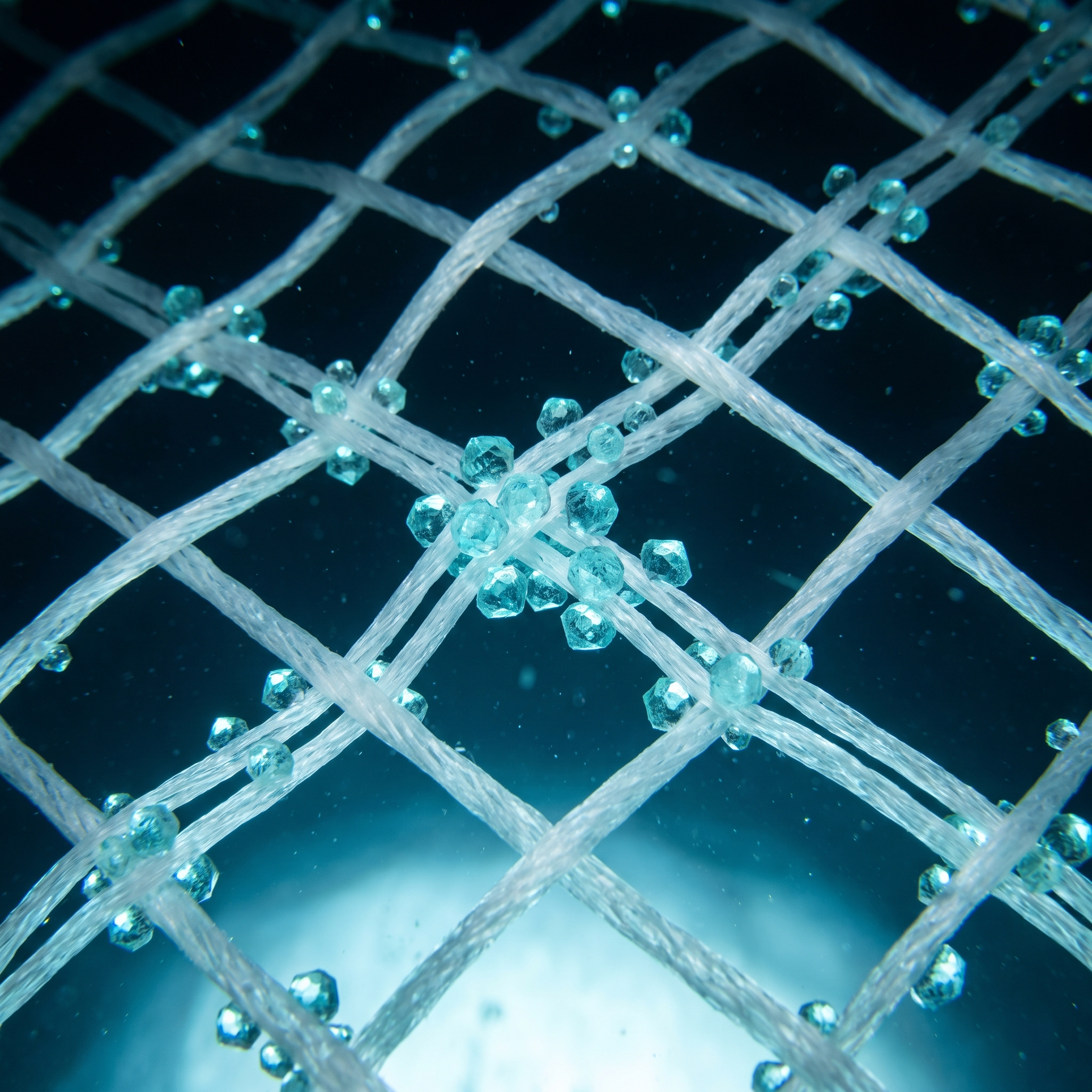
Eliza Ward: PhosCage is a chemical sponge, basically. Ocean water has uranium dissolved in it — we're talking trace amounts. You lower this material in, it grabs uranium and holds it. Milligrams per gram is just how saturated each gram of sponge gets. PhosCage gets eight times more saturated than anything the DOE measured. That's the result.
Brian Reed: But hang on — eight times better than what, exactly? Because the DOE benchmark it's being measured against, that 6 mg/g number, that was set in 2016. And the DOE program basically wound down after 2018.
Eliza Ward: Right. So — and this is the part that needs a confidence downgrade — you're not beating America's best. You're beating America's old homework.
Brian Reed: An abandoned scorecard.
Eliza Ward: And even if you take 50.4 mg/g at face value — which, fine, it's peer-reviewed, two journals — neither PhosCage study actually published what that uranium costs per gram to recover. The researchers flagged scaling and cost reduction as, quote, future work. So the number that would actually tell you whether this matters commercially? Missing.
Brian Reed: So adsorption capacity is, let me see — it measures how full the sponge gets, not whether filling it is worth the energy or money to do it.
Eliza Ward: Exactly that. And there are real engineering steps here — PhosCage is in bead form, which matters for actual deployment, and it preferentially grabs uranium over vanadium and other competing ions. That's genuinely hard. But it's still a laboratory tank, not open ocean. The gap between those two things — actually, that's the part we should get into next, because what happens when you put this in actual seawater is a very different story.
Brian Reed: So what we actually have today is a materials science result. Not a deployment result.
Eliza Ward: And the take circulating right now skips that entirely. Like — 'China has a strategic uranium breakthrough.' That framing is what I want to push on, because the PhosCage papers themselves say the testing was in controlled lab conditions. Natural seawater samples, yes, but a tank. Not open ocean.
Brian Reed: Biofouling alone — you put a material in actual ocean water, microorganisms colonize the surface, and your adsorption capacity can drop dramatically. Add wave action, currents, variable salinity, a much broader mix of competing ions than any lab replicates. That's not a minor footnote.
Eliza Ward: No, that's the whole question.
Brian Reed: And yet — okay, here's what I don't want to lose. The strategic motivation is real even if the technology isn't proven at scale. China imported 13,000 metric tons of uranium in 2024. Mined about 1,700 domestically. That's, let me see, roughly an 8-to-1 import dependency. That gap is why seawater extraction gets funded even when ocean trials aren't done yet.
Eliza Ward: Right — and the IEA projects China surpasses the US and EU in installed nuclear capacity by 2030. They're building more nuclear plants than anyone on earth right now. So the vulnerability is genuine.
Brian Reed: Which explains the announcement. It doesn't validate the claim. And — actually, the social media response is weirdly telling here. Low engagement, no independent scientists visibly contesting or confirming the numbers. Yongquan Zhou's team has a parallel line, this 'predator-like' micromotor material that swims toward uranium ions — also not at ocean scale. Multiple bets, none of them across the finish line.
Eliza Ward: So what we can actually say is: the strategic signal is real. China has genuine import dependency, real nuclear expansion ambitions, real funding motivation. The strategic achievement — wait, that's a different sentence entirely. That is not established.
Brian Reed: The oceans hold 4.5 billion tonnes of dissolved uranium. More than a thousand times terrestrial reserves. But at three parts per billion, getting it out cost-effectively is the whole problem — and we don't have that number for PhosCage. The breakthrough framing collapses right there.
Eliza Ward: And that's actually — wait, the 70-year number keeps striking me. There's an ANS-cited analysis that land-based uranium could be depleted in as few as 70 years at current consumption rates. So this isn't a hypothetical long-term problem. That's a real ceiling, and the US DOE walked away from seawater extraction after 2018, which means China is now the most active state-backed program on earth chasing this. Not because they're ahead. Because everyone else left the field.
Brian Reed: Right — but that actually makes the missing cost number worse, not better. If terrestrial mining has a 70-year ceiling and seawater is the only realistic alternative at scale, then whether PhosCage comes in above or below the cost of digging it out of the ground in Kazakhstan is the whole question. And we just... don't have that. The papers don't publish it. The researchers called it future work.
Eliza Ward: No cost-per-gram, no open-ocean trial. Those are the two facts that would actually settle this — and neither exists yet for PhosCage. I think that's where we are. Genuine materials science achievement out of the Qingdao Institute, real strategic pressure behind it, and a gap between the lab result and anything that changes how China — or anyone — actually fuels a reactor.