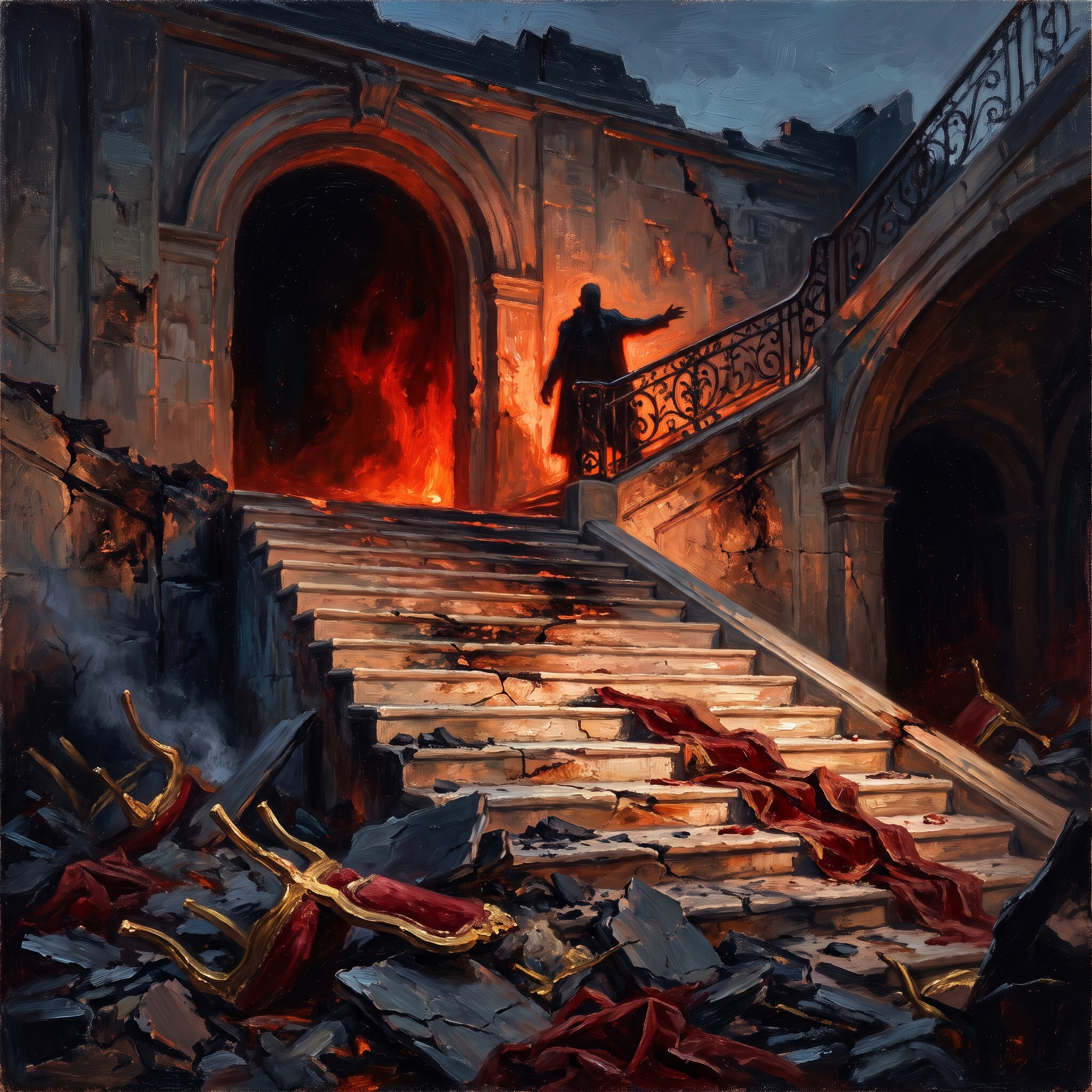
Hana Field: Hey — long week, and then I open my phone and there's this @geogeolite thread and suddenly I'm staring at burning buildings in Paris, 1830 and 2026, side by side, and I genuinely couldn't tell which was which for a second.
Jude Walker: That's the move, isn't it — the visual parallelism does the analytical work before you've read a word.
Hana Field: And the thread puts the Archbishop's Palace looting next to the 2026 footage and asks, 'when does protest become revolution?' The Eugène Delacroix aesthetic was already saturating the discourse before @geogeolite posted — so people arrived primed to see 1830. What stopped me cold is... so, Charles X issued the July Ordinances July 26, 1830. By August 9, Louis-Philippe is the constitutional monarch. The entire Bourbon Restoration is finished in two weeks.
Jude Walker: Two weeks versus Macron still imposing curfews in October 2026 and still governing. That gap is doing all the work.
Hana Field: And the 2026 unrest started as student protests — deteriorating public school conditions, not a constitutional coup, and yet the framing just... absorbs all of that into the bigger revolutionary image.
Jude Walker: Same smoke. Possibly very different fire.
Hana Field: But couldn't street chaos itself cause that kind of collapse? Like, if the scale is big enough, if it goes on long enough — doesn't institutional confidence just erode under the weight of it?
Jude Walker: That's the move everyone makes, and it's wrong — or at least it's backwards. Think of it like a building on fire. The fire looks catastrophic whether it's a controlled burn or a structural collapse. The difference isn't the flames. It's whether the foundation's already gone. In 1830, the foundation actually gave way — army regiments didn't just waver, they physically defected to the revolutionary side. By July 29, they'd taken the Tuileries. Charles X wasn't just threatened, the regime had already collapsed before he fled. In 2026? Zero institutional actors have broken ranks. No parliamentary switching, no defections — nothing.
Hana Field: Wait — actual regiments switching sides, not just refusing orders?
Jude Walker: Literally changing sides. That's not soldiers going home, that's institutional collapse in uniform. And the trigger mattered — Charles X's July Ordinances weren't an austerity package, they were a constitutional coup. Dissolved parliament, gutted press freedom, narrowed the electorate. The Chamber of Deputies realigned because the regime had attacked the Chamber. School conditions in 2026 are a real grievance, but they're a different lever entirely.
Hana Field: And @geogeolite's whole visual anchor — the Archbishop's Palace — you know what's strange to me, and I don't know how much weight to put on this, but the academic sourcing on that looting is apparently... thin? Like we're not even sure the centerpiece of the parallel is well-documented.
Jude Walker: Nah, and it gets worse — François Valentin flagged that 1830 revolutionaries themselves executed pillagers. So even inside 1830, the romanticized looting narrative is complicated. The iconic image @geogeolite is building everything on rests on thin evidentiary ground and a sanitized read of what actually happened. The imagery feels like proof. It isn't evidence of structural collapse.
Hana Field: And the quieter version of collapse — where it actually starts — that's what we haven't touched yet, and I think that's genuinely unsettling.
Jude Walker: And that's the part that actually breaks the clean 'no structural equivalence' argument. Because — nah, look, the absence of visible defection doesn't mean the foundation is solid. It might mean you're watching the six months before anyone admits the foundation's gone.
Hana Field: Which is — and this is what unsettles me — picture a 17-year-old in Lyon on a Sunday evening, October 2026, livestreaming a burning city hall. She captions it 'Liberty Leading the People' with a Delacroix emoji. She didn't invent that. France's cyclical protest tradition — 1789, 1830, 1848, May '68, Yellow Vests — that whole script is pre-loaded into her. The revolutionary frame arrives before any analysis does.
Jude Walker: Does the script matter if the structural conditions aren't there, though?
Hana Field: That's exactly the Charles Tilly point on barricades — they're a repertoire of contention, a learned recurring form. They're almost ritualized in French political culture. So they neither confirm revolutionary intent nor rule it out. The barricade is... it's a costume the grievance wears, not a diagnosis.
Jude Walker: And Macron's government chose the 'insurrection' end of the spectrum by invoking curfews — which isn't neutral. That label unlocks specific legal powers. So the question @geogeolite asked, 'when does protest become revolution,' that framing was already doing political work before anyone answered it.
Hana Field: And the 2018 Yellow Vests were writing 'Macron equals Louis XVI' near the Champs-Élysées. So the monarchy parallel isn't analysts imposing a frame — protesters are actively deploying it as a tool.
Jude Walker: Here's what I'd actually flag, though — in 1830, the Chamber of Deputies didn't defect during the street fighting. It moved after the military balance had already shifted. Institutional collapse followed the visible unrest, it didn't cause it. So by the time you can see it? It's already done.
Hana Field: So the thing I keep snagging on is — if it's already done by the time you see it, what are we actually supposed to be watching for? Because it's not the burning city halls. We've established that.
Jude Walker: Yeah, and I mean — it's not a dramatic defection speech, it's not a general going on television. It's a mid-level aide in the Élysée who quietly stops returning calls from defense ministry press. Doesn't write a memo. Just stops. And if that gets repeated across five or six mid-tier actors over six months, and nobody's tracking it — that's the structural equivalent of 1830's army defections. That's what makes the @geogeolite parallel accidentally useful, actually. Not as a current diagnosis, but as a warning structure. Watch whether anyone with institutional weight quietly stops defending Macron's governing capacity. That's the tell.
Hana Field: The riots are the symptom. And the revolution, if it comes — it'll be the moment people act on confidence they already lost weeks before. That's a quieter thing than anything Delacroix ever painted.
Jude Walker: Yeah. That's probably the honest place this lands — not 'is it 1830,' but 'are the phones going unanswered.' Appreciate you sitting in the uncertainty with me on this one.