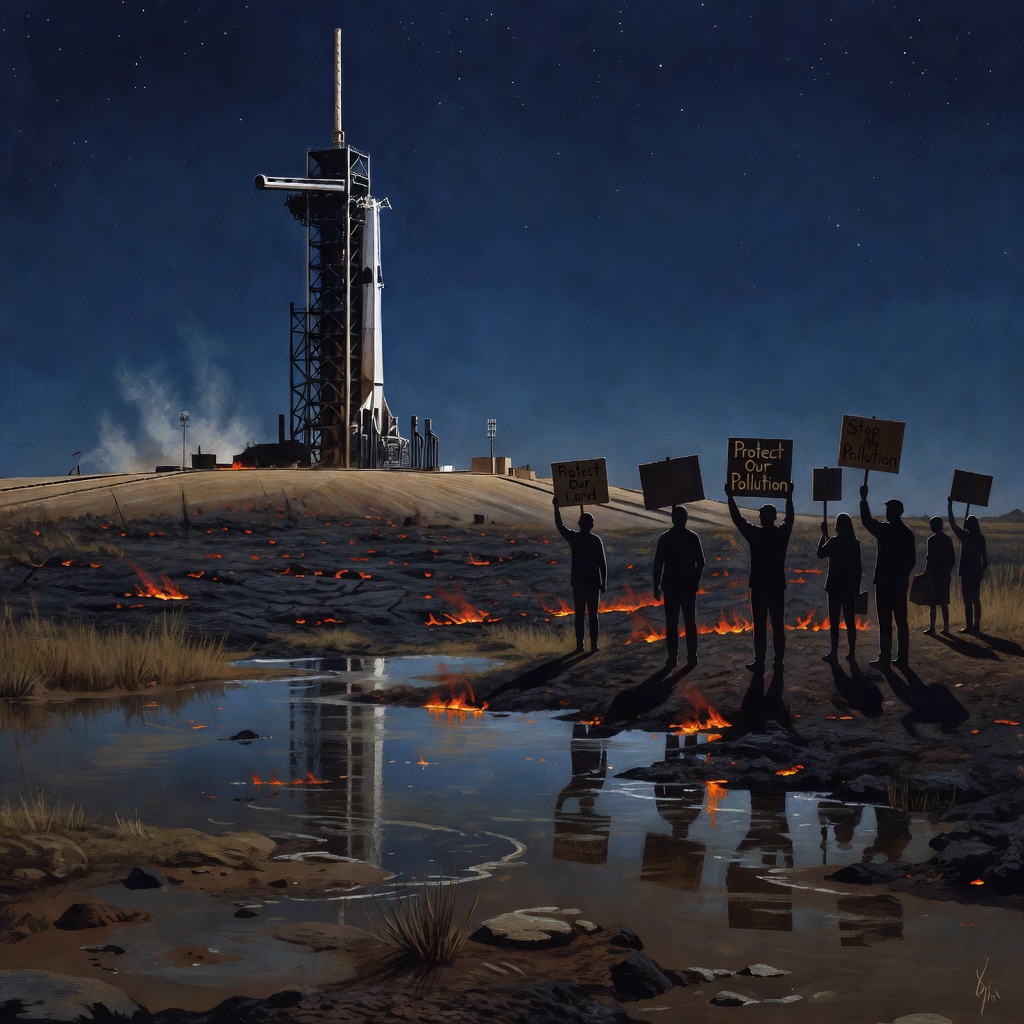
Jonathan Ingles: The EPA fines SpaceX $150,000. Clean Water Act violations. Starbase site. And then — I mean, you'd expect the next move to be enforcement, right? Tighter restrictions, maybe a pause on operations.
Elena Marsh: Mm. Not quite.
Jonathan Ingles: The FWS approves a land exchange. 715 acres of the Lower Rio Grande Valley National Wildlife Refuge — to SpaceX. And there's a lawsuit now, filed June 10th and 11th in federal court in Washington — South Texas Environmental Justice Network, Center for Biological Diversity, Save RGV, the Carrizo/Comecrudo Nation of Texas — all suing to block it. FWS Director Brian Nesvik is named personally.
Elena Marsh: And SpaceX gives back 683 acres. Adjacent to a completely different refuge — Laguna Atascosa, not the Lower Rio Grande Valley.
Jonathan Ingles: Which the FWS calls no significant impact. Same language in their final environmental assessment — 'no significant impact' — this after the Texas Commission on Environmental Quality cited SpaceX for discharge violations in August 2024. Look, the fine plus the land transfer — that's not two separate decisions. That's one posture.
Elena Marsh: What's the posture, in your read?
Jonathan Ingles: Managed decline. The agency isn't enforcing — it's administering the loss. They look at the FAA's number — 25 launches a year, up from 3 — and they decide that land is gone regardless. So they paperwork it.
Elena Marsh: That's — yes. And that's actually the thing that strikes me as genuinely new here. The FWS's own justification — they said, publicly, that the exchange lets them divest lands 'likely to be impacted' by Starbase operations. That's not conservation language. That's... surrender language dressed as management.
Jonathan Ingles: Eight times the launches. No significant impact. Come on.
Elena Marsh: Well, and that's where the National Wildlife Refuge System Improvement Act becomes the actual legal hinge — the lawsuit argues the exchange violates that statute directly, because you cannot permanently remove refuge land from conservation use this way. That's not a technicality. That's the whole case.
Jonathan Ingles: Is it capture or is it institutional failure — that's what you're holding open?
Elena Marsh: I am. Because there's a Carrizo/Comecrudo Nation member — an elder — trying to reach ancestral land on the Rio Grande for ceremony. Road closed. Rocket debris. She files with the FWS. And in the same system, simultaneously, the agency is processing the paperwork to hand that corridor to SpaceX. That's not a policy debate. That's a daily reality for a plaintiff in this lawsuit.
Jonathan Ingles: And the Carrizo/Comecrudo Nation isn't a stakeholder at the table — they're a plaintiff in federal court. That distinction tells you everything about how far the agency relationship has already broken down.
Jonathan Ingles: The wrong take — and I hear it constantly — is that this is SpaceX getting a favor. One powerful company, one friendly agency, done. That's not what's happening. The DOJ went into a Mississippi federal court and argued that the NAACP's pollution lawsuit against Musk's xAI threatens — I'm quoting — 'American national, economic, and energy security.' That's not a favor. That's a legal architecture.
Elena Marsh: The standing argument.
Jonathan Ingles: If that theory holds, it doesn't matter what the Center for Biological Diversity proves. It doesn't matter what Save RGV establishes about the beach closures — they already lost one lawsuit in 2021, by the way. Private standing collapses. The government decides which environmental suits get heard.
Elena Marsh: I want to test that. Because — and I'm genuinely asking — is that coordinated strategy, or is it agencies arriving at the same conclusion separately? The FAA expands to 25 launches, the FWS finds no significant impact, the DOJ intervenes in Mississippi... those could be convergent outcomes rather than a designed system.
Jonathan Ingles: Frankly, that distinction doesn't matter at the outcome level. Coordinated or convergent — the lawsuit still can't win if standing is gone.
Elena Marsh: And the communities near Starbase who depend on SpaceX economically — they deserve weight in how we tell this. That's a real tension, not just an industry talking point.
Elena Marsh: And that's where I keep getting stuck. Because there are residents in Port Isabel and South Padre Island who filed a separate lawsuit — 11 Starship and Super Heavy test flights, April 2023 through October 2025 — alleging structural damage to their homes. Overpressure waves. Noise above 110 decibels. Those aren't ideological plaintiffs. Those are people with cracks in their walls. And if the DOJ's federal-exclusivity theory becomes settled law... I mean, what does it actually mean that SOTXEJN, and the Carrizo/Comecrudo Nation, and the Center for Biological Diversity filed this lawsuit at all? If the standing question goes the wrong way — what does filing accomplish?
Jonathan Ingles: The record. That's the only honest answer. You build the factual record before the door closes.
Elena Marsh: But if the next administration inherits a landscape where federal agencies manage land for development and private suits are framed as national security threats — does the record matter? Or does losing this, on standing, just ratify the architecture?