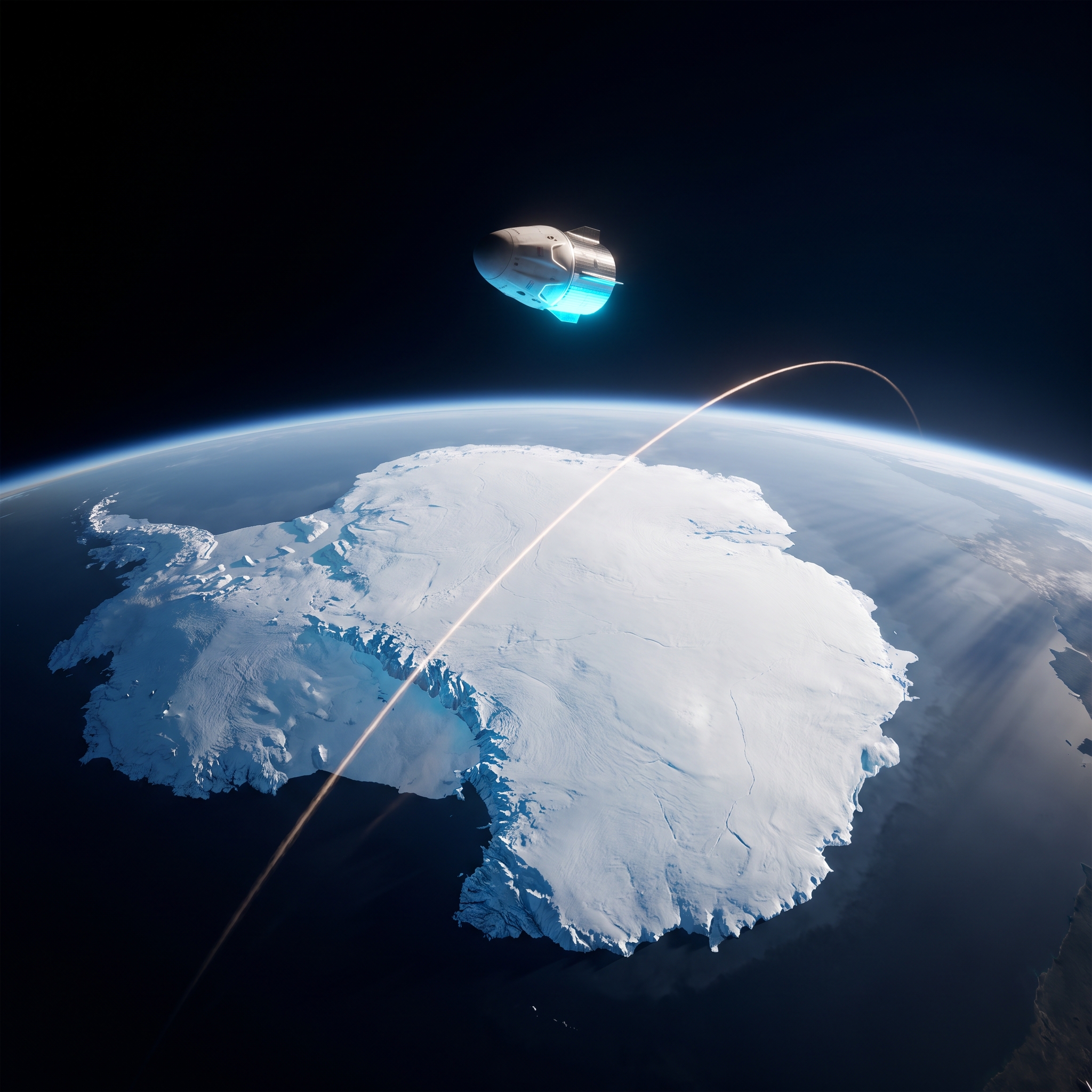
Juniper Vale: Every crewed spacecraft that has ever flown — every single one — stayed away from the poles.
Juniper Vale: The ISS is up there right now, people on board, and it never passes directly over the North Pole. Never over the South. Neither does Tiangong. That's not some technical limitation — that's just where crewed spaceflight has lived for sixty-plus years.
Juniper Vale: Until March 31st.
Juniper Vale: 9:46 p.m. EDT, Falcon 9 lifts off from Launch Complex 39A at Kennedy Space Center — Crew Dragon Resilience, four people inside — into a 90.01-degree inclination orbit. And that number, 90 degrees, that's the whole story. It means the spacecraft doesn't go around the equator. It goes over the poles. Both of them. Every single revolution.
Juniper Vale: Full global coverage. No latitude left out.
Juniper Vale: The mission was called Fram2. Crew was — okay, Mission Commander Chun Wang, a Maltese crypto entrepreneur, co-founder of f2pool, who also funded the entire thing. Then Vehicle Commander Jannicke Mikkelsen, Pilot Rabea Rogge, and Medical Officer Eric Philips. Four civilians.
Juniper Vale: No government agency. No astronaut corps.
Juniper Vale: They splashed down April 4th off Oceanside, California — SpaceX's first crewed Pacific recovery — and quietly closed a gap that had stretched more than six decades. The gap where humans just… didn't go over the poles.
Juniper Vale: What keeps snagging me is this. Uncrewed satellites have been flying polar orbits for decades. Starlink deployments, weather satellites, spy satellites — all of it. The path was proven. Nobody was waiting on some technical breakthrough.
Juniper Vale: The ISS is up there right now, passing over the same equatorial band it always has. Tiangong too. Same latitudes, every orbit. Meanwhile Crew Dragon Resilience — three and a half days, apogee 413 kilometers, perigee 202 — was crossing both poles. Every single revolution.
Juniper Vale: That's not a small gap to close.
Juniper Vale: So what was NASA waiting for? What was Roscosmos waiting for? ESA? Because sixty years is a long time to leave full global coverage on the table when the orbital mechanics were never the problem.
Juniper Vale: The honest answer is motivation. Priority. Money directed at a specific thing. And the entity that finally supplied all three wasn't a government — it was Chun Wang, crypto entrepreneur, co-founder of f2pool and stakefish, who wrote the check and then strapped in as Mission Commander.
Juniper Vale: I'll be honest — I find that genuinely strange. Not bad, necessarily. Just… strange. The National Space Society called Fram2 a historic breakthrough, and they're right. But the reason it happened is a billionaire decided it was worth doing.
Juniper Vale: And that's actually the part that matters. Private commercial spaceflight — missions conceived and funded outside any national agency — just closed a sixty-year gap that three of the world's biggest space programs never bothered to close.
Juniper Vale: Is that democratization? Or is it just… different gatekeeping? The gate used to be government budgets. Now it's private wealth. I'm not sure those are the same thing.
Juniper Vale: The National Space Society called it a historic breakthrough. I don't think that's wrong. But the name — Fram2 — that's what sticks with me. The Fram was a real ship. A 19th-century polar exploration vessel that pushed further north and further south than any ship before it. That's a genuinely stirring legacy to invoke.
Juniper Vale: And then I think — 3.5 days. 413 kilometers up. No docking. No surface. The original Fram spent years in the ice. I'm not sure the analogy survives contact with the actual mission profile, you know? There's something a little… curated about the framing. Like the romance was chosen before the trajectory was.
Juniper Vale: Which doesn't erase what Crew Dragon Resilience actually did. The Pacific recovery alone — Oceanside, California, April 4th — that's SpaceX expanding operational flexibility in a real, concrete way. Atlantic splashdowns were the only crewed option before this. Now that's not true.
Juniper Vale: But the part I can't stop sitting with is the structural question underneath all of it. If a polar orbit waited sixty-plus years because no government prioritized it — and Chun Wang wrote the check and it happened — then what else is just… sitting there? What other trajectories, what other mission profiles, are dormant right now waiting for the next wealthy person to find them interesting?
Juniper Vale: That's not a small thing to leave open.
Juniper Vale: Because the ISS is still up there in its same band. Tiangong too. And the decision about what comes NEXT in human spaceflight — which latitudes, which destinations, which science gets to happen with people attached to it — that decision used to live inside government agencies. Now it's migrating. Toward private wealth. Toward whoever finds it worth funding. I don't think we know yet what that means. I genuinely don't.
Juniper Vale: The sixty-year gap wasn't a mystery. It was a choice — just not a conscious one. It was the sum of a thousand smaller choices about what got funded, what got prioritized, what got a line item. And none of those choices, not one, came from someone who looked at a 90-degree inclination and said yes, that's what we're doing next. Not NASA. Not Roscosmos. Not ESA.
Juniper Vale: Chun Wang did.