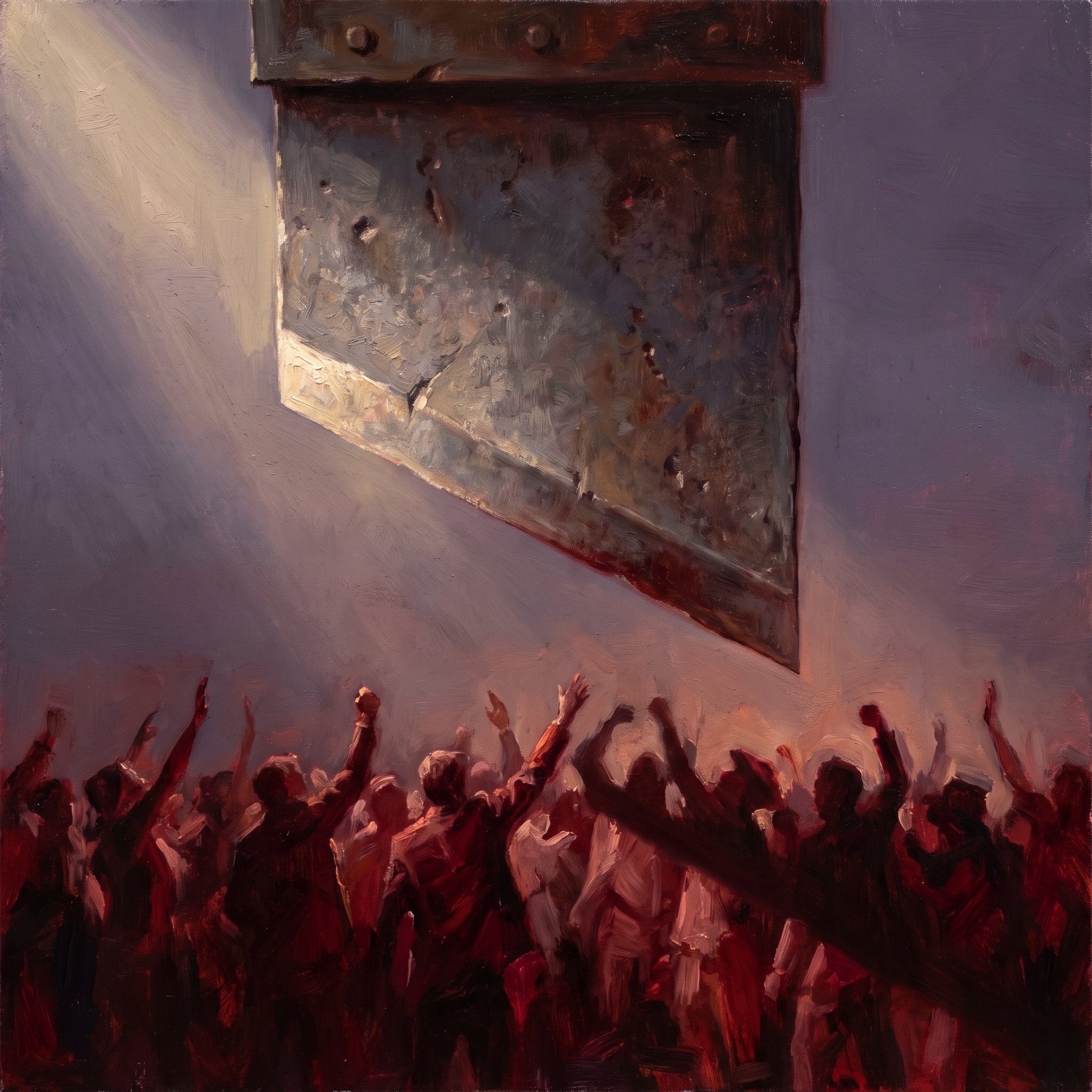
Michael C. Vincent: France has always told itself this story — that the street belongs to the people, that protest isn't just permitted, it's sacred, it's baked into the national character all the way back to 1789.
Michael C. Vincent: And that story just collided hard with October 2026.
Michael C. Vincent: Left marks.
Michael C. Vincent: October 17th — hundreds of thousands marched across the country, living costs, failing schools, real grievances — and then the Limoges town hall gets set on fire, shops get looted, and by the weekend of the 18th and 19th it had become something authorities were struggling to even name without flinching.
Michael C. Vincent: More than nine hundred police officers injured since this began.
Michael C. Vincent: Town halls burning. Hundreds of businesses looted.
Michael C. Vincent: Interior Minister Laurent Nunez stood up and said — and this is the part worth actually pausing on — that police had lost control in several cities.
Michael C. Vincent: Not managed. Not contained. Lost.
Michael C. Vincent: Prime Minister Sébastien Lecornu responded on October 19th, calling for partial curfews — Marseille authorities had already gone further, banning all public gatherings until 8pm.
Michael C. Vincent: President Emmanuel Macron condemned the violence and pointed at far-left activists as the architects of the chaos.
Michael C. Vincent: The Yellow Vests — the Gilets Jaunes, the same movement born in 2018 out of fuel taxes and inequality — had come back, calling for demonstrations on October 18th, joining the student-led unrest that'd been building for weeks, the weeks in which Greta Thunberg had shown up at a high school in Saint-Denis on October 13th to stand with students who'd been blockading their lycées.
Michael C. Vincent: The Associated Press ran a piece on October 21st placing all of this inside France's revolutionary long memory — 1789, the Bastille, forward from there.
Michael C. Vincent: That lens matters here.
Michael C. Vincent: Because the French tradition says protest IS the civic mechanism — the people hold the state accountable from the street, not just the ballot — and yet the Interior Minister just told you the state can no longer account for the street.
Michael C. Vincent: And here is where the trap closes.
Michael C. Vincent: Because France's political tradition — the one born in 1789, the one that stormed the Bastille and rewrote the social contract — it doesn't treat the street as a place where disorder happens. It treats the street as the mechanism. The actual civic mechanism through which the people hold power accountable.
Michael C. Vincent: Julian Bourg — history professor at Boston College — puts it plainly: the French state is directly accountable to the people, not in the diffuse Anglo-American sense where the state is some external threat to individual liberty, but in the immediate, embodied sense that the people in the street ARE the sovereign.
Michael C. Vincent: La Marseillaise makes this explicit. Written in 1792, it isn't a hymn to the nation in the abstract — it's a call to arms against tyranny. Collective resistance, framed as civic duty. That's the anthem. That's what they sing at state occasions.
Michael C. Vincent: So when Laurent Nunez stands up and says the police have LOST control — that phrase carries a particular weight here that it just … wouldn't carry in, say, London or Washington.
Michael C. Vincent: It doesn't just mean disorder. It means the state has lost its footing on terrain it was never supposed to simply own.
Michael C. Vincent: Charles Tilly gave us useful scaffolding for how this works over time. He drew a distinction between what he called reactive mobilization — food riots, anti-tax violence, communities pushing back against a state intrusion — and proactive mobilization, which is unions, strikes, demonstrations that go on offense, that try to claim a seat at the table of national institutions. The shift in France, he traced it to the mid-nineteenth century. The Commune, 1871. May 1968. These aren't reactive outbursts. They're organized claims on power.
Michael C. Vincent: And the pattern that follows — every time — is the same. Mobilization escalates to crisis. The state represses. And then, more often than not, there are concessions. Sometimes a regime changes entirely.
Michael C. Vincent: 1830. 1848. 1871. 1968. The cycle runs.
Michael C. Vincent: Michel Fize, French sociologist, looked at what was happening this week and didn't see a mob. He described the coalition as broadly inclusive — ordinary people, students, workers — and reached for a phrase with real historical mass behind it. He called it 'The People.' Capital T, capital P. That's not accidental language. That's a specific invocation.
Michael C. Vincent: Now — and here is the honest tension — Macron is also not wrong that some of what happened this week looks like organized provocation. Burning town halls. Targeted looting. He blamed far-left activists, said they were deliberately trying to foment chaos. Critics shot back immediately: those actors are a minority, and blaming them erases the legitimate grievance underneath.
Michael C. Vincent: Both things can be true. And both things are unresolved.
Michael C. Vincent: But here's what Macron cannot do — what no French president can do without sawing off the branch he's sitting on. He cannot simply call this a law-and-order problem and suppress it. Because the tradition that legitimizes his own authority is the SAME tradition that says the street has standing. You cannot invoke 1789 as the founding of the Republic and then tell the people the street is off-limits.
Michael C. Vincent: That's the trap. And October 2026 just slammed it shut.
Michael C. Vincent: Now here is the part that is still open — and I mean genuinely, uncomfortably open.
Michael C. Vincent: Lecornu's partial curfews, Marseille's ban on all public gatherings until 8pm — those are the named decisions still sitting in the air. Do they hold? Because if the history tells us anything — and Tilly, George Rudé, both of them spent careers mapping exactly this — the answer is: repression can dissolve a movement, or it can forge one. Forge it into something harder and more coherent than what walked in.
Michael C. Vincent: That is the specific thing to watch.
Michael C. Vincent: But — and this is where I have to be honest about what I'm not sure of — the cycle-of-concession model, the one that runs 1830, 1848, 1871, 1968, the model that says uprising leads to repression leads to the state eventually giving ground … that model assumes something. It assumes there's a coherent demand at the center. One thing the state can actually negotiate with.
Michael C. Vincent: And right now I'm not sure that exists.
Michael C. Vincent: The Yellow Vest movement called for a second day of demonstrations on October 18th — but whether they are DRIVING this or simply arriving at it is genuinely unresolved. The lycée students blockading their schools, the cost-of-living marchers who filled the streets on October 17th, and then the actors who burned the Limoges town hall — those are not one movement. They're three overlapping grievances with no unified leadership. That is a harder problem than 1968. In 1968 there was at least a shared left political grammar.
Michael C. Vincent: And it isn't only France. María Silvestre, professor of sociology at the University of Deusto in Spain, put her finger on something when she talked about young Europeans' sense of uncertainty — housing protests in tent camps across Spain and Portugal, crowds in Italy and Albania, arrests, injuries. The same vertigo, different addresses.
Michael C. Vincent: Which means Macron isn't managing a French story anymore. He's managing a French chapter of something wider.
Michael C. Vincent: So when you sit with the question of whether these curfews hold — whether the street hardens or fragments — the honest answer is that the romantic framing and the brutal numbers are both true at once. Nine hundred police injured. Town halls burned. Businesses looted. And also: a tradition, a long civic memory, that says this is exactly what legitimate pressure looks like. I don't know how you resolve that. And I'm not sure October 2026 is done showing us which way it falls.
Michael C. Vincent: And that is the thing Nunez's admission keeps circling back to, the thing I can't quite set down. When the Interior Minister of France stands at a podium and says the police have lost control — he isn't just describing a crowd-management failure. He is describing a rupture in the story. The story France has told itself since 1789, the one encoded in La Marseillaise, the one that says the street and the state are not enemies but two expressions of the same sovereign will.
Michael C. Vincent: You cannot reform that story without rewriting what France IS. That's not rhetoric — that's the actual structural problem sitting on Lecornu's desk right now. You can issue curfews. Marseille already did. You can call the far-left provocateurs the architects of chaos, the way Macron did, and you're probably not entirely wrong. But the tradition that licenses the protest is the SAME tradition that licenses the republic. Pull one thread and you're pulling both.
Michael C. Vincent: The honest question — the one October 2026 leaves open — is what holds when the founding myth becomes genuinely indistinguishable from the mob. And I don't think France has an answer to that. I'm not sure it ever did.