Hugo Vance: You looked tired when you walked in — good week or bad week?
Lila Soto: Oh, mixed — but I read something Tuesday that genuinely bothered me in the best way, so I've been in a weird mood since.
Lila Soto: Just — the Kanem-Bornu Empire. Around Lake Chad. No famous gold routes, not the glamour of Mali or the Songhai golden age under Askia the Great, and yet it held power for something like a thousand years by controlling trans-Saharan routes toward Tripoli and Egypt. A thousand years, Hugo. That's not a dynasty, that's a geological feature.
Hugo Vance: Indeed. And that longevity is what today is really about — we're getting into how geography, specifically sitting at the right node on a trade route, translated into political power for empires across the medieval world. Timbuktu, Samarkand, the whole Silk Road corridor.
Lila Soto: Timbuktu — which, I mean, we use that name like it means 'impossibly far away,' and it was actually one of the wealthiest and most intellectually influential cities in the medieval world. Not farmland, not mines. Trans-Saharan trade revenue, full stop.
Hugo Vance: Full stop. Now, the question I'd put to us — and I don't think the sources settle it — is whether the route itself generated that power, or whether you needed institutional capacity first. The ability to enforce a contract, run a caravanserai, project military protection. Because the Silk Road didn't become a regularized corridor until the Han dynasty followed Zhang Qian's missions around 114 BCE with actual state machinery.
Lila Soto: So the route was already there, merchants were already moving, and the state kind of... reached in and made it legible?
Hugo Vance: Yes — legible is exactly the word. And that's what clicks it for me. Think of it like a toll bridge on the only road between two towns. The ruler doesn't need to own either town. Doesn't need the farms, doesn't need the mines. Just the bridge. Ghana, Mali, Songhai — none of them extracted gold directly. They taxed it crossing their territory. Gold from the south, salt from the Sahara moving north. That structural dependency, the gold-salt complementarity, meant merchants couldn't route around. The goods were only valuable because they were scarce on the other side.
Lila Soto: But what stops a merchant from just... going around the bridge?
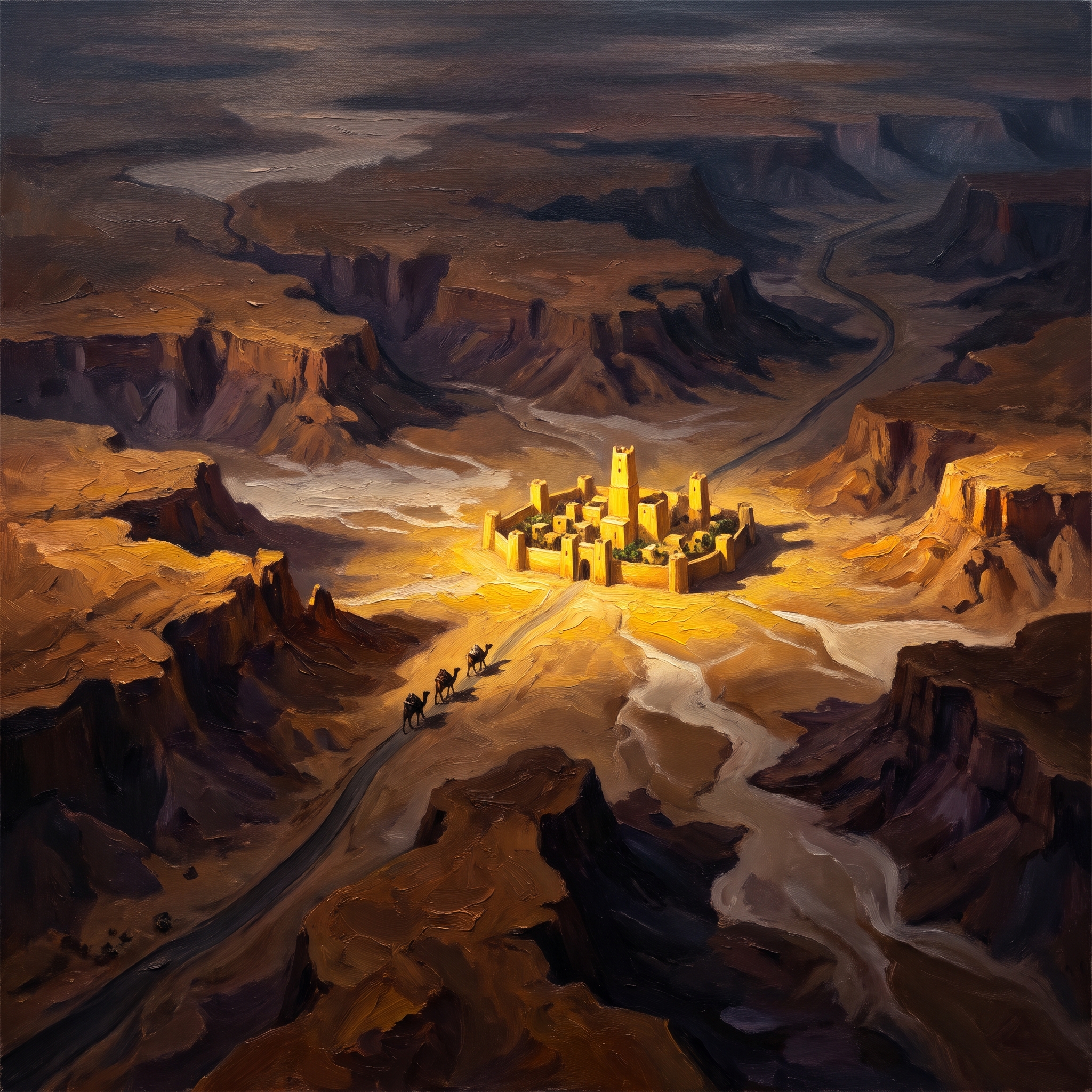
Hugo Vance: Geography, mostly. These weren't arbitrary checkpoints — they were oasis towns. The only place with water for three days in any direction. You can't go around Kawar in the Sahara, any more than you could go around a mountain pass. And caravanserais compounded that — the state or wealthy merchants built rest stations at exactly those nodes, supplied animals, extended credit. Which meant the same infrastructure that sheltered you also tracked you. Licensed you, really.
Lila Soto: Oh — so the caravanserai is both a service and a checkpoint.
Hugo Vance: Precisely. And the revenue from that taxation — gold, salt, ivory, enslaved people crossing those nodes — it funded armies, which then protected the routes from raiders. Which meant merchants kept coming. Which meant more revenue. That loop, once it starts turning, is genuinely self-reinforcing. The taxation funds the protection that justifies the taxation.
Lila Soto: I mean — that's almost a protection racket, except the protection is real.
Hugo Vance: It is real, yes. And that's what separates it from extortion — merchants in Timbuktu were receiving something: security, standardized weights, courts that could enforce contracts. The question I'd push on is whether a caravan master arriving at Samarkand around 800 CE felt he was paying a tax or buying a service. I suspect he felt both, and I suspect that ambiguity was deliberate.
Lila Soto: And when that protection disappears — when, say, Moroccan Saadi forces break Songhai in the sixteenth century and suddenly no one's enforcing those routes — does the commerce just stop?
Hugo Vance: It fragments. Routes don't vanish overnight — merchants are pragmatic. But confidence collapses. The loop runs in reverse: lost revenue means fewer soldiers, which means less protection, which means merchants divert, which means still less revenue. What took generations to build can unwind surprisingly fast once the cycle inverts.
Lila Soto: But the loop running in reverse — that's almost scarier than the original collapse. Because it means the city with no gold, no farmland, no real population base, like Timbuktu, is the most fragile thing imaginable if something breaks the cycle.
Hugo Vance: And yet Timbuktu held. For centuries. Which is — well, that's the counterintuitive part. Because what Askia the Great understood, and I think this is the move that gets underappreciated, is that Islam wasn't just the state religion. It was the operating system. Islamic commercial law meant a merchant arriving from Cairo and a merchant arriving from Marrakesh could sign the same contract, enforceable by the same courts. You didn't need shared ethnicity or language. You needed a shared legal framework.
Lila Soto: Oh — Islam as infrastructure. Not metaphor, literally infrastructure.
Hugo Vance: Documented infrastructure. Ibn Battuta travels through Mali around 1352 and what he's describing, almost without meaning to, is how Islamic networks made cities like Timbuktu internationally legible. A stranger could arrive, find a madrasa funded by customs fees, attend a lecture, sign a contract under law he already knew. The city became its own advertisement.
Lila Soto: Picture a caravan master — say he reaches Timbuktu in 1400. He pays the customs fee at the gate. He deposits goods in a licensed warehouse. And then, I mean, the same revenue that just left his hands is funding the scholar he's going to hear that evening at the madrasa.
Hugo Vance: Yes. And he signs his next contract under Islamic commercial law before he leaves. The fee, the scholar, the contract — one stop. That's why merchants didn't flee Timbuktu for somewhere cheaper. The bundle was worth the tax.
Lila Soto: Which brings me back to Kanem-Bornu, because — no gold. None of that famous gold-salt complementarity. Just routes toward Tripoli and Egypt, taxing salt and horses and enslaved people. And it lasted a thousand years. How does that not break the whole argument about gold being necessary?
Hugo Vance: It does break it. That's the point. Kanem's expansion toward the northern oases of Kawar in the eleventh century — that wasn't about gold. It was about owning the corridor. Route position alone, if the institutional layer is solid enough, is sufficient. Gold was one kind of leverage. Geography was another. Kanem-Bornu proved they're not the same thing.
Lila Soto: And we haven't even touched what happens when that position gets taken away — the Moroccan Saadi forces, the Songhai collapse, whether the empire was already weakening when conquest arrived or whether conquest made it weak. That causality question is going to matter.
Hugo Vance: That causality question is — well, it's the one the sources refuse to settle cleanly. And I think that refusal is itself the finding. Because what we know about Songhai is this: the Moroccan Saadi forces that broke it in the sixteenth century were explicitly targeting gold-trade revenue. That's not incidental. That's the stated goal. Which means the attackers understood the loop better than historians have sometimes credited.
Lila Soto: So they weren't just conquering territory — they were conquering the mechanism.
Hugo Vance: Exactly the mechanism. The genuinely unresolved question is whether Songhai's succession fractures came before the Saadi invasion made it viable, or did the invasion cause the fractures? Both sequences are documented. That suggests, to me anyway, something more like a feedback collapse. Not one cause. The route loss accelerates the political fragmentation, the fragmentation makes the route harder to defend, and so on downward.
Lila Soto: Which means the empire that Askia built — that whole consolidated, Islam-as-infrastructure system — it wasn't just weakened. It was specifically legible to an attacker who understood what made it run.
Hugo Vance: And that's the brittleness no territorial map shows you. Mai Idris Alooma expands Kanem-Bornu to its greatest reach — Hausaland, Ahir, Tuareg peoples — and yet the empire's survival still hung entirely on whether the corridors toward Tripoli and Egypt stayed open. All that territory, and the revenue base was essentially a thread.
Lila Soto: Oh — a thousand years, and it's still just one thread.
Hugo Vance: One thread. Which is — I mean, think of a Kanem-Bornu customs official in, say, the fourteenth century, sitting at a waystation north of Lake Chad, watching a salt caravan come through. He doesn't know his empire will outlast Songhai. He just knows that if that caravan stops coming, he has no soldiers next season. The fragility was baked in from Kanem's very first push to control Kawar back in the eleventh century. Route control as survival strategy always contained route loss as existential risk.
Lila Soto: So the same logic that makes you powerful is the logic that can erase you. The loop doesn't care which direction it runs.
Hugo Vance: And the loop doesn't care about the empire's name. That's what strikes me about the Silk Road — papermaking, compasses, gunpowder, all of it crossed the full corridor even when no single merchant made the whole journey. Ideas moved through the handoffs.
Lila Soto: Oh — so the network outlived every empire that taxed it.
Hugo Vance: Every single one. Songhai falls, the Silk Road corridor keeps carrying Buddhism, Islam, the technology. The institution — the caravanserai, the contract, the legal network — that's what actually transmitted civilization. Not the empire sitting on top.
Lila Soto: I think that's what I'll sit with. It was never about the geography. It was always about whether you could build the institutional layer fast enough to monetize it — and that question hasn't gone away.
Hugo Vance: Askia's question. Still the question.
Lila Soto: Good conversation. I mean that.