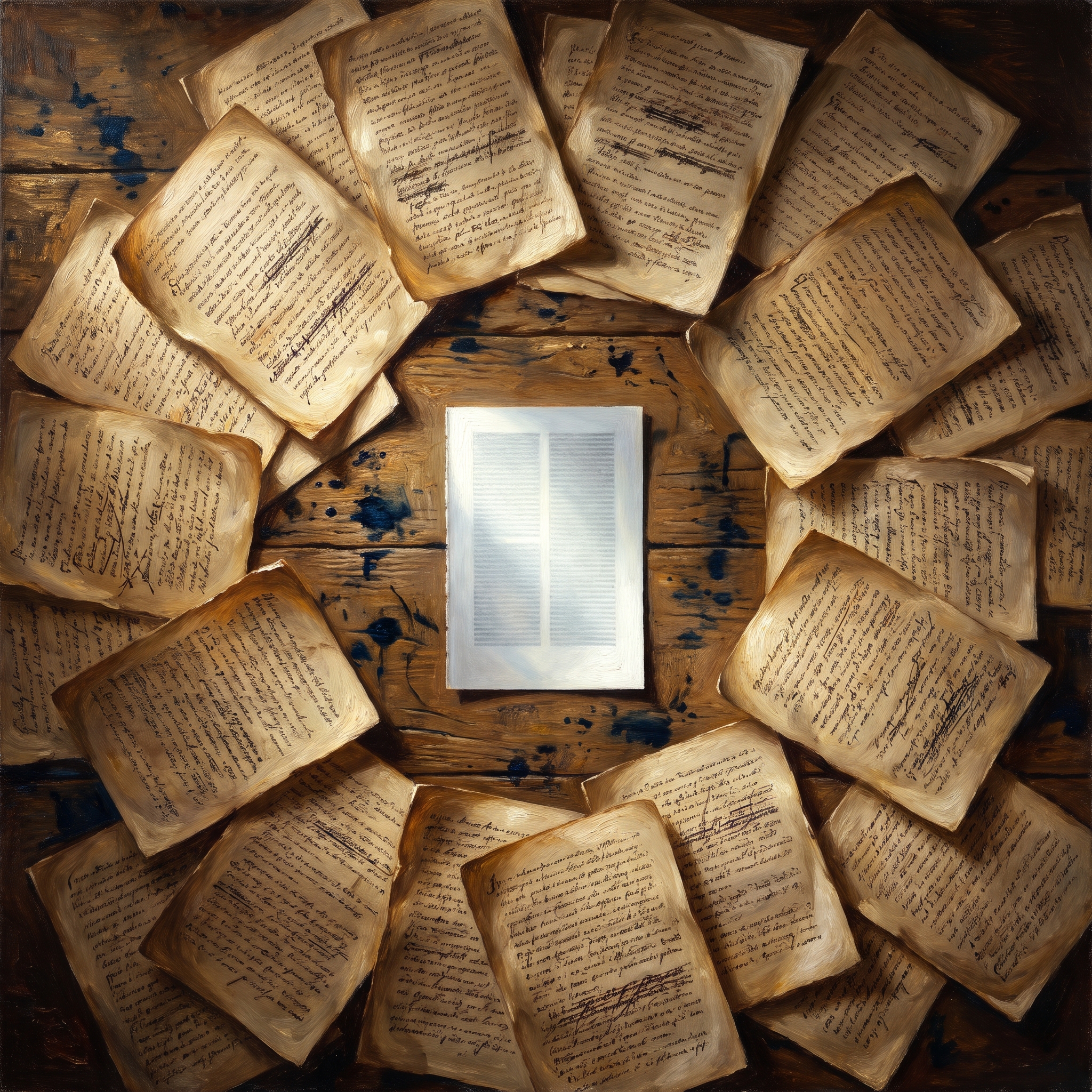
Hope Sterling: Juniper, hi, quick question before we start: have you ever copied a sentence a hundred times in a row and kept it perfect?
Juniper Vale: Honestly, no. By the tenth I'd have changed something without noticing.
Hope Sterling: Right?! And that's the whole thing. Monks did that for centuries, letter by letter, and no two manuscripts ended up identical.
Juniper Vale: So how do you even know which copy is the real one?
Hope Sterling: You don't! That's the hook. Monastic scriptoria preserved almost everything we have, but the monks were also quiet co-authors. Like, a margin note gets folded into the text and nobody notices.
Juniper Vale: And it isn't carelessness. A scribe misreads an abbreviation, or skips a line when two end alike. Those are variant readings, and the next scribe copies the mistake.
Hope Sterling: Telephone! Where each player thinks they're fixing the message. Does that mean nothing before print is trustworthy?
Juniper Vale: Not at all. Lorenzo Valla took down the Donation of Constantine with no press. He caught "satrap," a word that didn't belong, and Latin that kept switching tenses.
Hope Sterling: Wait, that's a receipt-check, I'm obsessed.
Juniper Vale: So picture everyone holding the very same page. What changes?
Hope Sterling: Okay, so everyone holding the same page, that's like, the whole game changer, right? Gutenberg, what, 1440? Movable metal type, and then it just... goes?
Juniper Vale: Around 1440, yes, in Mainz. Then by the 1460s and 1470s presses are running in Cologne, Strasbourg, Rome, and Venice. City by city, in about thirty years.
Hope Sterling: Thirty years! That's like a viral trend, but with lead and ink.
Juniper Vale: And the historian Elizabeth Eisenstein, in The Printing Press as an Agent of Change, 1979, named what mattered. Typographical fixity. Many substantially identical copies, holding a text steady across time and distance. Think of it like this: page 212 says the same thing in Venice and in Basel.
Hope Sterling: Okay but wait, why does that matter? Like, beyond books being cheaper? I mean, a cheap copy is still just a copy, right? Is it literally just more people can afford one, or is it, I don't know, something else? Because that's what I'd be asking.
Juniper Vale: It's something else. Picture a scholar in Cologne with a printed book open, writing to a friend in Venice: see page 212, second paragraph.
Hope Sterling: And the friend opens his copy.
Juniper Vale: Finds the same passage, same spot. Then writes back, your reading is wrong, and here's why. With two manuscripts, you couldn't even start that argument. You'd be pointing at different pages, maybe different words.
Hope Sterling: Ohhh. So the identical page isn't the proof. It's like, the shared table you argue on?
Juniper Vale: That's it. Pagination and indexes make a text citable by location. And then reliable evidence becomes what independent readers can check in identical copies. That's reproducibility as a standard, and I'd say it's a change in kind, not just more access.
Hope Sterling: Stop. So Erasmus and Froben in Basel, 1516, that Novum Instrumentum omne, people could actually check it page against page.
Juniper Vale: Exactly that, and Aldus Manutius in Venice was doing it with Greek and Latin authors from 1494. Same pages, so people could finally catch mistakes together.
Hope Sterling: So that's why a grad student can text her advisor, "page 42, third paragraph," and they're literally looking at the same words. A hundred years before, that sentence meant go hunt down another manuscript and, like, hope.
Juniper Vale: And a printer like Aldus Manutius was building for that. What was he actually doing in Venice?
Hope Sterling: The Aldine Press, 1494. He's printing Greek and Latin authors, carefully edited, and small enough to carry. Portable! Like, a scholar could throw one in a bag and take it to a friend's house and say, look, line three.
Juniper Vale: Careful editing by whom, though? The printer alone?
Hope Sterling: Scholars in the shop! That's the partnership part. And that's textual criticism, philology, whatever you want to call it. You line up versions, spot where they split, and reconstruct the most authoritative text. With manuscripts, you'd have to travel to compare. With editions, they come to you.
Juniper Vale: So Erasmus and Johann Froben in 1516, that's the same move, aimed at the New Testament.
Hope Sterling: Yes! Basel, the Novum Instrumentum omne. Erasmus is the scholar, Froben has the press. And, oh my gosh, okay, my favorite bit. Erasmus had already published Valla's notes on the New Testament, in 1505.
Juniper Vale: Valla died in 1457.
Hope Sterling: Right?! Nearly fifty years dead, and his footnotes get a second life. Valla's method, meet the machine that distributes it.
Juniper Vale: Okay, that I did not know. And it's the same logic as the Cologne letter. Valla's notes were checkable because anyone could hold the same pages and test them.
Hope Sterling: But wait, if every copy is identical, doesn't that just, like, make a mistake permanent? Because that feels like the catch.
Juniper Vale: It can. And the part that comes next, about why a thousand identical copies still beat scattered unique manuscripts anyway, that's the crucial bit.
Hope Sterling: Because like, that's the part that bugs me. A thousand identical copies of a mistake isn't a fix. It's the same wrong sentence, but now it's everywhere, and it looks official.
Juniper Vale: It is the catch. Printers could reproduce a single error across an entire edition. Where a scribe's slip lived in one book, a printer's slip lived in the whole run. Error got concentrated.
Hope Sterling: Okay, the Wicked Bible! 1631. The printers left out the "not" in "Thou shalt not commit adultery." So the commandment just says, commit adultery. In print! And they got fined for it.
Juniper Vale: Fined, which tells you somebody could actually prove who made the mistake.
Hope Sterling: Ooh. Okay, but that's literally my group chat problem. Somebody posts a screenshot of a quote, wrong, but it has a nice font and a name under it, and like, ten people repost it. Identical copies feel trustworthy. That's the trap. Consistency is not truth.
Juniper Vale: So print didn't guarantee accuracy. I'd actually say it depended on people. Aldus, Erasmus, Froben. And here's my surprise. Erasmus's 1516 Novum Instrumentum omne was rushed.
Hope Sterling: Wait, rushed? The landmark one?
Juniper Vale: He later said it was more "precipitated than edited." It had plenty of typos. The founding critical edition of the print era was sloppy.
Hope Sterling: Okay, that's kind of hilarious? So why does anyone still care about it, if it's, like, full of typos?
Juniper Vale: Because others held the same pages. They spotted the mistakes, pointed to them, and corrected later editions. You can't do that with a scattered pile of one-off manuscripts. The typos were findable.
Hope Sterling: Ohh. So it's not that the page is right. It's that it's checkable. Verifiability, not correctness. So, a thousand identical copies with a typo, or a few manuscripts none of us can compare, which is better?
Juniper Vale: The thousand copies. I'll be honest, a flawed page you can check beats a perfect one you can't.
Hope Sterling: Okay, so I'll say what clicked for me. At the start I asked if you could copy a sentence a hundred times and keep it perfect, and I thought the answer was gonna be, the press can. Like, machine wins. But it's not that. The press made the page checkable, and then people had to, like, actually check it.
Juniper Vale: And that's why Eisenstein titled it the way she did. An agent of change. Not the agent. Popular retellings drop that, and it turns Gutenberg into a one-man revolution.
Hope Sterling: Oh, so the tidy before-and-after story is kind of wrong?
Juniper Vale: Quite a bit. Manuscripts didn't vanish. Look at Renaissance epigraphy, 1521 to 1603. Scholars copying inscriptions were using printed books and handwritten notebooks side by side, for generations.
Hope Sterling: Huh. So it's less a switch flipping and more, like, two group chats running at once, and everybody's got both open. Wait, and the distance thing, didn't that still bite?
Juniper Vale: It did. Van Groesen and Müller show printed news from far away was still distrusted. A crisp page from a distant city didn't settle anything. People needed ways to vouch for it.
Hope Sterling: Which is the screenshot problem again. Same font, same page, and you still ask, who sent this, and can I find it somewhere else? I think that's where I land. Print changed what counted as evidence, through fixity and citation, but editing and citing and verifying are what made anyone trust it.
Juniper Vale: I'd land there too. And with text that's copied and edited in a second now, the question hasn't changed. It's which habits we build around it, not which machine.
Hope Sterling: Funny. A hundred copies, and the part that mattered was still somebody saying, show me the page. Thanks for walking me through it, genuinely.