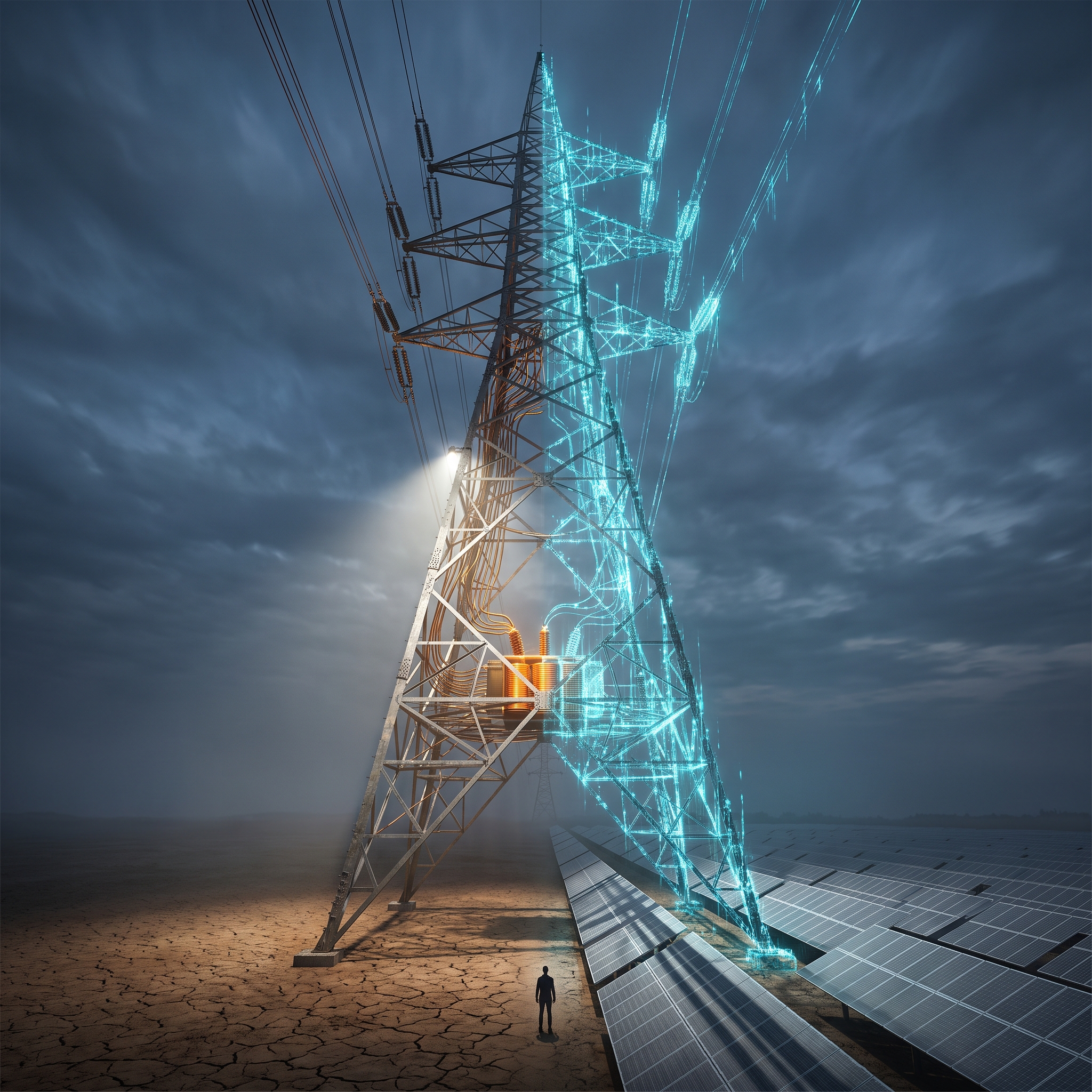
Marcus Vale: You look like you have a question you've been sitting on — what is it?
Cole Bryant: Okay, bro, so I have been staring at this one fact and I cannot figure out if it's ironic or just — wait, is ironic even the right word? Australia reaches roughly 50% renewables, and grid operators start reporting mounting stress. Not from too little generation. From variability they couldn't steer.
Marcus Vale: Right — and that's the tell. Stress from abundance, not shortage.
Cole Bryant: Which is wild, right? Like how do you — how does the grid buckle when there's actually more energy than ever coming in?
Marcus Vale: Because the grid was never designed to handle supply it couldn't control. Every coal plant, every gas turbine — those are dispatchable. Operators ramp them up or down, second by second, to match what consumers are drawing. Wind and solar don't answer to commands. Weather runs them.
Cole Bryant: Wait, so the design assumption — it's literally 'supply follows demand' — and renewables just break that at the source?
Marcus Vale: Intermittency is the word. Non-dispatchable generation. And that's not new information — engineers knew this. The pace of deployment just outran the grid's ability to adapt.
Cole Bryant: So what we're actually trying to work out today is — like, what does it take to rebuild the grid around a fundamentally different relationship between supply and demand? Because that's not a small patch. That's a redesign.
Marcus Vale: Physical, market rules, regulatory framework — all three, simultaneously. Adding more renewable capacity without the rest of it doesn't solve anything. Australia is exhibit A.
Cole Bryant: Okay — let's get into it.
Marcus Vale: Think of it like a water tap. Legacy grid — you turn the tap up or down exactly as much as people are drinking. Coal plant, gas turbine, nuclear — dispatchable, all of them. Operators ran them like dials. Renewables are rain. You get what the weather gives you.
Cole Bryant: Rain. Okay. That's — yeah, that lands.
Marcus Vale: And the grid was literally engineered — for a hundred years — on the assumption that the tap model was permanent. So every piece of economic infrastructure embedded in it? Peaker plants, for instance — fast-starting gas turbines held in reserve just for demand spikes — those exist because someone had to be the emergency dial. That's the whole job.
Cole Bryant: Wait, so the peaker plant is basically — it's a backup tap? You keep it warm specifically because you might need to crank it in twenty minutes?
Marcus Vale: Within minutes, yeah. That speed is the product. You're paying for dispatchability, not cheap electrons.
Cole Bryant: Okay, so — and this is what I want to understand — when you start pulling those spinning turbines off the system and replacing them with solar panels and wind inverters, what actually breaks first? Like what's the physical thing that goes wrong?
Marcus Vale: Synchronous inertia. That's what breaks. Every spinning turbine-generator mass on the legacy grid is storing rotational kinetic energy. Physically spinning. And when frequency spikes or drops — someone plugs in a data center, a plant trips offline — that spinning mass resists the change. Buys the operator seconds to respond. Solar inverters, wind inverters — power electronics. No spinning mass. No inertia. The grid loses its shock absorber.
Cole Bryant: So it's not just that renewables are unpredictable — it's that they actively remove the thing that was stabilizing the system the whole time?
Marcus Vale: Exactly that. And it doesn't show up as a problem until penetration gets high enough. Which is why California Independent System Operator — CAISO — is the proof point everyone uses. The duck curve isn't just a fun graph. It's the grid's legacy architecture visibly straining. Midday, solar floods in — more generation than demand. Late afternoon, solar drops off a cliff. CAISO has to ramp gas capacity thousands of megawatts in a two-hour window. That's the tap trying to compensate for the rain.
Cole Bryant: Two-hour ramp window — bro, that's — I mean, that's not a simulation. There is a person at CAISO watching that curve tip and trying to — wait, actually, what are they even doing in that moment? What's the move?
Marcus Vale: They're calling on whatever dispatchable capacity is still on the system. Gas peakers, some hydro if there's water. And when those aren't enough? They've had to curtail solar — literally turn off clean energy — because the grid can't absorb it without destabilizing frequency. CAISO has documented recurring over-generation events where that's the only option.
Cole Bryant: You're curtailing clean energy because the grid isn't built to catch it. That is a design problem, not a supply problem.
Marcus Vale: That's the plain-language version, yeah. The grid was built assuming the tap. It has no architecture for catching rain.
Cole Bryant: But that's — wait, that's the part I keep tripping on, because curtailing clean energy is like the dumb solution, right? So you go, okay, overbuild. Just install enough solar and wind that even at 20-35% capacity factor you've got headroom. And that actually works, until — I mean, it works until it doesn't?
Marcus Vale: It works below roughly 30% penetration. Above that, overbuilding creates its own spiral. More excess at midday, bigger curtailment problem, and you've just spent capital on capacity that's legally required to be wasted.
Cole Bryant: Wasted at scale.
Marcus Vale: Right — so the second answer is Battery Energy Storage Systems. BESS. Absorb the surplus, discharge during the deficit. Decouples when the generation happens from when consumption happens. Sounds clean.
Cole Bryant: Okay but picture this — it's a July Tuesday, like 7 PM. A grid operator at NYISO is watching solar generation cliff-dive as the sun drops, and demand is still pinned high because everyone's running AC. BESS should be the answer. So why isn't the operator just — dispatching storage and going home?
Marcus Vale: Because NYISO has explicitly flagged dispatchability and fast-ramping flexibility as core reliability attributes — and the market rules don't have a clean mechanism to price what a battery actually provides in that moment. The battery has an opportunity cost. If it discharges now, it can't discharge at 9 PM when the second peak hits. How do you price that in a real-time market that was designed around fuel costs?
Cole Bryant: Wait — so the market literally can't pay the battery the right amount because the pricing model doesn't account for the battery saving itself for later?
Marcus Vale: That's the dispatch-pricing problem. And frankly — that's a thread we're going to pull harder in a minute, because BESS looks like the clean answer until you ask who actually gets paid and how. The market design isn't just incomplete, it's actively hostile to the correct behavior.
Cole Bryant: Okay, hold that — because the third path is demand-side management, and I actually — no, wait, I want to name what DSM is doing, because it's the one that messes with my head the most. It's flipping the original assumption entirely. Instead of supply following demand, you're moving demand to follow supply.
Marcus Vale: And it works. Commercial and industrial loads can flex — a factory can shift a shift. But residential loads basically don't move. So above 30% penetration, DSM hits a ceiling that's not technical. It's political.
Cole Bryant: Because you're deciding whose lights stay on at 7 PM and whose get — I mean, managed is a polite word for that.
Marcus Vale: Every demand-response program historically has hit an adoption ceiling exactly there. You're either building a two-tier reliability system or you're pricing it in a way that becomes a political nonstarter. Neither gets you past the 30% wall cleanly.
Cole Bryant: So overbuild, BESS, DSM — bro, all three of them actually work at low penetration and then each one breaks differently above 30%? That's — I mean, that's not an engineering failure. That's three separate regulatory and political failures dressed up as engineering problems.
Marcus Vale: That's exactly the diagnosis. The physics has answers. The permission layer doesn't.
Cole Bryant: Okay but that 'permission layer' framing — I want to actually stress-test it, because you said the market is actively hostile. That's a strong word. Like, name me one battery storage company that's built a durable, repeatable margin on arbitrage under existing rules. Can you even?
Marcus Vale: Stem. Fluence. Form Energy. None of them. Not one has cracked it at scale under current market rules. They're all selling a story about what the business looks like after regulatory reform. That's not a business. That's a bet on a future rulebook.
Cole Bryant: Wait — Stem and Fluence are both publicly traded companies and neither one has a working margin on this?
Marcus Vale: Not on arbitrage and grid services under existing market structures. And the reason is exactly what ISO-NE research has been trying to solve — they've built chance-constrained dispatch models, social-welfare-maximizing frameworks, specifically because the conventional generator dispatch framework cannot correctly price what a battery does. The opportunity cost problem, the dynamic energy constraints — none of that exists in the legacy pricing rules.
Cole Bryant: So — wait, I want to make sure I have this right — social welfare maximization, like the actual academic objective, requires pricing the battery's opportunity cost. Which the market doesn't do. So the model works on paper and the business bleeds in practice.
Marcus Vale: And it gets worse. A battery operator who can time charge and discharge cycles — that's a market-power vulnerability regulators haven't resolved. A battery can game the spread in ways a coal plant physically cannot. So regulators are also scared of the thing working too well.
Cole Bryant: Bro, that's — the solution is also a threat? The regulator is simultaneously annoyed it doesn't work and afraid of what happens if it does?
Marcus Vale: That's the actual trap. And so the alternative — the geographic substitute for storage — is interregional transmission. Move power across regions, smooth the variability spatially instead of temporally. Technically works. Deployment has been glacial. Not because of physics. Because of cost-allocation fights and FERC jurisdiction and state-level siting battles.
Cole Bryant: Which is why Congress had to step in with mandates. And there's that 68% figure. Policy-driven expansion produces 68% more interregional transmission than least-cost optimization. What does that gap actually mean?
Marcus Vale: It means least-cost concentrates builds where low-cost generation potential is highest — so you get a few fat corridors. Policy-driven spreads capacity across all regions, which looks inefficient on a spreadsheet but distributes reliability and, frankly, political buy-in. Those two outcomes are not reconcilable at the technical level. The choice between them is political.
Cole Bryant: So there's no technically correct answer. Someone has to decide — efficiency or equity — and that's a values call, not an engineering call.
Marcus Vale: Right — but the part that doesn't fit is that we keep funding engineering research as if cracking the dispatch model unlocks the business. It doesn't. BESS has a working technical model in ISO-NE simulations right now. The business still doesn't exist. The gap is the market design, and the market design is downstream of political decisions that haven't been made.
Cole Bryant: So the actual investment thesis for whoever cracks this — it's not 'build better batteries.' It's 'survive long enough for the regulatory world to catch up to the physics.'
Marcus Vale: Ten-year play, minimum. And most of the capital chasing storage right now is priced like it's three years out. That mismatch — that's where the risk actually lives.
Cole Bryant: Ten years. And the deployment is already happening now. That's — I mean, that's the thing that actually settled for me in this whole conversation. It's not that the physics is unsolved or that the engineering failed. It's that three completely different clocks are running at different speeds and nobody's syncing them.
Marcus Vale: Physical redesign — years to a decade. Market redesign — regulatory proceedings, so a decade or more. Legislative authority shifts — longer than that. And renewable capacity is being bolted on right now. The gap between what's being built and what's governing it is already real. Nigeria's hitting 2030 electricity targets, Kalimantan's trying to cut imported fossil fuel dependency, Saudi Arabia's running the economics on transitioning off fossil generation — same structural mismatch, different geography.
Cole Bryant: Wait — Nigeria and Kalimantan are running into the same wall?
Marcus Vale: Same wall. Because the problem isn't grid maturity. It's that you can't just add generation capacity and call it integration. The permission layer — market rules, regulatory authority — that's the binding constraint everywhere.
Cole Bryant: So — and this is where I actually landed — when someone says 'just build more solar,' that's the beginning of like five harder questions. Not the answer. And I think that's the one thing I'd actually hand someone walking away from this.
Marcus Vale: Generation was never the bottleneck. Never was.
Cole Bryant: Good conversation, bro. Genuinely.