Hope Sterling: Michael, hey — okay I need to just launch right in because I have been thinking about this all week and I feel slightly betrayed by my entire education.
Michael C. Vincent: Betrayed. That's a word. Hand me the thing that did it.
Hope Sterling: Wait, no, I'm not going to editorialize, I'm just going to say it: the Renaissance, the thing we all wrote essays about, the whole Italian city-states, the birth of modernity, Leonardo — that entire period was basically invented in 1860. By one guy. A Swiss historian named Jacob Burckhardt.
Michael C. Vincent: 1860.
Hope Sterling: 1860! Like, he published this book — 'The Civilization of the Renaissance in Italy' — and that's the moment it becomes a coherent, nameable thing. Before that it's just... events. And I got an A on my Renaissance essay in tenth grade, and that A was graded against a framework that a single historian assembled two hundred years after the fact. I just can't move past it.
Michael C. Vincent: Well, now isn't that something. And here is where the story turns — because Burckhardt wasn't lying. He wasn't making something up out of nothing. He was making an *argument*. He looked at the record and said: this cluster of things — the Italian city-states, the emphasis on the individual, this particular relationship to antiquity — these belong together. That choice, that bundling act, is what periodization actually *is*.
Hope Sterling: But wait — like, is there a difference between making an argument and just... deciding? Because to a tenth grader, nobody said 'argument.' The chapter was called 'The Renaissance.' Full stop.
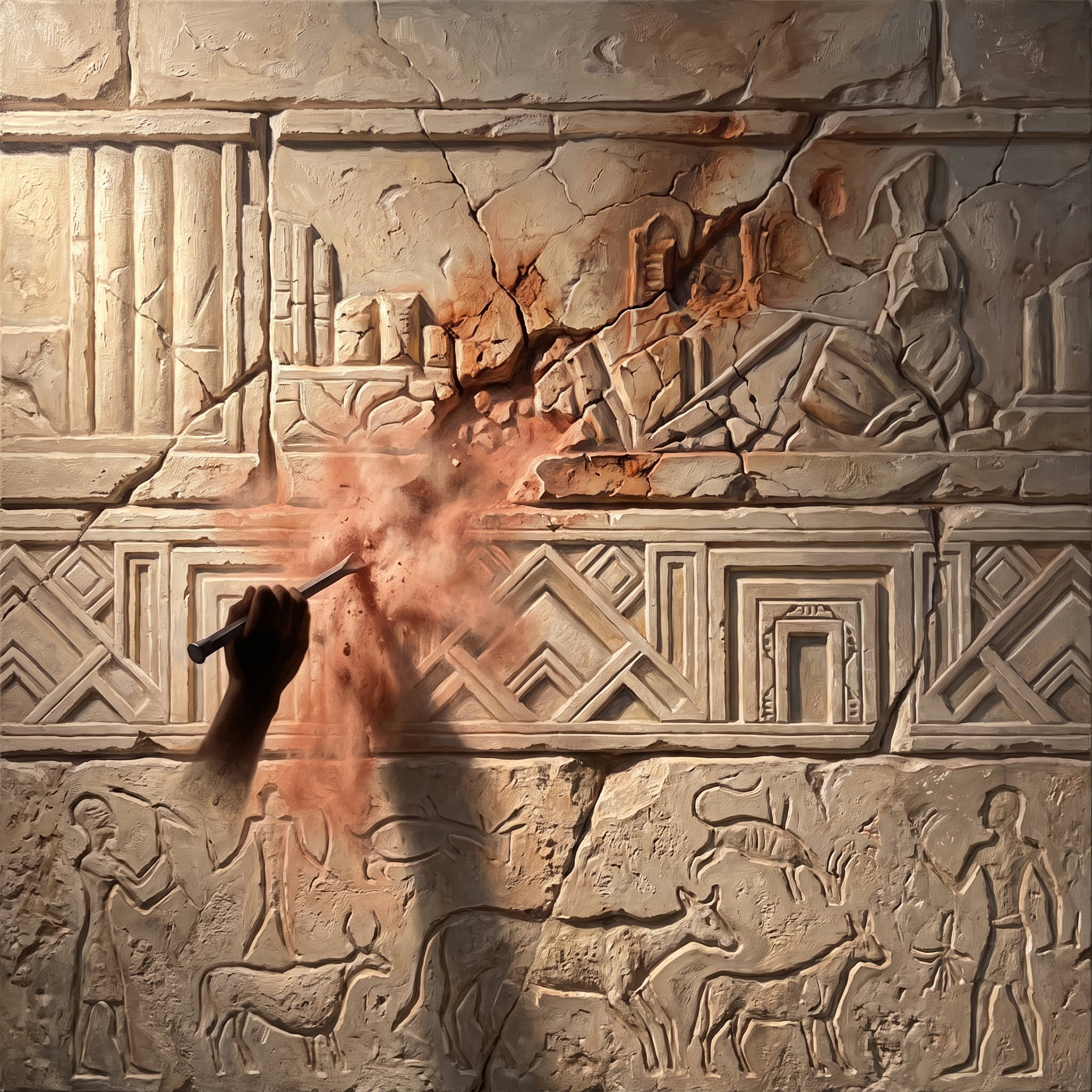
Michael C. Vincent: That is exactly the thing. George Orwell — and this image has stayed with me — described learning history as a child as seeing thick black lines ruled across a scroll. Hard divisions. Before and after. The lines feel permanent, geographical almost. But someone drew them.
Hope Sterling: Oh that's — yeah, that's exactly what it felt like, thick black lines, like it was *geography*.
Michael C. Vincent: You see, that's periodization doing its work invisibly. The plain word for it: historians divide the past into named, bounded blocks — 'Renaissance,' 'Industrial Revolution,' 'Cold War' — to make analysis possible. Those blocks are not facts they found. They are arguments they made about which changes were transformative enough to mark a seam in time.
Hope Sterling: So like — okay, it's less like finding a chapter break that was already there, and more like a writer deciding where to put one.
Michael C. Vincent: That's the heart of it.
Hope Sterling: But — wait, like, a writer choosing a chapter break is still kind of a neutral metaphor, right? Because a writer is just organizing. What I'm not getting is how that choice actually *argues* something. Like what does the chapter break *say*?
Michael C. Vincent: Now, that's exactly the lever. There's a philosopher of history — W. H. Walsh — who gave this a name. He called them colligatory concepts. Period labels like 'the Renaissance' or 'the Industrial Revolution' that pull masses of disparate events into a single intelligible whole. Not because the whole was sitting there waiting. Because the label *makes* it one thing.
Hope Sterling: Okay — colligatory, like colligation — wait, so it's literally just... gluing things together with a word?
Michael C. Vincent: Essentially. Heuristic devices, Walsh called them. The value is analytical — they make the unmanageable continuity of events something a human mind can grip. Not a claim to have found a natural seam. A tool. But the moment you choose *which* tool, you are also choosing *what caused the change.*
Hope Sterling: Stop — so the start date is the argument?
Michael C. Vincent: The start date, the end date, the name — all of it. Say you date the Industrial Revolution to around 1760. That choice foregrounds coal, steam, the mechanized factory. You are saying *technology* drove the break. But if you push the boundary earlier, you start emphasizing capital accumulation, colonial extraction — suddenly it's a different story with different villains and different heroes.
Hope Sterling: Oh that's — I mean, that's kind of terrifying? Like the same decades, totally different meaning depending on where you draw the line.
Michael C. Vincent: A philosopher named Eugen Zeleňák actually examined this — colligatory concepts as a site of contest between two camps. Realists say the label tracks something genuinely there in the past, a real coherence. Constructivists say the label is an analytical fiction imposed by the historian, no independent existence outside the narrative.
Hope Sterling: Mmm — and which one is right? Like, is 1760 real or not?
Michael C. Vincent: I'd be careful about collapsing it that cleanly. My read — and I'll own that this is a position — is that the 1760 boundary is constructed, yes, but it is not arbitrary. Coal and steam really were being deployed in fundamentally new ways around then. The boundary *highlights* a genuine break. It doesn't discover one the way you discover a fossil. It foregrounds what was already shifting.
Hope Sterling: Okay but — so if it foregrounds something real, it also has to be hiding something, right? Like what gets pushed to the back?
Michael C. Vincent: That is exactly the question worth sitting with.
Hope Sterling: Right — but that's the part that keeps snagging me, like what gets hidden is maybe the whole point? Because with Burckhardt's Renaissance, the thing that got pushed back was — wait, actually, this is where I need to drag in William Caferro, because he didn't just move the dates around. He wrote 'Contesting the Renaissance' and basically said — hold on — did this thing even represent what Burckhardt said it did? Like, was there actually progress? Was there actually a clean break from the medieval past? He's not arguing over the boundary, he's arguing the whole construction was kind of... distorting.
Michael C. Vincent: That is the part worth pausing on. Caferro isn't moving the line. He's asking whether the line ever should have existed.
Hope Sterling: Stop — so it's not like, 'the Renaissance started in 1350 actually,' it's 'the Renaissance as a coherent story of progress and modernity and individualism — that might be Burckhardt's editorial, not the actual fourteenth century.'
Michael C. Vincent: Exactly so. Burckhardt built his 1860 argument around Italian city-states as the cradle of individualism, the birth of modernity. Caferro's challenge is that Renaissance humanists themselves were already selling that story — and Burckhardt crystallized their marketing as history.
Hope Sterling: Oh that's — okay that's genuinely unsettling. The period is basically citing itself as evidence.
Michael C. Vincent: Now carry that to the Cold War. Same mechanism, different stakes. Prasenjit Duara, writing in the Journal of Global History, examined this directly — and the question he poses is: is the Cold War even a coherent global period? Because if you foreground nuclear deterrence, you get one story. Soviet-American rivalry, the balance of terror, 1947 to 1991. Tidy.
Hope Sterling: Right — but the part that comes later in what we're getting into is going to make this so much worse, because these frameworks weren't built for the whole world to begin with — but that's— we'll get there.
Michael C. Vincent: We will. But stay with Duara for one moment — because if you shift the frame and foreground decolonization, Third World liberation movements, the Cold War becomes something unrecognizable from the first version. Different geography, different casualties, different causes. Same decades. Completely different war.
Hope Sterling: Wait — like, it's not even a disagreement about facts, it's a disagreement about which facts get to be the center?
Michael C. Vincent: That is the mechanism. The boundary choice is a theory of causation wearing a date.
Hope Sterling: Okay I — I need to sit with that phrasing for a second because that's — I mean, that's what I was fumbling toward with the Industrial Revolution dates too, like 1760, 1840, those aren't just when things started and stopped, they're someone's argument about whether steam engines matter more than, I don't know, the enclosure of land, or slave-trade capital—
Michael C. Vincent: Mm. And whoever wins that argument controls what the Industrial Revolution *was*. Technology story or empire story. The date is the opening sentence of an explanation.
Hope Sterling: So these aren't different framings of the same history. They're — actually competing theories, like the period label is the thesis statement disguised as a calendar entry.
Michael C. Vincent: History as active interpretation rather than passive chronicle. That's the thing Jacques Le Goff spent a whole book circling — whether we can even divide the past into periods without that division becoming an argument we're no longer announcing as one.
Hope Sterling: But wait — Le Goff is saying that even if it's unavoidable, we're still exporting it everywhere, right? Like that's the part that's breaking my brain right now — because 'Early Modern' isn't just a European category that stayed in Europe. It went everywhere. Asia, Africa — and historians are literally fighting about it right now, like not in 1860, not a settled thing, an active argument happening as we record this.
Michael C. Vincent: That is the cut that goes deepest. Standard Western frameworks — 'Early Modern,' 'Renaissance,' 'Industrial Revolution' — were built from European historical experience. Specifically. And then they traveled.
Hope Sterling: Traveled as — what, neutral tools?
Michael C. Vincent: As universal history. One culture's story wearing the costume of everyone's story. And when global history emerged as a serious discipline — late twentieth, early twenty-first century — that's the wall it ran into. You cannot apply 'Early Modern' to the Mughal Empire or the Qing Dynasty and have it mean what it means in Florence.
Hope Sterling: Stop — because 'Early Modern' is supposed to signal, like, the beginning of the modern world, which is itself a European idea about what modern means—
Michael C. Vincent: Precisely. Modernity as Europe defined it. Printing press, Protestant Reformation, the nation-state emerging. Now apply that checklist to fifteenth-century West Africa or the Ottoman court. The frame doesn't fit — and when you force it, you're not illuminating those histories, you're distorting them.
Hope Sterling: Okay and — wait, that means the distortion isn't a side effect, it's kind of baked in? Like the framework was never designed to hold those histories in the first place, so applying it universally isn't just imprecise, it's — I mean, it's actively wrong about what was happening outside Europe.
Michael C. Vincent: And that is exactly what Le Goff was wrestling with in 'Must We Divide History Into Periods?' — Columbia University Press published it, and the question he poses isn't rhetorical. Is periodization a necessary practice or an avoidable one? His answer: indispensable. But only if you hold it critically. Meaning: you use the tool, you name what the tool was built for, and you do not pretend it was built for everything.
Hope Sterling: Indispensable but critical — that's almost more unsettling than just saying it's wrong? Because it means we can't escape it.
Michael C. Vincent: You see, that's the hard fact this whole conversation has been circling. Stability in usage is not the same as settled truth. 'Early Modern' gets used constantly — syllabi, textbooks, journal titles — and that repetition starts to feel like consensus. But underneath it, historians of Asia and Africa are contesting the label's legitimacy right now.
Hope Sterling: So the question generalizes — like if 'Early Modern' doesn't hold outside Europe, how many other labels are just one region's chapter title standing in for the whole book?
Michael C. Vincent: That, it turns out, is the question global history is still trying to answer. And the not-yet-having-an-answer is itself the most honest thing about where historiography actually stands.
Hope Sterling: I keep thinking about this — like, we're in it right now. Some future historian is going to draw a line somewhere in the 2020s, or maybe the 2010s, and call it something, and everything we think we're living through is going to get collapsed into a label we literally cannot see yet.
Michael C. Vincent: And that label will be an argument. About what caused this. About which forces were primary.
Hope Sterling: Which means — wait, we're already inside a constructed frame and we can't see the walls. That's — I mean, that's Le Goff's whole point, right? Indispensable but critical. You can't opt out, you just have to know you're using a tool.
Michael C. Vincent: That is where he lands. Periodization isn't avoidable — it's how history becomes argument rather than chronicle. The mistake isn't using it. It's treating it as received wisdom. Forgetting the hand that drew the line.
Hope Sterling: Forgetting the hand. Yeah. I think that's — honestly, that's where I landed today too. Not that the categories are fake, just that they're never neutral. And knowing that feels kind of important.
Michael C. Vincent: Exactly so.
Hope Sterling: This was a lot. A good a lot.
Michael C. Vincent: The good kind of unsettled, I'd call it.