Felix Ortiz: Tess, hey — good week, bad week, chaotic week?
Tess Hollis: Chaotic, yeah — I've been staring at AI capex numbers all week and honestly I feel a little unhinged.
Felix Ortiz: Okay perfect, because I have a number for you. React to this: Kimi K3 shut down new subscriptions in forty-eight hours. Not because it flopped — because they ran out of GPUs.
Tess Hollis: Wait — forty-eight hours?
Felix Ortiz: Forty-eight hours. Moonshot's Kimi K3, demand just — vaporized their supply. And Jensen Huang looked at that and basically said yeah, that's the proof. That's not a failure story.
Tess Hollis: Right — because in his frame, you can't run out of something nobody wants. So the question is whether that's a real argument or the most convenient argument in the world for the CEO of Nvidia.
Felix Ortiz: Yeah and — okay, he actually made that case explicitly. July 25th, interview with Mike Allen, Axios co-founder. Huang said a chip-sector bust was 'not for a while' — and then he just, he walked right into the phrase 'this time is different.' Didn't hedge it, didn't walk it back.
Tess Hollis: He said it out loud. The exact phrase.
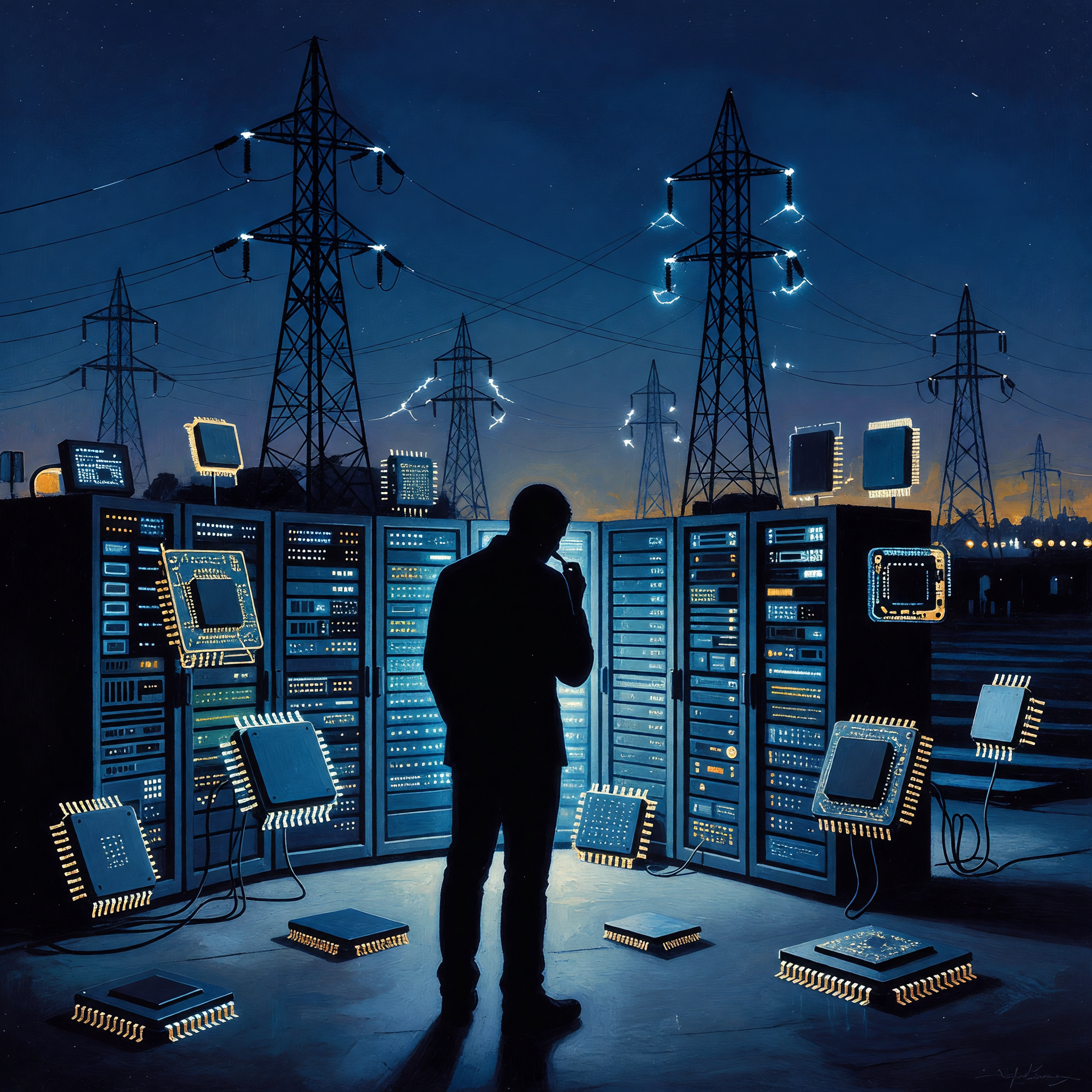
Felix Ortiz: And that's actually — that's the hinge, right? Because the argument isn't 'trust me.' The argument is physical. Like, Huang's saying the demand showed up and the world wasn't built for it. Same way a city that triples overnight has no roads for it, no water pipes, no grid.
Tess Hollis: That's the cleanest way to say it. The demand is real — the infrastructure just doesn't exist yet.
Felix Ortiz: Yeah. And so when he says electricity — not GPUs — is the actual ceiling, he means the pipes. Literally. He said AI is going to need a thousand times more power than we currently have.
Tess Hollis: Wait — a thousand times. That's not a rounding error on current capacity. That's a completely different civilization's worth of electricity.
Felix Ortiz: Right — and it's not just power. He's calling for a five- to tenfold expansion of the entire semiconductor manufacturing industry over the next decade. Not Nvidia's output. The whole industry. And then — okay, this is the part I wasn't expecting — Chris Caso at Wolfe Research goes on Squawk Box July 29th and basically confirms it from the outside. Says 'there isn't the physical space to make semiconductors right now.' An analyst, independent, same conclusion.
Tess Hollis: So it's not just Huang saying it. That's the thing. That's actually meaningful corroboration.
Felix Ortiz: Yeah and — wait, no, here's what's wild to me — he's not even stopping at fab space. His answer to the power problem is small modular nuclear reactors in data centers. SMRs. Within a decade, he thinks that's just normal.
Tess Hollis: Which tells you something about the scale he's imagining. You don't wire nuclear reactors to a trend you think might flatten. That's a very specific bet on how permanent this gets.
Felix Ortiz: But — okay, that's actually where I want to pump the brakes, because here's what's bothering me. Huang says electricity is the ceiling. Wolfe Research, Chris Caso, says it's fab space. And then there's a third set of analyst commentary that says no, actually, memory is the biggest bottleneck. Three different answers. None of them reconcile.
Tess Hollis: Right — and that's the tell.
Felix Ortiz: Yeah, because if you actually knew which one was the ceiling, you'd stop spending on the other two. You wouldn't be simultaneously pouring capital into power infrastructure and fab expansion and data center builds. That's — wait, no, that's not a strategy, that's a hedge.
Tess Hollis: And a hedge disguised as a forecast is worth asking about. Because Amazon is committing around two hundred billion, Microsoft close to one-ninety, Alphabet one-eighty-five — these are not companies that throw capital at three problems at once because they did the math on all three. That's what you do when you don't know which one is the binding constraint.
Felix Ortiz: Okay but — I mean, couldn't the lead times explain it? Like, a semiconductor fab engineer in Arizona halfway through a multi-year expansion can't wait for the electricity debate to resolve. She has to have already decided.
Tess Hollis: Sure — but that's kind of my point. If lead times force you to bet before you know, then the bottleneck story isn't a diagnosis. It's a permission slip. And who benefits most from that framing? Nvidia. The hyperscalers. The fab builders. 'Physical limits, not economic limits' — that's a hall pass to keep expanding without ever proving ROI.
Felix Ortiz: Derek Thompson actually went at this directly — 'The Four Horsemen of the AI Bubble Apocalypse,' July 31st. And the thing that got me is he tries to rebut his own arguments inside the piece. Like, he builds the counterpoint and then attempts to knock it down. Which tells you — the debate is genuinely not settled.
Tess Hollis: Huh — yeah. If the most structured counterpoint is also hedging its own conclusions, nobody's actually closed this.
Felix Ortiz: Which is exactly why I want to get into what the one-trillion number actually means — whether the hyperscalers genuinely believe it pays out or whether they're all just moving because everyone else is moving. That's the part that I think changes everything about this story.
Tess Hollis: And that's the thing nobody's asking out loud — whether they actually believe it pays out, or whether they're locked in. Huang told Larry Fink at Davos, January 2026, this is 'the largest infrastructure build-out in human history.' But if everyone's only spending because everyone else is spending, that's not a forecast. That's a trap.
Felix Ortiz: Yeah and — okay, the Bank of America number makes the trap feel very real. Amazon, Alphabet, Microsoft, Meta — combined seven hundred and twenty-five billion in 2026 alone. Up seventy-seven percent year-over-year. More than triple what they spent in 2024. That's not gradual.
Tess Hollis: Triple 2024 spending in a single year.
Felix Ortiz: And then Stargate — OpenAI, SoftBank, Oracle — five hundred billion on top of that. So you cross one trillion, first time ever, and it arrives a full year ahead of where Wall Street projected it would land. A year early. That's — wait, no, that's not a trend accelerating. That's everyone moving at once.
Tess Hollis: Which is exactly the coordination problem. If Microsoft's CFO is watching Amazon's capex announcement and thinking 'I can't be the one who didn't,' that's not demand analysis. That's fear.
Felix Ortiz: But — I mean, herd intelligence is also real, right? Like, someone saw a window closing. The question I can't answer is whether it was smart-fast or panic-fast.
Tess Hollis: So what do you watch to tell the difference?
Felix Ortiz: Okay — yeah, that's the thing. Late July 2026, chip stocks sell off hard. Strong earnings, persistent shortages confirmed, and the stocks drop anyway. That's the market pricing in capex exhaustion while supply is still genuinely constrained. Those two things shouldn't coexist. That disconnect — that's actually the signal.
Tess Hollis: So you watch Q3 earnings. Specifically whether AI revenue at the hyperscalers is growing fast enough that the ROI question stays quiet — or whether someone on an analyst call finally asks it out loud.
Felix Ortiz: The second an Amazon or Alphabet exec gets asked 'when does this pay back' and doesn't have a clean answer — that's when the whole framing shifts from infrastructure build-out to something harder to name.
Tess Hollis: And that's — I mean, that's actually where I keep getting stuck. Huang's whole argument is that the constraints are physical. Structural. Not speculative. If he's right, the trillion is a down payment on a real thing. But if electricity and fab space and memory are all simultaneously the binding constraint, nobody — not Nvidia, not the hyperscalers, not Bank of America running the models — nobody can tell you when enough capital has been deployed. There's no signal for 'enough.' And if you can't see the signal before it arrives, how do you know when a supercycle tips into something else?
Felix Ortiz: Yeah. And — wait, that's actually the question I don't have an answer to. Like, what does rational capex even look like in an arms race where sitting out costs you more than overspending? If you're Microsoft and you undershoot, you've handed Amazon the edge. So you overshoot. Everyone overshoots. And the overshoot might be exactly the right call and you'd never know, because the counterfactual doesn't exist.
Tess Hollis: Yeah. I don't know. I genuinely don't.
Felix Ortiz: That's — I mean, that's a real place to land.
Tess Hollis: Good talk. Disturbing, but good.