Iris Holm: You sent me that paper at midnight. That's never a good sign.
Lila Soto: I know, I know — I couldn't sleep, and I think it's because I kept trying to figure out if I'd been wrong about a word my whole life.
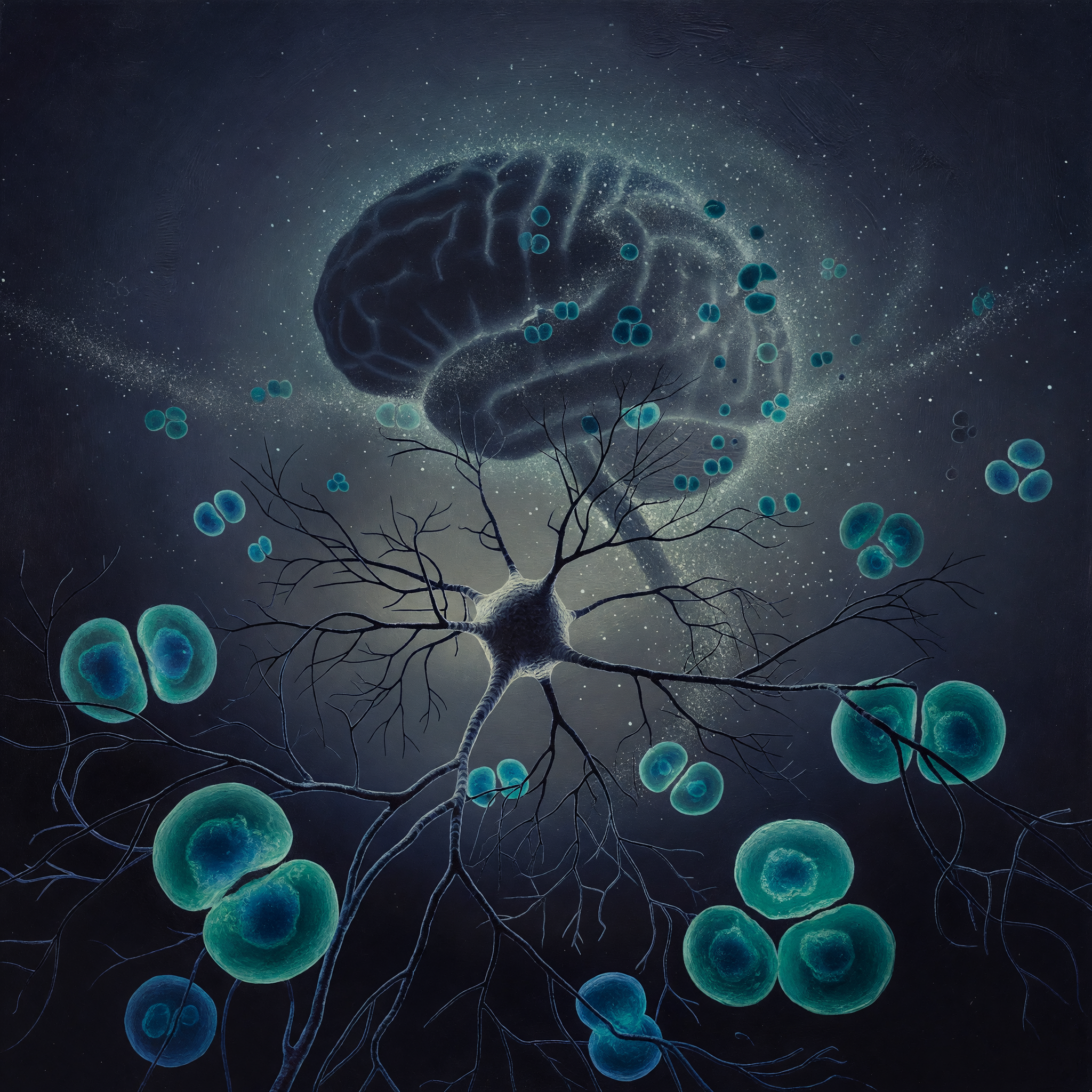
Lila Soto: Memory. Like, I've always assumed memory is a brain thing — neurons, synapses, you know, the whole infrastructure. And then this study lands in Nature Communications, July 28th, 2026, and it's showing that human haematopoietic stem and progenitor cells — HSPCs, blood-forming stem cells — carry something the researchers call clonal memory. Heritable. Passed across multiple cell generations. Division timing, fate commitment — what the cell becomes — all of it encoded and inherited. No neural tissue anywhere.
Iris Holm: Right — and that persistence across generations is what separates this from just a cell responding to a signal. This is the daughter cell remembering what the parent encoded.
Lila Soto: Which either means memory was always distributed — lived in cells long before brains evolved — or we've been applying a neuroscience word somewhere it was never supposed to reach. And I genuinely don't know which reading is more destabilizing.
Iris Holm: The second one, frankly. Because if we've been using the wrong word, that's a problem with the field — not the cells.
Lila Soto: Mm, and that's where I want to start — what does it cost us to use the word correctly?
Iris Holm: What it costs is precision. Think of it like a family recipe — no one wrote it down, but the daughter cells inherit the exact same behavioral timing and fate choices as their ancestor. Not because anyone told them. Because the instructions are baked into how the cell is configured.
Lila Soto: Okay but — what's actually carrying that? Like, what's the physical thing being passed down?
Iris Holm: Epigenetic inheritance. Chromatin configurations — how the DNA is packaged and which genes are accessible. That state passes from parent cell to daughter cell. The DNA sequence itself doesn't change. The configuration does.
Lila Soto: So it's — the handwriting on the page stays the same, but which pages are open changes.
Iris Holm: That's close enough. And — look, this isn't isolated to HSPCs. Non-neural immune cells have Toll-like receptors detecting PAMPs and DAMPs — pathogen signatures, damage signals — and responding adaptively. Outside the nervous system entirely.
Lila Soto: Wait — so pattern recognition was already happening in immune cells, way before this study?
Iris Holm: Decades. That part isn't new. What the July 27th Nature Materials study adds is — I mean, cells using their own traction forces as information triggers. Mechanical pull, not chemical signal. The cell physically straining against a scaffold activates its own growth factors. That's a third mechanism, totally distinct.
Lila Soto: So we have epigenetic inheritance, receptor-based pattern recognition, and now the cell's own muscle memory, kind of — three separate channels, all non-neural.
Iris Holm: Yes. That's the claim. And they're mechanistically distinct — which is exactly why calling all of it 'cellular memory' is either a useful umbrella or a very convenient blur.
Lila Soto: But that's the blur I can't get past — because one of those things just flipped on me completely. There's a paper, Cell Death Discovery, published July 29th, 2026, showing that human stem cells differentiating into myotubes, adipocytes, osteoblasts — five cell types — are doing something called physiological re-replication. Specific genomic regions copied more than once per cell cycle. And that's... I flagged almost exactly that process as a tumor marker in my reading last year.
Iris Holm: Hold on. Same molecular event.
Lila Soto: Same molecular event. DNA amplification in specific regions. In cancer, it's instability. In normal differentiation, it's — apparently now — developmental memory. Gene expression gets amplified exactly where it needs to be. And the thing that gets me is, we knew this from Drosophila first. Fruit fly development. But now it's in human stem cells, which means it survived across species, which means it's probably doing something real. I just... what actually changed? The cell, or us?
Iris Holm: The interpretation changed. And that's precisely where 'memory' gets dangerous — because now you've got four mechanisms being folded under one word. Epigenetic state inheritance. Receptor-ligand detection through Toll-like receptors. DNA amplification via re-replication. Mechanosensory traction-force signaling from the Nature Materials work. Those are not the same thing. Not even close to the same thing. Calling all of it 'cellular memory' papers over distinctions that matter clinically.
Lila Soto: So is the word helping or hiding?
Iris Holm: That depends entirely on what you're trying to explain. Think about — actually, here's a concrete case. A researcher, summer 2026, bench work, reads the Cell Death Discovery paper the morning it drops. She'd spent months the prior year flagging re-replication events in a tumor sample as pathological. Now the same process, same amplification pattern, is being called normal developmental mechanism in healthy differentiating cells. Her classification system just inverted overnight.
Lila Soto: And she can't just — I mean, it's not like the biology changed between those two papers.
Iris Holm: No. The framing did. Which is why 'cellular intelligence' as a unifying concept might be obscuring more than it reveals — synaptic plasticity works through ion channels and neurotransmitter release. None of these four mechanisms touch that. Grouping them rewards the headline, not the mechanism.
Lila Soto: And the AML piece — where clonal memory actually breaks — I think that's where this stops being terminology and starts being something harder to argue with. We should get there.
Iris Holm: AML is where it stops being terminology. The July 28th Nature Communications study — clonal memory is specifically disrupted in acute myeloid leukaemia cells. Not degraded. Not noisy. Disrupted. That's a signal.
Lila Soto: Okay but — disrupted how? Like, the cells lose the memory entirely, or they develop some other pattern?
Iris Holm: That's actually the unresolved part, and it matters enormously. Either the clonal memory is lost and the loss itself drives disease — which means the mechanism is protective — or AML cells have built their own aberrant version. Their own inherited misbehavior, passed through generations of cancerous HSPCs.
Lila Soto: Those are — wait, those are completely different stories about what memory is doing.
Iris Holm: Yes. And both readings make cellular memory clinically significant. That's the point. If you lose it and get cancer, it was protective. If cancer builds its own version, memory is the disease mechanism. Either way — it's not incidental. It's load-bearing. The cell heterogeneity we see in AML, the way cells in the same tumor population behave differently? That divergence could be driven by heritable clonal states, not random mutation.
Lila Soto: Huh. So the diversity inside the tumor might be — I mean, it might be memory doing its job wrong, not just genetic noise.
Iris Holm: Now imagine a haematologist, late 2026, designing a treatment protocol. She's been targeting surface markers on leukaemia cells. But if clonal memory is driving the heterogeneity — if Max Planck Institute researchers working on cellular cognition are right that this is an emerging property across cell types — the target isn't the marker. The target is the inherited state. That's a different intervention entirely.
Lila Soto: And that's where the word we use actually matters. Not philosophically — practically. If you call it memory, you look for ways to restore it. If you call it epigenetic noise, you suppress it. The mechanism you're targeting follows from what you believe the thing is.
Iris Holm: That's the practical floor, yes. And I think that's where I actually land — not on whether 'cellular intelligence' is the right frame, but on whether the measurement finally caught up to what was happening. Toll-like receptors detecting PAMPs and DAMPs — that was always information processing. We just didn't call it that.
Lila Soto: Which is — I mean, that's kind of a strange thing to sit with. That the intelligence, or whatever we're calling it, was distributed across HSPCs and immune cells this whole time. We just only had instruments pointed at neurons.
Iris Holm: The word was always reaching down. The biology wasn't waiting for us.
Lila Soto: Yeah. I think that's the thing that actually shifted for me in this conversation — not that cells are smarter than we thought. It's that the question of where intelligence lives was always wrong. It's not a location. It's a continuum.
Iris Holm: Fair. Though I'd say — the continuum was always there. We just measured the neural end and assumed it was the whole thing.
Lila Soto: That's enough to sit with for one night. Thanks for not letting me get away with just the metaphor.