Brian Reed: Hey — quick check before we get into this. When you saw the Nobel drop this morning, what was your first read?
Eliza Ward: Honestly? The year. The foundational channelrhodopsin paper is from 2003. That's — that's a long runway for a Nobel.
Brian Reed: The Nobel Assembly at Karolinska announced this morning — October 5th, 2026 — the prize in Physiology or Medicine goes jointly to Deisseroth, Hegemann, and Nagel. For optogenetics. And your first instinct is the timing.
Eliza Ward: The citation is 'light-gated ion channels and optogenetics.' They're specifically naming the foundational layer — the algae protein work — not just Deisseroth's 2005 Stanford demonstration in rat nerve cells. That ordering matters.
Brian Reed: Hold on — what do you mean the ordering matters?
Eliza Ward: Hegemann and Nagel published in 2003. Deisseroth gets — I mean, he gets a lot of the press because the rat-neuron work is viscerally dramatic. But the committee explicitly named both layers. The ion channel discovery and the technique built on top of it.
Brian Reed: So this prize is less 'one breakthrough moment' and more — let me see — a whole lineage the committee decided to honor together.
Eliza Ward: Twenty-three years of lineage, yeah. And the prize says nothing about a patient seeing the result of it yet.
Brian Reed: But that 'no patient yet' framing — I want to push on it, because I think it skips the part that actually changes things. Like, what did neuroscience look like before this existed?
Eliza Ward: Correlation. All correlation. You could watch which brain areas lit up during a behavior — imaging, electrode recordings — but you couldn't prove that activity was doing anything. You were always guessing.
Brian Reed: Right — and that's the actual shift. Think about a mouse freezing in fear. A researcher before optogenetics could see a cluster of neurons firing. But she couldn't — I mean, she had no way to test whether those neurons were the cause or just... along for the ride.
Eliza Ward: And now she can switch them off. Specifically those cells. And watch whether the freezing stops.
Brian Reed: That's the whole thing, right there.
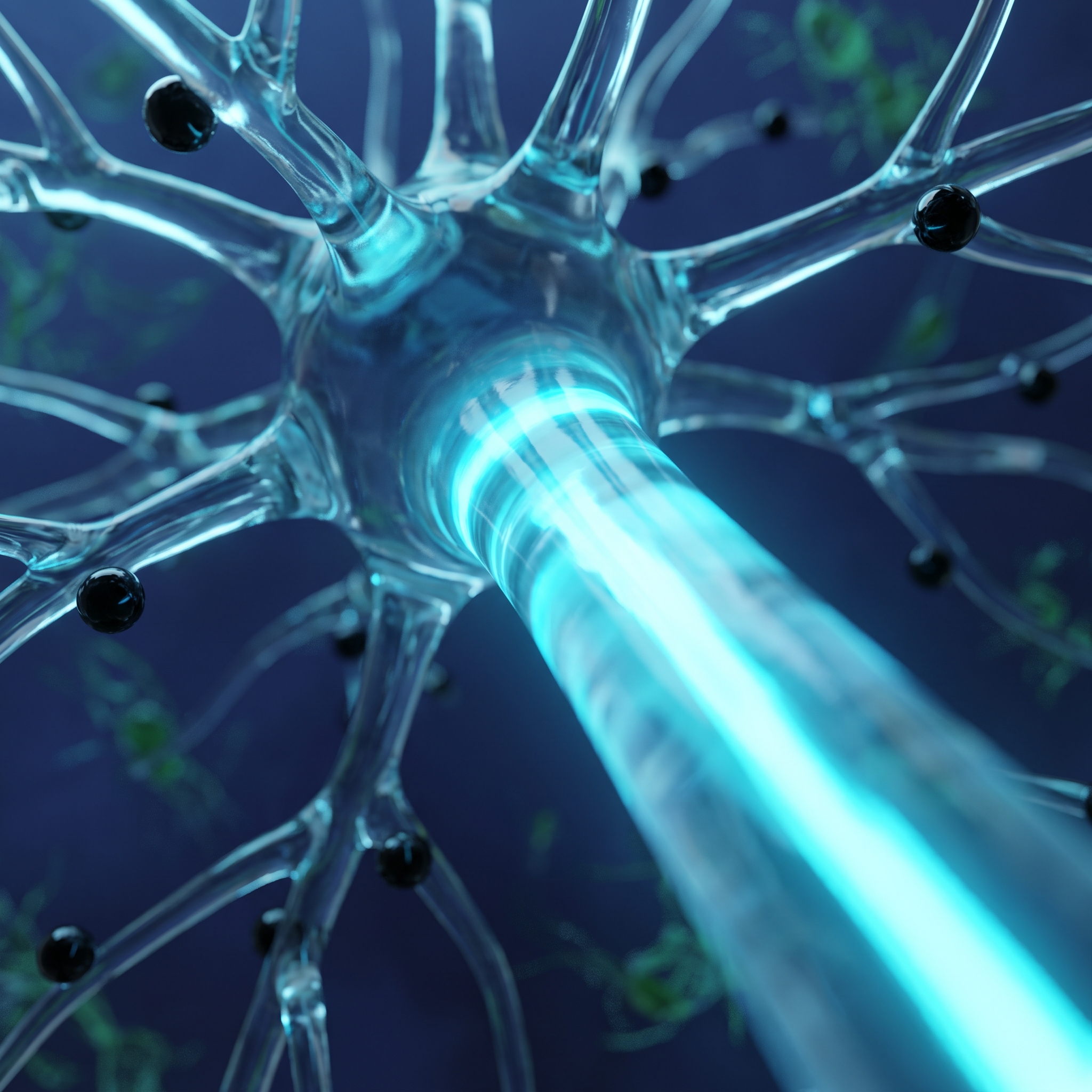
Eliza Ward: It's a dimmer switch wired into one specific neuron type. You press it — only those cells fire. Nothing adjacent, nothing else in the region. That's what channelrhodopsin makes possible. The algae protein opens when light hits it, ions cross the membrane, the neuron fires. Millisecond precision.
Brian Reed: Wait — one specific type, not just one region?
Eliza Ward: Cell-type specific. That's actually — I mean, that's what makes the causation claim stick. Earlier stimulation methods hit everything nearby. Optogenetics, because you're genetically targeting which cells express the channelrhodopsin, you know exactly what you turned on. Memory circuits, addiction pathways, motor control — all of that research now runs on a causal claim, not a correlational one.
Brian Reed: So the Nobel isn't just honoring a tool. It's honoring the moment neuroscience got to stop saying 'associated with' and start saying 'caused by.'
Eliza Ward: Which is real — that shift is confirmed. But here's where I want to slow down, because a lot of coverage this morning is taking that causation victory and jumping straight to: Nobel signals treatments are coming. Parkinson's. Blindness. Soon. And I don't think the evidence gets you there.
Brian Reed: No, that's — yeah, I've seen that framing. 'Optogenetics poised to help Parkinson's patients.' What's actually confirmed versus what's optimism?
Eliza Ward: Animal models. That's what's confirmed. In Parkinson's research, optogenetics has been used to stimulate specific pathways — compensating for dopamine neuron loss, reducing motor symptoms. In mice. The blindness work is restoring light sensitivity to retinal cells that lost photoreceptor function. Also not a confirmed human clinical outcome.
Brian Reed: Hold on — nothing confirmed in humans at all?
Eliza Ward: Not that the sourced reporting confirms. And — wait, the Nobel citation actually does this work quietly if you read it. 'For their discoveries.' Not therapies. Not treatments. Discoveries. The Nobel Assembly chose that word deliberately.
Brian Reed: That's a real distinction. But then there's the delivery problem, which the coverage almost entirely skips — and this is the part that actually makes me pump the brakes. To get light into a specific brain region, you need fiber-optic implants. In brain tissue. That's not a pill, that's not an injection, that is surgery, with hardware that stays in.
Eliza Ward: Right, and Parkinson's already has deep-brain stimulation as a surgical option — so it's not like surgery is categorically off the table. But fiber-optic implants delivering blue light pulses on a continuous basis is a genuinely different engineering problem than what's already approved.
Brian Reed: So the take that needs correcting is: the Nobel accelerates the path to clinic. What I'd actually say is — the Nobel recognizes that the science changed. The clinical path is a separate, much harder question that the prize doesn't touch.
Eliza Ward: And the three laureates — Deisseroth at Stanford, Hegemann, Nagel, the twenty-three year gap between the 2003 channelrhodopsin paper and this morning — that split actually tells you something about how foundational science gets recognized that we haven't gotten to yet.
Brian Reed: That three-way split — that's actually the part that doesn't fit the standard Nobel story. Usually there's a single eureka moment the committee can point to. Here they're saying: no, actually, you need the algae biology *and* the mammalian translation, and those are two separate things done by different people years apart.
Eliza Ward: And the naming itself is deliberate. The method didn't even get called 'optogenetics' until 2006 — a full year after Deisseroth's rat demonstration. So the committee is honoring something that didn't have a name yet when half the foundational work was done.
Brian Reed: Wait — 2006, after the rat work?
Eliza Ward: Yeah. Hegemann and Nagel in 2003, Deisseroth's Stanford demonstration in 2005, and then the field names the technique the following year. The Nobel Assembly — and this is in the citation framing — is explicitly calling this a methodological revolution across an entire field. Not a discovery. A revolution in how the field operates.
Brian Reed: Which is — I mean, that's actually why the 23-year wait makes sense to me. The committee wasn't waiting for a cure. They were waiting until they could say: neuroscience runs differently now because of this. That takes time to confirm. You need a decade of papers all citing the same method before that claim is undeniable.
Eliza Ward: Confirmed impact, not projected impact. That's the real clock they're on.
Brian Reed: So what does the Nobel's implicit wager actually look like going forward? Because there is one — the prize says this matters. If optogenetics delivers a confirmed human result — blindness, a motor disorder, something — in the next decade, the committee looks prescient. And if it doesn't—
Eliza Ward: Then the 23-year gap stops being a story about patient recognition and starts being a story about a clinical pipeline that stalled. That's when people ask hard questions about why brain translation is slower than, say, gene therapy. Deisseroth's Howard Hughes Medical Institute affiliation — that's the kind of long-horizon funding that keeps basic science alive without a commercial deadline. But it doesn't compress the trial timeline.
Brian Reed: And that's genuinely unresolved right now — not manufactured uncertainty. The prize is real. The methodological shift is confirmed. Whether it reaches a patient is still an open question that this Nobel made visible but did not answer.
Eliza Ward: And that's — I mean, that's the actual question the Nobel Assembly left on the table. They recognized Deisseroth, Hegemann, and Nagel for transforming how scientists ask questions about the brain. Not for answering the clinical ones yet. Those are two different things, and the prize is only claiming the first.
Brian Reed: Which makes it a wager, right? The implicit bet is: a method powerful enough to reshape how an entire field thinks will eventually change what doctors can do. The committee is saying that's worth honoring before it's cured anything. And I genuinely don't know if that's wisdom or — I mean, is that the committee getting ahead of itself?
Eliza Ward: Wait — I don't think we can answer that yet. That's the honest version. If you want the confirmed part: the methodological revolution is real. The clinical payoff is not confirmed. Whether those two things eventually connect is exactly what's unresolved.
Brian Reed: Fleming won in 1945 for penicillin — that one had obvious patient outcomes. This one doesn't. And that gap is what I keep returning to. Not as a criticism. Just as — the thing that isn't settled.
Eliza Ward: We'll be watching for it.