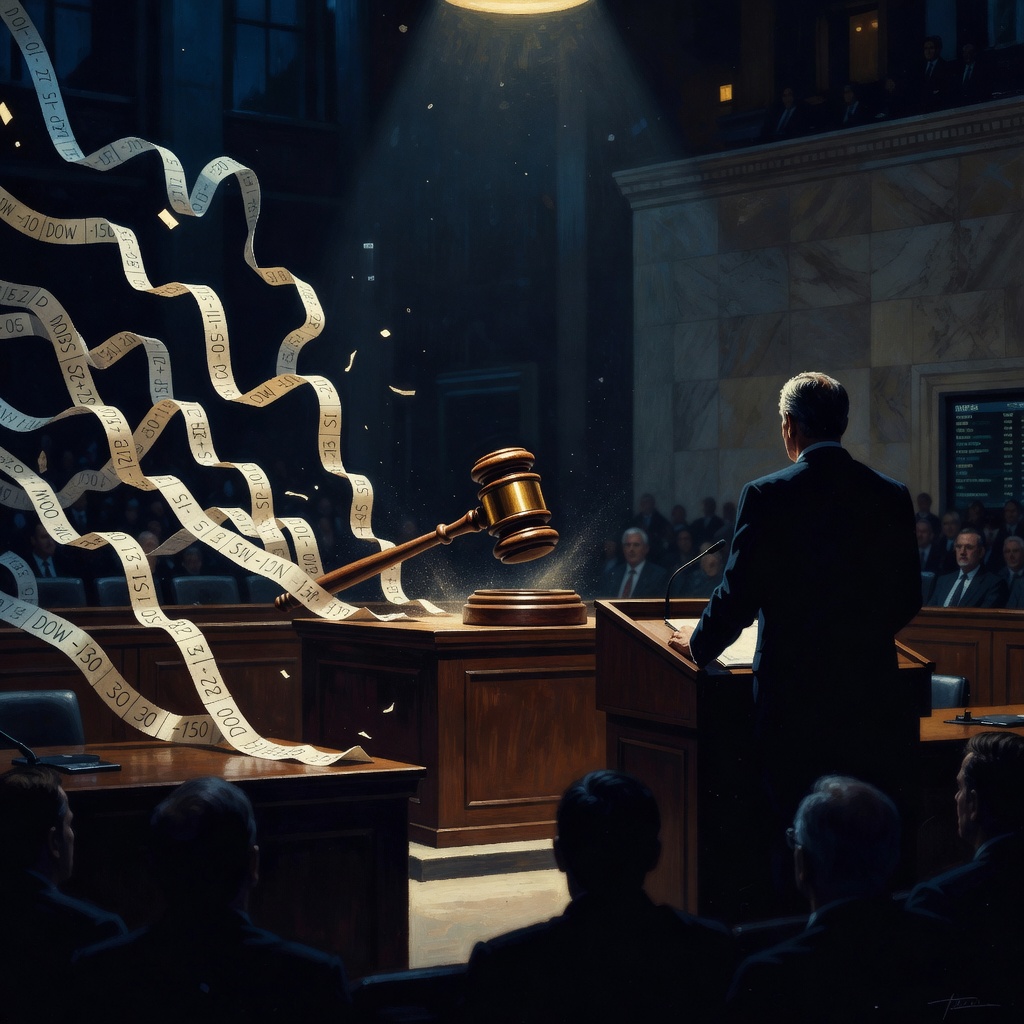
Alex Mercer: I've been thinking about this one all week, and I genuinely don't know if I feel more sorry for Kevin Warsh or more — I mean, the situation is almost perfectly designed to be impossible.
Jordan Hale: Right, like — you know when someone walks into a room and the thing they were hired to fix has somehow gotten worse while they were putting on their coat?
Alex Mercer: That's — yeah, that's basically it. Kevin Warsh was sworn in as Fed chair in May 2026 and is holding his first FOMC meeting on June 16-17 — but the economic conditions that justified his nomination have reversed: inflation hit 4.2% in May, a three-year high, oil prices are elevated because of the Iran conflict, and job growth just came in at 172,000, which means the rate cuts Trump wanted him to deliver are nearly indefensible right now.
Jordan Hale: Wow. And what's fascinating is — he hasn't even called the first meeting to order yet, and already the whole premise of why he's sitting in that chair has kind of collapsed under him.
Alex Mercer: The key point is that 4.2% inflation is not a technicality — that's the highest reading since 2023, and if you look at the data, it's being driven by both energy and some pretty stubborn core pressures, so he can't just wave at oil prices and say it's transitory.
Jordan Hale: I mean, the crazy part is he has to stand up in front of the cameras after this meeting and either cut rates — which the politics demand — or hold, which the economics demand, and either answer is going to make someone very loudly furious.
Jordan Hale: Here's what I keep coming back to. Warsh spent fifteen years outside the Fed publicly saying the Fed got it wrong. On inflation, on QE, on basically everything. And now he owns the building. He's the 17th Chair. He walked into the Marriner Eccles Building on May 22nd, Trump standing next to him at the swearing-in, and now his first FOMC meeting is June 16th. And inflation is running at 4.2% — the hottest CPI in over a year.
Alex Mercer: Right, and the 4.2% is partly an Iran conflict energy story. Which is genuinely awkward for him, because his whole line — and he said this explicitly at his Senate confirmation — is 'inflation is a choice.' The Fed owns it. No excuses.
Jordan Hale: And now the first thing on his desk is an energy shock driven by geopolitics. That's not a choice. That's a war.
Alex Mercer: I'm not totally convinced that breaks the argument, though. Even if oil prices triggered the spike, inflation has run above the Fed's 2% target for over five consecutive years. That's not an energy shock. That's a structural failure. And Warsh knows it — that framing is basically Friedman's. 'Inflation is always and everywhere a monetary phenomenon.' Warsh is just modernizing it.
Jordan Hale: But that's also a hostage to fortune, you know? Because if he says the Fed owns all of it, and then oil stays elevated into fall, he either has to hike into a slowing economy or quietly walk it back. And walking it back — that's exactly what destroyed Powell's credibility on 'transitory.'
Alex Mercer: That's a fair parallel. Though Powell inherited a different situation. What I think matters more right now is what the dot plot shows on June 17th. That's Warsh's actual opening statement to markets — not his words, his projections. If he shifts the dot plot away from cuts and introduces hike signals, that tells you something real.
Jordan Hale: And Nordea's Jan von Gerich basically called this — he said Warsh would go for consensus and credibility, not political appeasement, because the alternative would, quote, 'seriously dent his credibility right from the start.' So the hold is almost certain. The dot plot's the tell.
Alex Mercer: Which makes Trump's recent comments interesting. Trump called the inflation numbers 'great' right around the meeting. That's — I mean, that's not how you describe 4.2% CPI if you actually understand it.
Jordan Hale: Wait — he said 'great'?
Alex Mercer: Yeah. Which some analysts read as Trump giving Warsh cover to hold. Like he's pre-accepting a decision he can't stop anyway.
Jordan Hale: Or he genuinely doesn't know what 4.2% means relative to target. Either way — Warsh still has to stand at that podium on June 17th and basically do the opposite of what Trump nominated him to do. Because remember, the whole reason Trump picked him was the expectation of cuts. That case has completely evaporated. Strong jobs, 140,000 a month on average, elevated oil. Nicolas Jabko at Johns Hopkins called Warsh's position 'almost impossible' for exactly this reason.
Alex Mercer: Jabko's framing is vivid but I think it overstates it. Warsh did say at the Senate Banking Committee hearing in April — explicitly — that he would not be Trump's 'sock puppet.' That's on the record. Markets heard it. The 54-45 confirmation vote is already priced in as a political signal.
Jordan Hale: That vote. Fifty-four to forty-five — narrowest confirmation margin in the modern era. And the only Democrat who crossed over was John Fetterman.
Alex Mercer: Which is strange, yeah. But here's what I actually think that vote signals — it's not just partisan noise. A margin that tight tells markets that half the Senate already perceives the Fed as politically captured. Every move Warsh makes gets read through that lens. He doesn't just have to be independent. He has to be visibly, demonstrably independent.
Jordan Hale: Which is where Powell being in the room gets really interesting to me — like, almost Shakespearean. The man Warsh replaced just... stays. He's still on the Board of Governors. He's publicly warned against political interference. That's not a ceremonial gesture. That's an institutional check built into the org chart.
Alex Mercer: I think that's — to some extent — overstated, though. Powell's a governor now. One voice. His presence is symbolically powerful, but structurally, Warsh chairs the meetings. Warsh controls the agenda.
Jordan Hale: Except that Powell served under Bernanke during the 2008 crisis — he knows exactly how a Fed chair navigates political heat. And Warsh knows that Powell knows. That's not nothing.
Alex Mercer: Fair. But the real test isn't Powell watching — it's whether Warsh changes how the Fed communicates. He's been skeptical of forward guidance for years. If he starts walking back the transparency norms Powell built, that creates a different kind of credibility problem. Markets don't love uncertainty.
Jordan Hale: And PIMCO and Raymond James have both flagged that — independence as the early test. Not just the rate decision, the communication around it. His first press conference on June 17th might matter more than anything in the statement itself.
Alex Mercer: So basically: hold rates, shift the dot plot hawkish, signal restraint without triggering Trump — and do it all while Volcker's ghost and Powell's actual presence are both in the room.
Jordan Hale: And if energy prices stay elevated through summer? Does he actually hike? Because if that happens, the rate-cut logic that got him the nomination in the first place doesn't just look wrong — it looks like the whole thing was a setup he walked into.
Alex Mercer: That's the thing I'm not sure anyone has a clean answer to. His Board term runs to 2040. Trump can't remove him for doing his job. But politically? If he's hiking rates while Trump is running economic messaging, that relationship corrodes fast.
Alex Mercer: Man, okay. I think the bottom line here is — Warsh walks into June 17 with basically no good options. Hold rates, you're credible but you've crossed Trump. Cut rates, you've surrendered to political pressure before you've even established yourself. The key point is: whatever he does on Tuesday sets the terms for everything that follows.
Jordan Hale: Right, that's it. And what's fascinating is — he spent years building this reputation as the guy who'd do the hard thing. The hawk who tells you what you don't want to hear. And now the whole job hinges on whether that was actually true or just a really good audition.
Alex Mercer: Yeah. And I don't think we'll know the real answer on Tuesday. We'll know it by November. So — we'll be watching. Catch you next week.