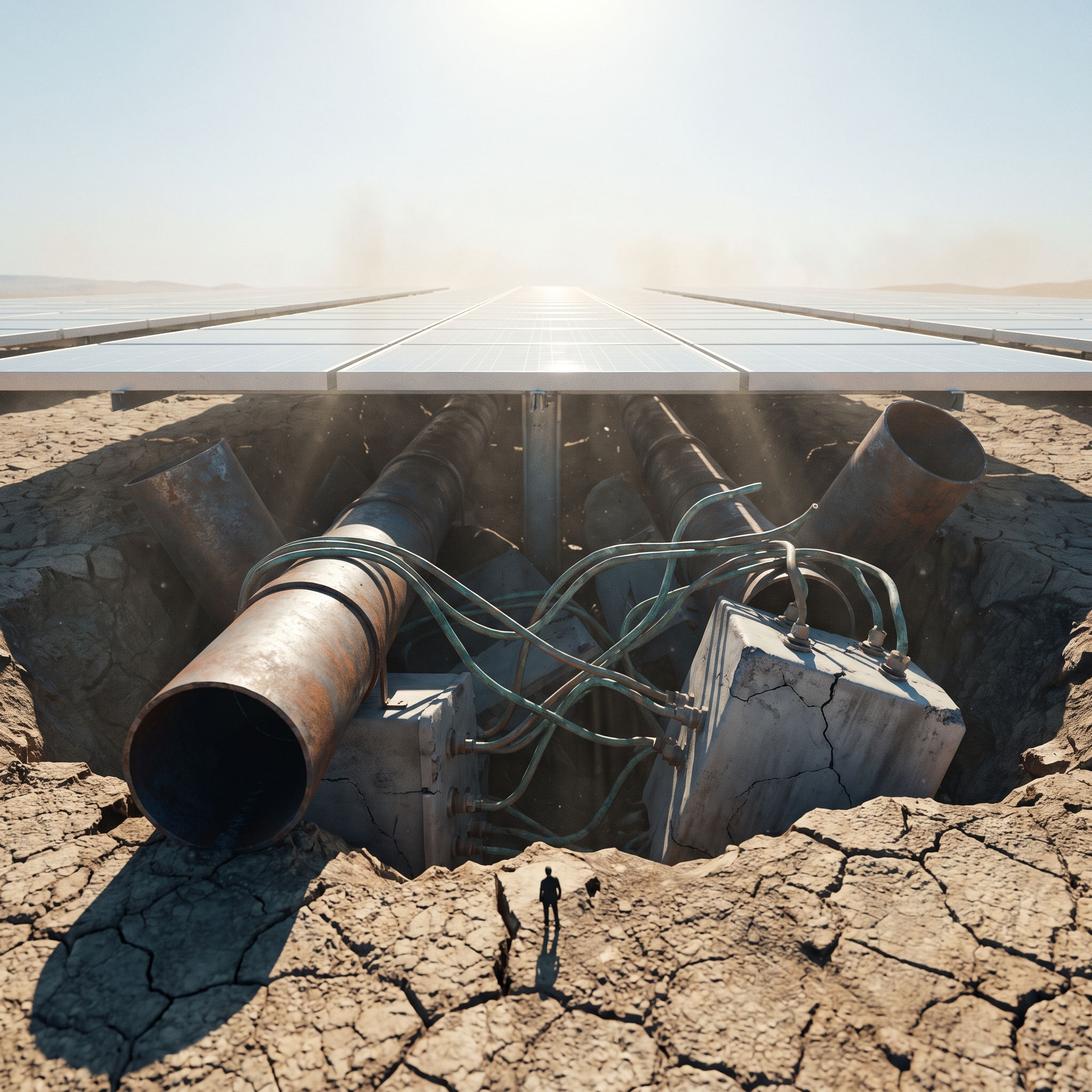
David Sterling: Megan, quick question before we start — did you come in today thinking renewables are cheap?
Megan Skiendel: Honestly? I came in thinking the question of whether renewables are cheap is doing a lot of hiding. Which is a very different thing.
David Sterling: Good. Because the headline number — IRENA, 2024, 91% of new utility-scale renewable capacity globally delivering power at lower LCOE than the cheapest new fossil fuel alternative — that number is real. I'm not disputing it.
Megan Skiendel: But utilities keep pushing back. Slowing down. Saying the grid can't absorb this much, this fast. And if that 91% number is as clean as it reads — why?
David Sterling: Because LCOE is measuring one thing and utilities are paying for something else. Levelized Cost of Energy: capital, O&M, financing, averaged over a plant's lifetime, dollars per megawatt-hour. It stops at the plant gate. What happens to that electricity on the grid — transmission upgrades, storage, backup capacity — none of that is in the number.
Megan Skiendel: And the U.S. Energy Information Administration has been publishing this as the policy-standard metric — Annual Energy Outlook, every year — so it's baked into basically every procurement decision and every legislative brief anyone's read in the last decade.
David Sterling: Which means the thing everyone is quoting as proof that renewables won — it's an asset-level measure presented as a system-level verdict.
Megan Skiendel: And that gap — between what the metric says and what the grid actually costs — that's not a rounding error. That is the whole argument. Who's right, who's paying, and who decided we'd measure it this way.
David Sterling: The metric and the resistance are both correct. They're just measuring different things.
Megan Skiendel: Because measuring different things sounds like a solvable problem. Like, just add the missing costs. But the omitted piece is actually bigger than the piece you're measuring.
David Sterling: That's the car analogy. LCOE prices the car off the lot. No road, no gas, no insurance. Then everyone argues about which car is cheapest.
Megan Skiendel: And then acts surprised when driving costs more than the sticker.
David Sterling: The number that stops me — transmission and distribution, roughly 50% of a typical electricity bill. Generation is 35%. LCOE is measuring the 35% and presenting it as the verdict on the whole bill.
Megan Skiendel: Wait — 50% versus 35%? I suspected you'd low-ball the gap but I — that's the T&D network just sitting there, structurally larger than the thing everyone's benchmarking.
David Sterling: Correct. And that's before you get into what else LCOE drops entirely. Curtailment — generation a solar farm could've produced but the grid couldn't absorb, so it gets wasted. That's a real cost, invisible in the number.
Megan Skiendel: Invisible to whom, though? I mean — the developer doesn't pay for curtailment losses the same way a ratepayer does, so the incentive to even surface that number is — honestly, it's not there.
David Sterling: Right, but the cost exists whether anyone's accounting for it or not. Same with balancing services — frequency regulation, spinning reserves, voltage support. Variable renewables can't self-provide those. They push that burden onto other grid participants. Also not in LCOE.
Megan Skiendel: Interconnection costs too. The studies alone — before a single panel goes up.
David Sterling: All of it. Transmission upgrades, interconnection, backup capacity, storage investment. The Potsdam Institute — Falko Ueckerdt, Lion Hirth — they built System LCOE precisely to add that stack back in. And when you do, the cost ranking between technologies can flip.
Megan Skiendel: Flip — as in the cheap resource becomes the expensive one.
David Sterling: At high penetration, yes. Which means we've been comparing a third of the cost stack to the full system bill and calling it a fair fight.
Megan Skiendel: And here's what that flip actually looks like in practice — not abstract. I'm in a Southwest utility planning office, 2019. Solar developer just won a bid. Headline LCOE, $25 per megawatt-hour. Planner opens the integration cost analysis — and it's another $40 to $60 on top. Battery storage, peaker standby, T&D upgrades. The developer isn't paying any of that.
David Sterling: Wait — $40 to $60? On a $25 base?
Megan Skiendel: On a $25 base. So you're potentially looking at $85 per megawatt-hour all-in, and the procurement decision was made on the $25.
David Sterling: That's the number. That's the one that inverts everything. Because at $85 you're not beating combined cycle gas. You're roughly matching it, maybe worse.
Megan Skiendel: And the reason that $40 to $60 exists is — I mean, it's not a flat surcharge. It's not fixed. It scales. The more solar you add to that grid, the more it costs per additional unit to integrate the next one.
David Sterling: Compounding. Because solar output doesn't align with demand — that's the root of it. Intermittency and variability aren't edge cases, they're structural. And as penetration rises, the grid is stressed in ways it wasn't designed for — voltage, thermal limits, protection systems.
Megan Skiendel: Which means LCOE gets least reliable exactly when it's most in use.
David Sterling: Say that slower.
Megan Skiendel: IRENA's 91% figure — the landmark number, renewables cheaper than fossil fuels almost everywhere — that's a high-penetration world. And the higher the penetration, the larger the integration costs the metric is hiding. So the bigger the headline win for LCOE, the more wrong it is.
David Sterling: The energy storage piece is what really — battery, pumped hydro, thermal — none of that is inside the generating asset's LCOE. It's an entirely separate capital expenditure. So the grid is being asked to absorb variable supply, and the tool that would stabilize it isn't priced into the comparison at all.
Megan Skiendel: Backup and peaker capacity too. Gas peakers sitting idle most of the year, kept warm in case the wind drops. That's a cost the renewable asset induced. Also not in its LCOE.
David Sterling: Which is why the question I can't get past is — Falko Ueckerdt and Lion Hirth built System LCOE at Potsdam specifically to capture this. The math exists. And yet the EIA's Annual Energy Outlook still anchors on plant-level LCOE, IRENA still leads with it. That non-adoption — there's a reason for it, and frankly it's not a technical one.
Megan Skiendel: And that's the part that actually gets darker when you look at who benefits from the simpler number — which is where this conversation is about to go.
David Sterling: Who benefits from the simpler number — that's the load-bearing question. And the answer is almost everyone in the room except the person who pays the bill. Developers, financiers, the EIA itself. Nobody has the incentive to switch.
Megan Skiendel: Nobody bears the cost of coordinating a switch.
David Sterling: Exactly that. Classic coordination failure. Falko Ueckerdt and Lion Hirth publish the System LCOE framework at Potsdam — the math is sound, the academic community accepts it — and then nothing. The EIA's Annual Energy Outlook keeps printing plant-level LCOE. IRENA keeps using it to announce that 91% figure. That's not inertia. That's a stable equilibrium where every actor prefers the status quo.
Megan Skiendel: Stable for whom, though? Because the Grantham Research Institute at LSE is explicitly saying policymakers need better metrics. The Breakthrough Institute is questioning whether $/kWh comparisons even make sense as the operative policy number. These aren't fringe voices.
David Sterling: No, but — well, naming the problem and bearing the cost of solving it are different things. A research institute publishes. A developer still prices their asset on LCOE because that's what the procurement contract references. The regulator inherits the metric because the EIA uses it. Nobody in that chain has unilateral reason to move.
Megan Skiendel: And the developer actively benefits from not moving.
David Sterling: Right. Which is what makes Lion Hirth's position so — frankly, it's the sharpest data point in this whole story. He's affiliated with PIK Potsdam and Vattenfall GmbH simultaneously. The same integration cost research that says the cost rankings can flip — that data is sitting inside an incumbent utility.
Megan Skiendel: Wait — Vattenfall had access to the System LCOE framework through Hirth directly?
David Sterling: That's the point. The same data, deployed differently depending on who's holding it. Vattenfall isn't publishing System LCOE in a press release. They're using it internally, for planning, probably for regulatory proceedings. The academic paper makes renewables look expensive at high penetration. Utilities know that. They just don't quote it publicly.
Megan Skiendel: So when utilities resist high renewable penetration — I mean, we keep asking whether that's regulatory capture or rational cost-accounting. But maybe it's neither, exactly. Maybe it's — they have the System LCOE math, they know the integration costs are real, and they're making a completely defensible argument that just happens to also serve their asset base.
David Sterling: That's the hard version. And the Ueckerdt result is what makes it hard — because he demonstrates mathematically that integration costs can be large enough to reverse the cost ranking between technologies entirely. Not chip away at it. Reverse it. So utility resistance isn't irrational. It's a rational response to a broken accounting system. They're just uncompensated for being right.
Megan Skiendel: Uncompensated and unpopular.
David Sterling: The metric didn't lose because it's technically inferior. System LCOE is better. Full stop. It lost because the winners of a simple metric — developers, financiers, the policy apparatus that adopted LCOE — outnumber the winners of an accurate one. That's not a technical problem. That's institutional design.
Megan Skiendel: And the ratepayer ends up holding the integration costs that the metric made invisible — which is, honestly, the most predictable ending to this story.
David Sterling: The metric wins. The ratepayer pays. And the number everyone quotes is still the one that stops at the plant gate.
Megan Skiendel: The metric question and the allocation question are not the same fight — and I don't think we've fully separated them. System LCOE tells you what the true cost is. It says nothing about who pays it. That's a completely different conversation, and it happens in rate cases, in state commission proceedings. Not in a research paper from PIK Potsdam.
David Sterling: That's the distinction I don't think most people are making. Ueckerdt builds the math. The math is correct. And then the allocation fight — developer, utility, ratepayer, or socialized as public infrastructure — that's political. Entirely.
Megan Skiendel: And it gets buried in regulatory proceedings where it's less visible. Which — I mean, that's not accidental. Rate cases are not front-page news. The IRENA 91% number is.
David Sterling: Right — but here's the structural consequence. As long as plant-level LCOE stays dominant as the public metric, those integration costs stay implicit. Unassigned. And costs that aren't assigned don't get negotiated. They get discovered. Usually by the ratepayer, usually after the fact.
Megan Skiendel: Discovered is the right word. That's exactly what it feels like in a rate case when it finally surfaces. Not a debate — a surprise. A line item nobody budgeted for.
David Sterling: Which leaves one open question. Does something force this into the open? Or does it stay buried in proceedings where it's consequential but invisible? My honest read — it probably takes grid failures at high penetration. Not papers. Not the Grantham Research Institute publishing that policymakers need better metrics. Actual failures.
Megan Skiendel: We started today asking whether renewables are cheap. And I think — honestly, we're ending somewhere stranger. The question isn't cheap versus expensive. It's cheap to whom, assigned to whom, visible to whom. You came in thinking the IRENA number was real but incomplete. I think it's still real. But it's real the way a sticker price is real.
David Sterling: The car off the lot. No road, no gas, no insurance. We're back where we started. Just with a better sense of how much the road costs — and who hasn't been handed the bill yet.