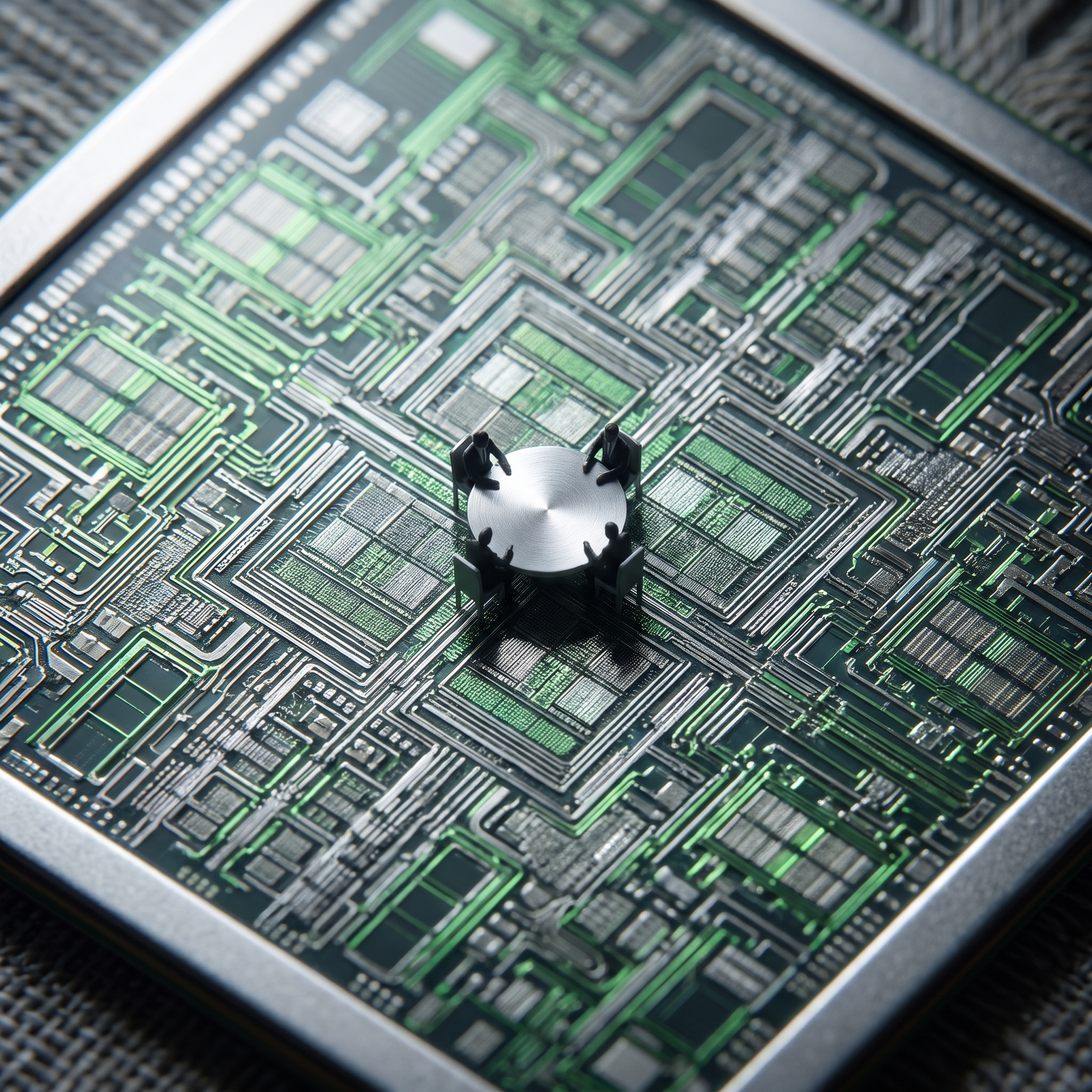
Brian Reed: Hey. Before we get going — did you catch the Yonhap story last night?
Eliza Ward: The LG-Nvidia thing. Yeah.
Brian Reed: So Koo Kwang-mo — chairman of the whole LG Group — is going to Nvidia's Silicon Valley headquarters. Week of August 12. To meet Jensen Huang. And I keep trying to work out, let me see, what exactly shifted between June and now.
Eliza Ward: What shifted is the direction of travel. Literally. In June, Huang came to Seoul — he flew to LG Twin Towers in Yeouido for the inaugural meeting. Now Koo is going to California.
Brian Reed: That's — yeah, that's a real inversion.
Eliza Ward: And then Changtae Kim — LG Electronics CFO — drops 'strategic partnership with Nvidia' on the July 30 earnings call. Six days before Yonhap publishes the Silicon Valley trip.
Brian Reed: Hang on — so investors heard 'strategic partnership' on the earnings call without knowing a chairman-level visit was already being planned?
Eliza Ward: That's what the timeline suggests. Whether 'strategic partnership' was vague corporate language or an actual specific commitment — that's the thing I don't know yet.
Brian Reed: Right — but that vague language might be the whole point, because now the number attached to it is ten thousand Blackwell GPUs. And that's — hang on, what is Blackwell, for anyone who just heard that and blanked?
Eliza Ward: Nvidia's newest, most powerful chip. The kind you need when you're trying to teach a robot to see and move in the real world. That's it. That's Blackwell.
Brian Reed: Ten thousand of those.
Eliza Ward: Five hundred million to seven hundred million dollars, at market rates. But — wait, here's the sourcing problem. That number comes from one outlet. Not Yonhap, which broke the meeting itself. Not Seoul Economic Daily. One source. So I'd actually hold off on treating that as a procurement plan.
Brian Reed: So the meeting is confirmed. The GPU number is — what, a reported target?
Eliza Ward: Reported target, yeah. And there's a real difference between LG telling Nvidia 'we might need ten thousand units' versus a binding order. We don't know which of those this is. Actually, we don't even know if the ten thousand figure came from LG at all — it could be an analyst working backward from their data center footprint.
Brian Reed: And Nvidia's supply commitments are already at a hundred and nineteen billion dollars. So LG is not — I mean, they're not at the front of a short line.
Eliza Ward: That's the number that reframes all of this. Nvidia's Data Center revenue hit seventy-five billion in Q1 alone. LG is one buyer among many competing for the same Blackwell allocation.
Brian Reed: Which means the meeting being confirmed is the signal. The ten thousand GPU figure — that's the noise we shouldn't be running with yet.
Eliza Ward: But that's actually where the circulating take breaks down — everyone's running this as a demand signal. Big Korean buyer wants chips. And I think that's wrong, or at least incomplete.
Eliza Ward: LG Electronics already holds Nvidia quality certification for its 600kW Coolant Distribution Unit. The CDU. First South Korean company to get that cert. That's not a customer relationship — that's a supplier sitting inside the tent.
Brian Reed: Wait — so LG is simultaneously trying to buy from Nvidia and selling cooling hardware back to them?
Eliza Ward: Right. And a 600kW CDU isn't decorative — GPU clusters at Blackwell density generate heat that will physically destroy the hardware without that cooling. So if Nvidia depends on LG's CDU to make its data centers function, the leverage dynamic... I mean, it inverts. Nvidia goes from 'we control allocation' to 'we need your hardware to ship ours.'
Brian Reed: Does that actually translate to GPU allocation though? Like, does holding a cooling cert let you jump the line for Blackwell?
Eliza Ward: Not automatically — but it changes what LG brings to the negotiation. A pure buyer has no equivalent dimension. LG walks in with both. And — wait, the other thing — this isn't just LG Electronics in the room. The June Seoul meeting had LG CNS and LG Uplus represented alongside LG Electronics. IT services and telecom. Thirty executives then flew to California separately. This is not a single product conversation.
Brian Reed: So the week of August 12 — when Koo actually sits down with Jensen Huang — that's the part that matters, whether this dual position actually becomes concrete commitments or stays framework. We'll get there.
Eliza Ward: That's the question. What's confirmed is the cert, the subsidiaries in the room, the two-month escalation. What's not confirmed is whether any of that leverage actually moves the needle on Blackwell allocation. Those are different claims.
Brian Reed: And that dual position is actually what makes the capital commitment legible — because Jensen Huang stood up at YC Startup School and said 'the ChatGPT moment of robots happened a couple of years ago already.' Not approaching. Already happened. And he put a number on it — fifty trillion dollars for the physical AI and robotics market. That's the framing LG is buying into. Literally.
Eliza Ward: Fifty trillion is the anchor that makes hundreds of millions of dollars in Blackwell procurement look like an early position rather than an overextension.
Brian Reed: Right — and think about what that actually looks like on the ground. An LG smart factory line somewhere in South Korea. A robot using Nvidia-powered vision software is adjusting an assembly sequence in real time — not following a preset program, actually reading what's in front of it and correcting. That system needs Blackwell compute to run the vision model. And it needs, I mean, the heat output alone requires a CDU — the exact 600kW unit LG Electronics just got Nvidia-certified. Both halves of this deal are in that one factory scenario.
Eliza Ward: Wait, and that's the agenda item that's actually confirmed for the August meeting — physical AI, robotics, smart factories, explicitly, per industry sources. Not just chip procurement.
Brian Reed: Which changes what we should be watching for, right? Because if the meeting stays at 'framework' language again — no named deployment, no supply agreement with a delivery date — that's actually meaningful. That's the signal that Huang's fifty trillion framing hasn't yet translated into a binding plan.
Eliza Ward: And LG is not doing this alone. This is the chaebol AI pivot — large Korean conglomerates deciding a technology wave is real and moving in formation. LG is just the one with the chairman visit confirmed this week.
Brian Reed: So the thing to actually watch out of August 12 — does anything specific come out? A named factory deployment, a Blackwell delivery timeline, a supply agreement on the CDU side? Or does Koo fly home with another 'framework'?
Eliza Ward: That's the test. Framework language again means June repeated itself. A number with a date means something actually closed.
Brian Reed: And we don't know yet — that's the honest answer.
Eliza Ward: What I'm wondering — and I don't have an answer — is whether LG is actually the outlier here or just the one that surfaced. Because other Korean chaebols aren't in the headlines this week. But the CDU certification, the dual customer-supplier play — that's not something you invent in two months. That takes years of positioning. Which means someone else probably started the same clock.
Brian Reed: Wait — so the question isn't just what Koo and Huang agree on August 12. It's whether we're watching one deal or the visible tip of a broader Korean chaebol move into AI infrastructure supply.
Eliza Ward: Right. And I genuinely don't know. What I can say is confirmed: the meeting, the CDU cert, the Changtae Kim earnings comment, the 30-executive California trip. What I can't say is whether Samsung or SK Hynix have already had the same conversation privately and we just haven't seen a chairman-level visit leak yet.
Brian Reed: So what actually settles the core question — is this GPU procurement, a risk-sharing arrangement, or something bigger about where Korean tech sits in AI infrastructure — that answer comes out of the week of August 12. Specifically whether Koo comes home with a Blackwell delivery timeline or a CDU supply agreement with numbers attached. Anything short of that and it's still framework.
Eliza Ward: That's the test. August 12, Koo walks into Nvidia's Silicon Valley office. What comes out the other side — named commitment or another handshake — that's the only thing that actually moves this from reported target to real signal.