Elin Cole: Hey — you catch the Lunar Outpost news this week?
Jude Walker: I did, and I don't know how to feel about it. Which is maybe the point.
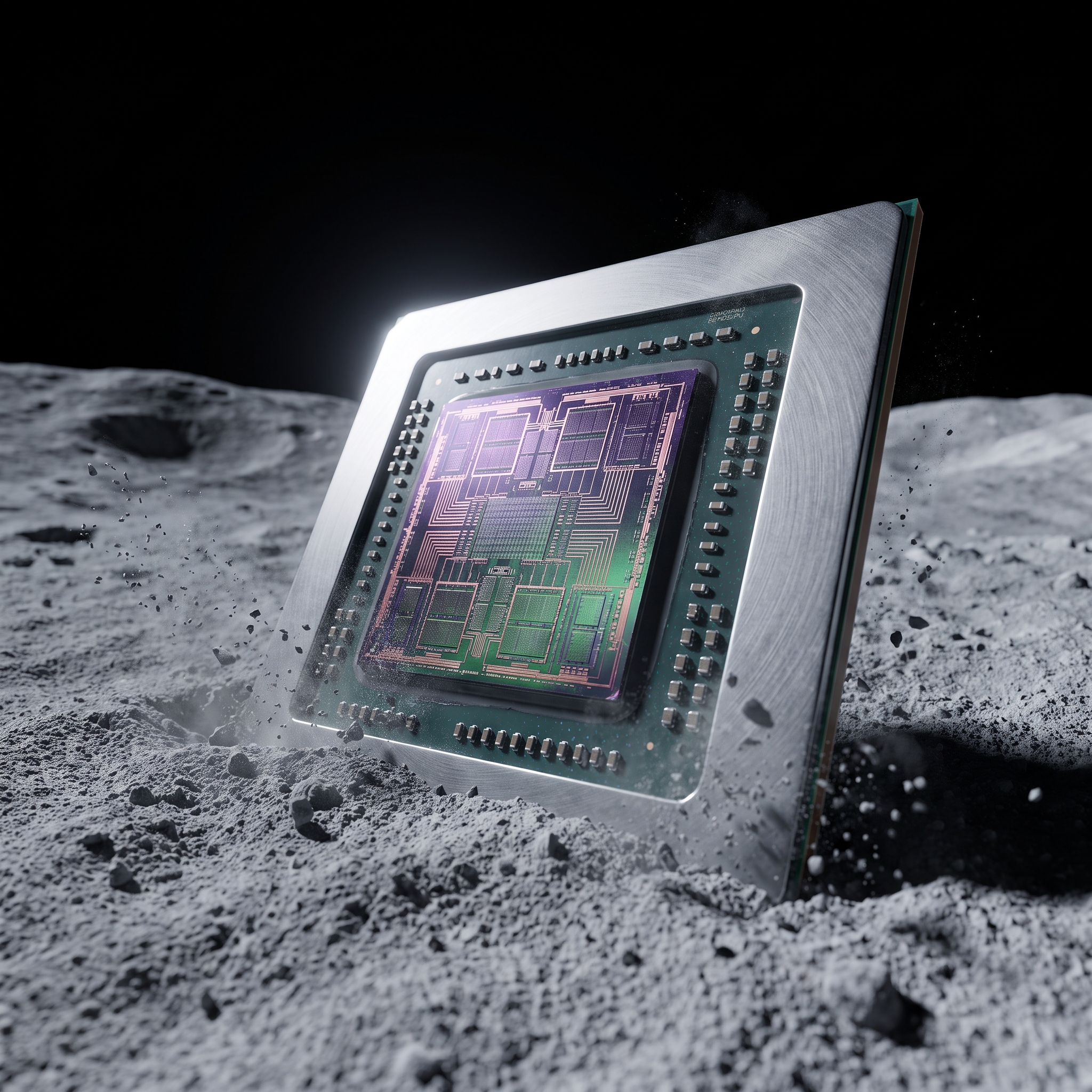
Elin Cole: That's kind of the whole episode, actually. So here's what happened — Lunar Outpost, Colorado-based space robotics startup, announced they're flying an Nvidia Jetson chip to the lunar surface on their MAPP rover. Mission's called Lunar Voyage 2. Launches on a SpaceX Falcon 9, rides an Intuitive Machines lander, target before end of 2026. And they're calling it — and I want to be precise here — they're calling it *likely* the first GPU on the lunar surface.
Jude Walker: Likely. Yeah, that word is doing a lot.
Elin Cole: It is — and actually, here's the number that's doing the heavy lifting on the skepticism side: the Lunar Outpost press release dropped July 23. Firefly Aerospace announced that Blue Ghost Mission 2 would fly a Jetson in lunar orbit on June 29. That's a nearly a month earlier. So the 'first GPU in space' frame was already seeded before Lunar Outpost's announcement ever landed.
Jude Walker: Right — but orbit isn't the surface, which is presumably why Lunar Outpost can still claim the milestone. I mean, that's the move.
Elin Cole: That's exactly the move. Justin Cyrus — Lunar Outpost's CEO — framed this as a comparative evaluation against existing flight-compute hardware. Which is interesting framing. Not 'we're flying this because it works.' More like 'we're flying this to find out if it works better.'
Jude Walker: So the real question is whether this is an engineering test or a marketing flag. And I don't think those are the same thing.
Elin Cole: And that distinction actually explains why the Jetson exists in this mission at all — because the engineering-versus-marketing split you're drawing runs right into a physics wall.
Jude Walker: The lag problem.
Elin Cole: One-way, Earth to Moon, 1.3 seconds. Round trip, 2.6. So imagine a surgeon trying to operate a robot hand where every move arrives three seconds late. At some point you stop steering and you just hand the robot a set of standing instructions.
Jude Walker: Right — that's the MAPP rover. You can't teleoperate it in real time. Not a preference, not a budget call. Physics. So the Jetson isn't a feature, it's the only way the mission functions.
Elin Cole: That's the core of it, yeah. MAPP uses the Jetson to run its LiDAR system locally — terrain mapping, navigation decisions, all processed onboard without waiting for a signal from Earth. Now here's where I think the before-picture matters. Blue Ghost Mission 1 landed in March 2025 and downlinked around 120 gigabytes of raw imagery. That's — I mean, that number is the actual problem. Raw transmission at that scale is expensive and slow.
Jude Walker: 120 GB. From the Moon. Raw.
Elin Cole: Raw. Which is why Blue Ghost Mission 2 is flying the Jetson aboard the Elytra orbiter — to run inference onboard, filter before transmitting, power the Ocula imaging service without shipping everything down. The Jetson is the compression step.
Jude Walker: And it beat out Blackwell — Nvidia's data center architecture — not because it's more capable, but because it's small, low power, built for edge computing. More teraflops means nothing if you blow your power budget on the second day.
Elin Cole: The engineering need is real. Whether the Jetson actually survives and delivers — that's the part nobody has published data on yet.
Jude Walker: Survives and delivers — yeah, but nobody's even asking the first question. They haven't said which Jetson model is on the MAPP rover. Not the module, not the variant. Nothing.
Elin Cole: That's the checklist I want to run. Model number — blank. Thermal-vacuum test results — blank. Radiation tolerance data — blank. Power budget — blank. The lunar surface swings from -170°C to 120°C, with unfiltered solar radiation, and not one of those boxes has a number in it.
Jude Walker: Could the data exist and just be proprietary?
Elin Cole: That's the move people make, and I think it's wrong. Here's the way to see this — Justin Cyrus himself called it a comparative evaluation against existing flight-compute hardware. His words. That framing means the question is open by definition. You don't run a comparative evaluation on hardware you've already qualified. So the silence isn't protecting a trade secret, it's — I mean, it's consistent with not having publishable results yet.
Jude Walker: No independent assessment cited either. Nobody outside Lunar Outpost or Nvidia has looked at this.
Elin Cole: Picture a mountaineer who announces a summit attempt, names their gear brand, won't say which boot model, hasn't published cold-weather test results, and declines to give pack weight. You'd call that a press release, not an expedition plan.
Jude Walker: And the summit is -170 degrees.
Elin Cole: The circulating take — the one I want to push back on — is that this announcement proves commercial off-the-shelf chips are ready for lunar hardware. That's the narrative doing the rounds. But Cyrus's own framing undercuts it. 'Comparative evaluation' is not 'this works.' Those are two different claims, and the second one hasn't been made with evidence. Now — the commercial logic behind why Nvidia and Lunar Outpost both need this framing to land, and what the Space-1 Vera Rubin roadmap actually depends on, that's thornier.
Jude Walker: Right — because if the qualification data never surfaces publicly, that precedent is the real problem. Not one rover. Every mission after it.
Elin Cole: And that precedent problem is actually where the commercial logic becomes worth watching separately from the engineering. Because both sides of this deal win regardless of what Jetson does on the surface.
Jude Walker: That's the part that doesn't sit right. Nvidia plants a flag in the commercial lunar economy — high-visibility, new domain — whether MAPP rover succeeds or craters. And Lunar Outpost gets to be the company that flew the world's most recognizable AI chip brand at exactly the moment CLPS contracts are being competed for. That's not nothing.
Elin Cole: The CLPS timing is the specific thing. Right — NASA is handing out commercial lunar contracts, Lunar Outpost needs to look like a serious technical player, and suddenly you're on a mission with Nvidia's name attached.
Jude Walker: And then look at the roadmap. LV3 and LV5, both before end of decade — those are the missions Lunar Outpost is planning to fly the Nvidia Space-1 Vera Rubin module. Not Jetson. Vera Rubin. That's a step up in capability. I mean, it's the cloud infrastructure pattern — you start with edge compute, you normalize the vendor, and then you escalate.
Elin Cole: That progression is worth naming clearly. Jetson on LV2, Vera Rubin on LV3 and LV5. That's not a product demo. That's a roadmap. It's how AWS got into hospitals.
Jude Walker: Exactly. And Firefly's Blue Ghost Mission 2 already seeded the Nvidia-in-space narrative a month before Lunar Outpost's announcement. The foothold is already there.
Elin Cole: So the watch item — and I think this is the one that actually matters — is whether LV2's results, at Reiner Gamma, whatever the MAPP rover finds at that magnetic anomaly, whether any of that data ever informs a procurement decision above demonstration tier. Because that's the regulatory question neither Nvidia nor Lunar Outpost controls.
Jude Walker: Nah, and that's the ceiling nobody's talking about. Even if Jetson nails it — thermal, radiation, the whole checklist — the decision about whether commercial COTS chips can replace radiation-hardened processors on anything above a demo mission sits with agencies and procurement bodies. Not with the companies.
Elin Cole: Which means the most consequential outcome of LV2 might not be the science at Reiner Gamma. It might be whether the qualification data — if it ever surfaces — is enough to move that institutional approval process. And right now we don't know if anyone's even structured this mission to produce that kind of evidence.
Jude Walker: And nobody's structured it to produce that evidence. Lunar Outpost hasn't said the LV2 data will be published. Nvidia hasn't said it. If the MAPP rover fails at Reiner Gamma, I genuinely don't know who announces that.
Elin Cole: That's — yeah, that's the open question I don't have an answer to. Whether this mission is even designed to produce evidence that procurement bodies above demonstration tier would accept. The word 'likely' in the original claim, the missing model number — I mean, that's not the shape of a mission filing for a higher approval tier. It might be, but we don't know.
Jude Walker: So we're waiting to find out if anyone will say so. Publicly. Either way.
Elin Cole: Yeah. That's where it sits.
Jude Walker: Good talk. Genuinely unsatisfying in the best way.