Ben Okonkwo: Marcus, hey — you ready? I'll admit I've been picturing a grad student staring at a screen all day, which is a very specific kind of dread.
Marcus Kline: Mm. Then picture the hit. A search through billions of DNA sequences, at the University of Miami, and one result with a genome too small to make sense.
Ben Okonkwo: Hold on. Billions? Nobody had grown this thing in a dish?
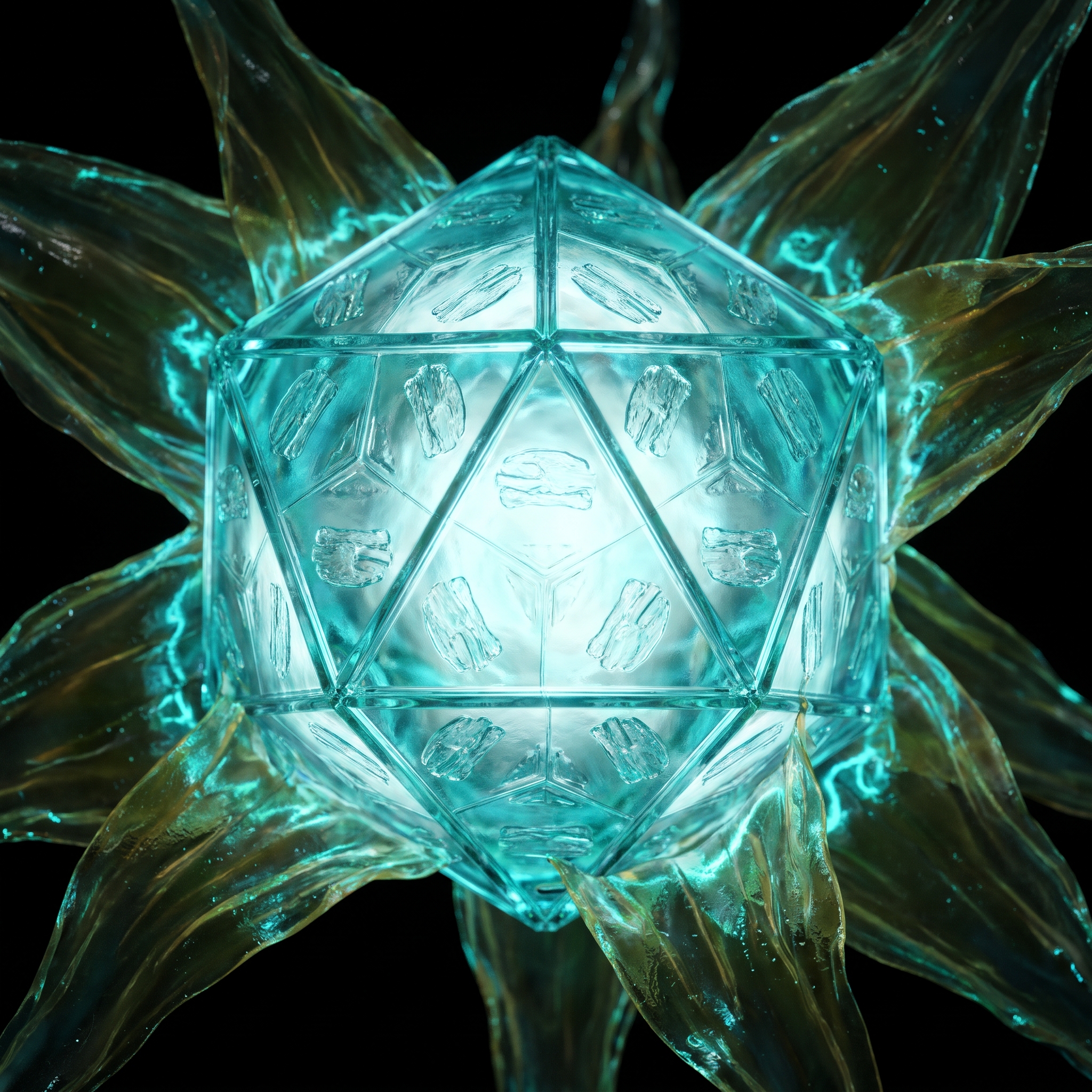
Marcus Kline: No one. That was Abelardo Aguilar, the lead author, working with Antoni Luque, the senior author. Witnesses never seen, only inferred. And the shell it predicted looked like a virus's. Also like a bacterium's storage locker.
Ben Okonkwo: Storage locker how, exactly?
Marcus Kline: Plainly: the same kind of box can hold a recipe to keep it safe, or hold tools to keep a messy job contained. One shape, two lives.
Ben Okonkwo: So which came first, the recipe box or the toolbox? Or was it ever just one?
Marcus Kline: And that's the question the screen couldn't answer. What came back was a previously unknown group of small viruses, genomes smaller and simpler than other viruses with the HK97-fold. Published in Nature Communications, October 14.
Ben Okonkwo: Okay, define the fold for me. Like I'm new.
Marcus Kline: The HK97-fold is a particular way a protein folds, and then locks into a shell. Many viruses build their coats this way. And encapsulins, the bacterial and archaeal compartments, wall off enzymes so a reaction stays isolated. Now, the shell of the new virus resolves, and it matches both.
Ben Okonkwo: And then what? Did they just announce it?
Marcus Kline: No. A preprint first. Aguilar and colleagues posted it on bioRxiv in 2025. Then the peer reviewers, then October.
Ben Okonkwo: Hm. So the simple genome is the interesting part. I mean, it reads like something caught halfway. But right, a small genome could also just be a small genome. Streamlined, not transitional.
Marcus Kline: Fair. Candidate intermediate. Not proof. And that distinction matters more than the headline will.
Ben Okonkwo: Candidate intermediate, fine. But that matters because of the old story. The standard one-way model says encapsulins descended from viruses. Some phage coat got domesticated, and a bacterium put enzymes inside it. Done.
Marcus Kline: A single hand-off. Virus to cell. And the Miami team says that's insufficient.
Ben Okonkwo: Because Aguilar and Luque's analysis finds at least three conversions. Capsid to encapsulin, and also back again, over millions of years. One arrow can't draw that.
Marcus Kline: Now, be careful with what that says. The claim isn't that viruses made cells. It's that the direction of traffic was never settled. We only ever tested the one-way story.
Ben Okonkwo: Hm, right. So picture a postdoc at a whiteboard, drawing the tree the old way, every encapsulin branch hanging off a viral trunk. Then three of those branches have to be redrawn, pointing the other way.
Marcus Kline: And the name is the first exhibit. HK97 is a phage. The virus is the reference, the cellular compartment the derivative. Filed under the wrong heading, perhaps, for decades.
Ben Okonkwo: Ha. Perhaps. And there's more behind it: some viral proteins seem to predate the last universal common ancestor, and viruses probably arose more than once. So they're not just parasites arriving late. They're building parts, early. Which, okay, that's the bigger claim.
Marcus Kline: Hm. Scale matters here. A 2022 ocean study used machine learning and found over 5,500 new RNA viruses, doubling the known viral phyla. We've barely sampled the witnesses.
Ben Okonkwo: Which cuts both ways. And the part that makes me nervous comes next: why "at least three" is a modeling result, and why a six-week silence from critics means very little. But first, what would the data look like if the old model were true?
Marcus Kline: But the old model isn't dead yet, and the evidence for "at least three" has a soft spot. Nobody watched a capsid become an encapsulin. It's a tree, built from sequences that diverged a very long time ago.
Ben Okonkwo: Right, and sequence similarity fades long before structure does. So the branches are the shaky part. Which is why one detail about HK97 matters to me. The phage it's named after has a capsid held together by covalent crosslinks between subunits. Molecular chainmail, forming as the shell matures.
Marcus Kline: Chainmail. Built after the fact?
Ben Okonkwo: During maturation, yes. The procapsid is the immature shell, formed before the genome is packaged. It then rearranges and locks. So the proposal is that this floppy first stage could be pointed at either job: protecting a genome, or compartmentalizing biochemistry. That's a physical transformation. Not a metaphor.
Marcus Kline: And so it can be tested. Show me the scene.
Ben Okonkwo: A structural biologist, late on a Friday, with a freezer rack of E. coli. She expresses one of these sequences and loads the sample onto a cryo-EM grid. Then three questions. Does it self-assemble? Does it package cargo? Does it expand like the phage shell does? Three yeses, and the intermediate idea stops being a drawing.
Marcus Kline: Now press on that. Is three conversions a finding, or an appealing reading? Because a shared shape could be two lineages arriving at the same fold on their own. Convergence.
Ben Okonkwo: Honestly, appealing reading with support. Convergence is the alternative the structure alone can't exclude. And the silence from critics? Six weeks. Late-November coverage is recirculation, not news. Silence is lag, not endorsement.
Marcus Kline: Hm. And keep it apart from the University of Bath work, in PLOS Biology. Laurence D Hurst and Sofia Radrizzani, on mutation rates. A different fifty-year-old idea, a different fight.
Ben Okonkwo: Different fight, same lesson, though. Both are old ideas getting poked. Neither one is finished being poked. Where does that leave the Miami claim for you?
Marcus Kline: Promising. Untested. And I'd say that plainly. Moderate confidence: an interesting hypothesis, not yet demonstrated. Two things could move it. Independent labs testing the procapsid idea on the bench, your Friday-night cryo-EM grid. Or more database searches turning up similar viruses, which would either strengthen the two-way model or break it.
Ben Okonkwo: Mm. I'd sign that. Either result teaches something, and that's about as much as I ask of a hypothesis. Which I think leaves us back at the student's screen, the shell resolved, and nobody in the room able to say which came first. Quiet kind of ending, honestly. I'm fine with it. Thanks for walking me through it.