Brian Reed: Hey. Glad you're here, because I've been sitting on this one and I need to think through it out loud.
Eliza Ward: Same. The Roman telescope?
Brian Reed: Yeah. So — NASA's Nancy Grace Roman Space Telescope, August 30, 2026, SpaceX Falcon Heavy, Launch Complex 39A at Kennedy Space Center. That's the confirmed date. And the number attached to it is — I mean, it's genuinely hard to sit with. Up to 200,000 new exoplanets over five years.
Eliza Ward: Wait — 200,000 against what baseline?
Brian Reed: That's what gets me. Roughly 6,000 exoplanets confirmed by every telescope ever, combined. Decades of work. Roman is projected to more than triple that in — actually, more than thirty times that — in five years.
Eliza Ward: Thirty times. Okay. And the name — Nancy Grace Roman. She was NASA's first chief of astronomy. The person who actually pushed Hubble into existence. The telescope was called WFIRST until 2020 when NASA renamed it.
Brian Reed: Which feels right, given what this thing is supposed to do.
Eliza Ward: It does. Though the 200,000 number — I want to come back to what that actually means, because I'm not sure every one of those is a discovery in the way people will picture it.
Brian Reed: Yeah, and that's the part I keep snagging on. Like — how exactly is Roman finding 200,000 of them? Because the method matters a lot for what we call the result.
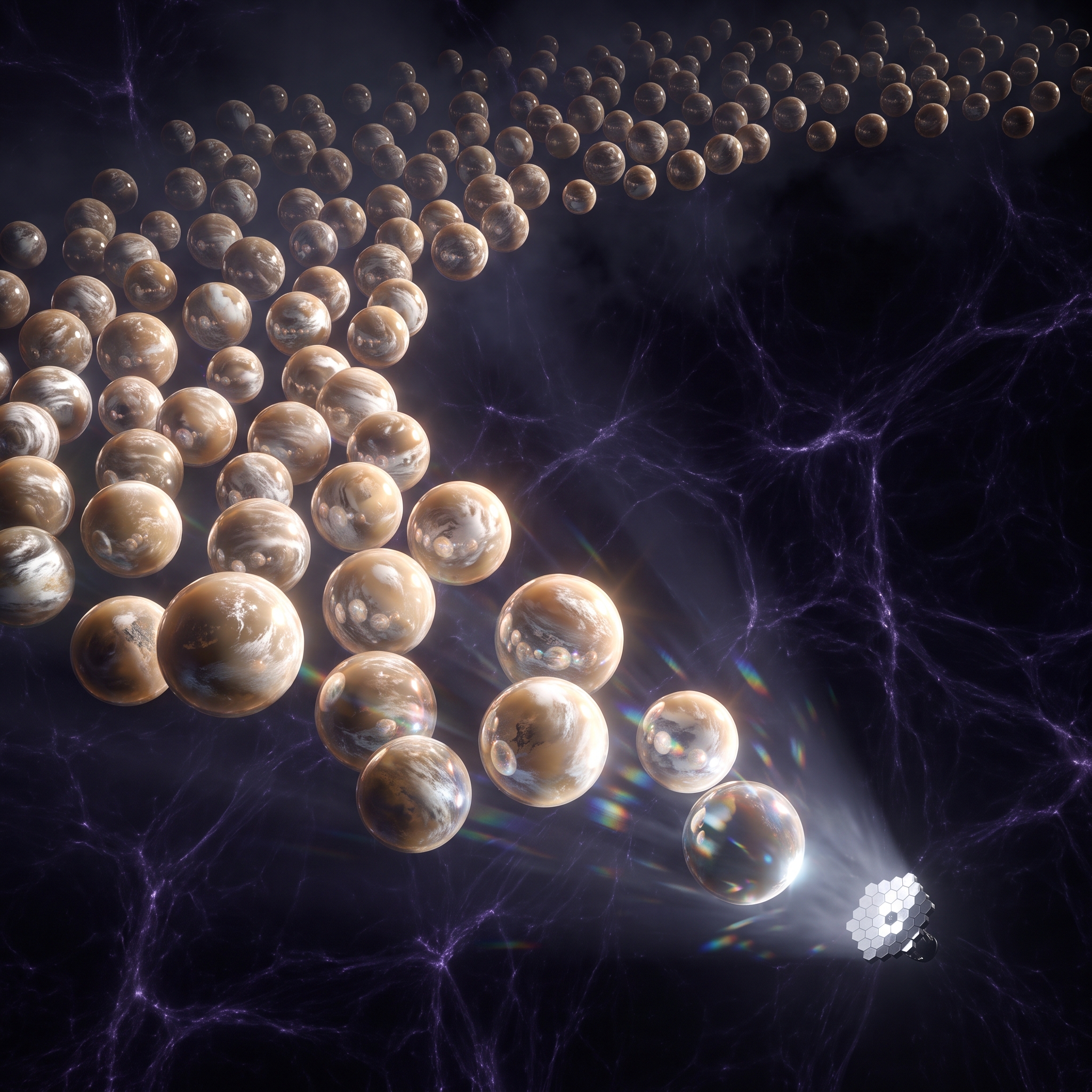
Eliza Ward: Okay, so — gravitational microlensing. Here's the plain version. You're standing a mile away from a streetlight. A car drives between you and that light. You never see the car. You just see the light get briefly brighter — and then you know something passed in front of it. That's microlensing. Roman watches a background star brighten because a planet's gravity bent and magnified the starlight. You're inferring the planet from the math. You don't have a photograph.
Brian Reed: So we're counting the shadows, not the planets.
Eliza Ward: That's it, exactly. And one credible source — Britannica — puts the number at 100,000 planets *investigated*, not 200,000 *discovered*. That gap isn't a typo. It's a definition.
Brian Reed: Wait — 100,000 versus 200,000 is just... a word choice?
Eliza Ward: A word choice that doubles the number, yeah. A microlensing event gives you a statistical signal — something probably caused that brightening — but the confidence level depends on how clean the event is. Roman also uses the transit method, stellar dimming when a planet crosses its star, which actually has different confidence characteristics. Those two methods aren't the same thing, and they shouldn't get collapsed into one headline figure.
Brian Reed: The part I don't get is — microlensing sounds almost like a flaw you're exploiting. Like, we can't see it, so we watch for the math of its existence.
Eliza Ward: It's actually, no — wait, it's a feature. Microlensing is sensitive to planets at orbital distances and masses that other methods just can't reach. Things as small as one-tenth of Earth's mass. The Wide Field Imager — that's the instrument doing this, the WFI — can image sky areas 200 times larger than Hubble's infrared views. That volume is the whole point. You need that scale to catch enough of these brief, unrepeatable brightening events.
Brian Reed: So the 200,000 number isn't wrong, it's just — it's carrying more uncertainty than the headline lets on. And nobody's resolving that before launch.
Eliza Ward: Right — but that uncertainty is actually the smaller problem. The take that's circulating right now, the one that's wrong, is that Roman is *more powerful* than Hubble or JWST. Sharper. Deeper. And it isn't.
Brian Reed: The mirror is 2.4 meters. Same as Hubble's. That's a 35-year-old design.
Eliza Ward: Same diameter, yeah. What changed is the optics — redesigned for the Wide Field Imager to cover sky area, not to go deeper on a single target. Roman's field of view is 200 times larger than Hubble's infrared. That's the actual leap. Width, not depth.
Brian Reed: So it's a deliberate trade. Not an upgrade — a different tool.
Eliza Ward: And nobody's saying that in the headlines.
Brian Reed: The Coronagraph Instrument is the other piece that's getting — I mean, the framing I keep seeing treats it like Roman is going to *photograph* Earth-like planets. And that's not — wait, that's not what it does at all, is it.
Eliza Ward: It's a technology demonstrator. NASA says that explicitly. The Coronagraph finished integration and testing at JPL. Its job is to prove that you can hit 10⁻⁸ flux contrast in space — that's the ratio of planet light to star light you have to suppress to even see a gas giant. Roman isn't imaging Earth-like planets. It's proving the technique works so the Habitable Worlds Observatory can actually be built to do that.
Brian Reed: That's honest, but it does not make a headline.
Eliza Ward: No. And the part that actually changes what all of this means — what Roman does to dark energy models, the Pardo and Doré modeling on dark matter, what early 2027 looks like for the astronomers receiving that first data — that's where the real consequence lands, and we'll get there.
Brian Reed: Dark energy and dark matter — that's the part I want to sit with. Because 95% of the universe's energy-mass content, and Roman can't tell us what either of them actually *are*.
Eliza Ward: Right, that's the honest version. Roman constrains how they *behave*. Not what they are.
Brian Reed: So when I read 'Roman will probe dark energy' — that's not solving dark energy. That's, what, tightening the fence around it?
Eliza Ward: Weak gravitational lensing, galaxy clustering surveys, the microlensing survey itself — those are the three methods Roman uses to do that tightening. And Kris Pardo and O. Doré actually ran the forward model on the microlensing side. They found Roman could place 95% upper limits on dark matter subhalo concentration — the NFW concentration parameter, c₂₀₀ below ten to the 2.5 — which is competitive with other proposed methods. Not superior. Competitive.
Brian Reed: Wait — so Pardo and Doré's result is basically 'Roman keeps up with the field,' not 'Roman wins'?
Eliza Ward: Which is actually fine science — I mean, that's additive. The reason it matters is LSST. Rubin Observatory, ground-based, covers complementary sky and wavelength space. Roman's space-based wide-field lensing maps combined with Rubin's data — that's not a hedge, that's the design. The science case *requires* both datasets.
Brian Reed: So 'synergistic with Rubin' isn't managed expectations. It's load-bearing.
Eliza Ward: Load-bearing, yes. And the scale of what Roman delivers into that system — twenty thousand terabytes, hundreds of millions of galaxies, billions of stars — picture an astronomer in spring 2027, Roman's first candidate alerts are flowing in, and she's running microlensing detection algorithms. Two hundred thousand signals. Her follow-up queue at a ground observatory handles maybe a few hundred confirmed targets per year. Roman didn't solve her bottleneck. It buried her in one.
Brian Reed: And the Early Definition Science recommendations are already published — so the community isn't waiting for launch to figure out the triage. They're already building the queue. Which means the bottleneck is visible right now, and nobody's announced a solution.
Eliza Ward: And that's — I mean, that's the tension I can't get past. Roman isn't building a bottleneck accidentally. Planetary demographics, population-level statistics on how common different planet types are across the galaxy — that's genuinely the science it's designed for. Not 'here is a habitable world.' More like, 'here is how many worlds of each type exist, statistically, across this region.' Which is real. That's load-bearing for everything that comes after. But then the Habitable Worlds Observatory is still a concept. It's the next step. Roman's Coronagraph is clearing the path for it — demonstrating the contrast ratios, proving the technique — and the Observatory itself doesn't have a launch date.
Brian Reed: So Roman is the proof-of-concept for the telescope we actually need.
Eliza Ward: That's the honest framing, yeah. And what would settle the darker version of that question — whether dark energy is actually changing over time, what most of those 200,000 candidates are really like — that's years of follow-up from ground observatories. Roman can't answer it alone. Nobody's announced who funds that follow-up queue or how you triage 200,000 signals into the few hundred a year that ground telescopes can actually chase.
Brian Reed: So the telescope that matters most might be the one that — wait, actually that's almost backwards from how it gets covered. Like, Roman finds 200,000 worlds and the story is Roman. But the thing that tells us whether any of them are worth caring about is some observatory that doesn't exist yet, processing a to-do list we haven't finished writing.
Eliza Ward: August 30, 2026 is confirmed. Everything after that is still open.