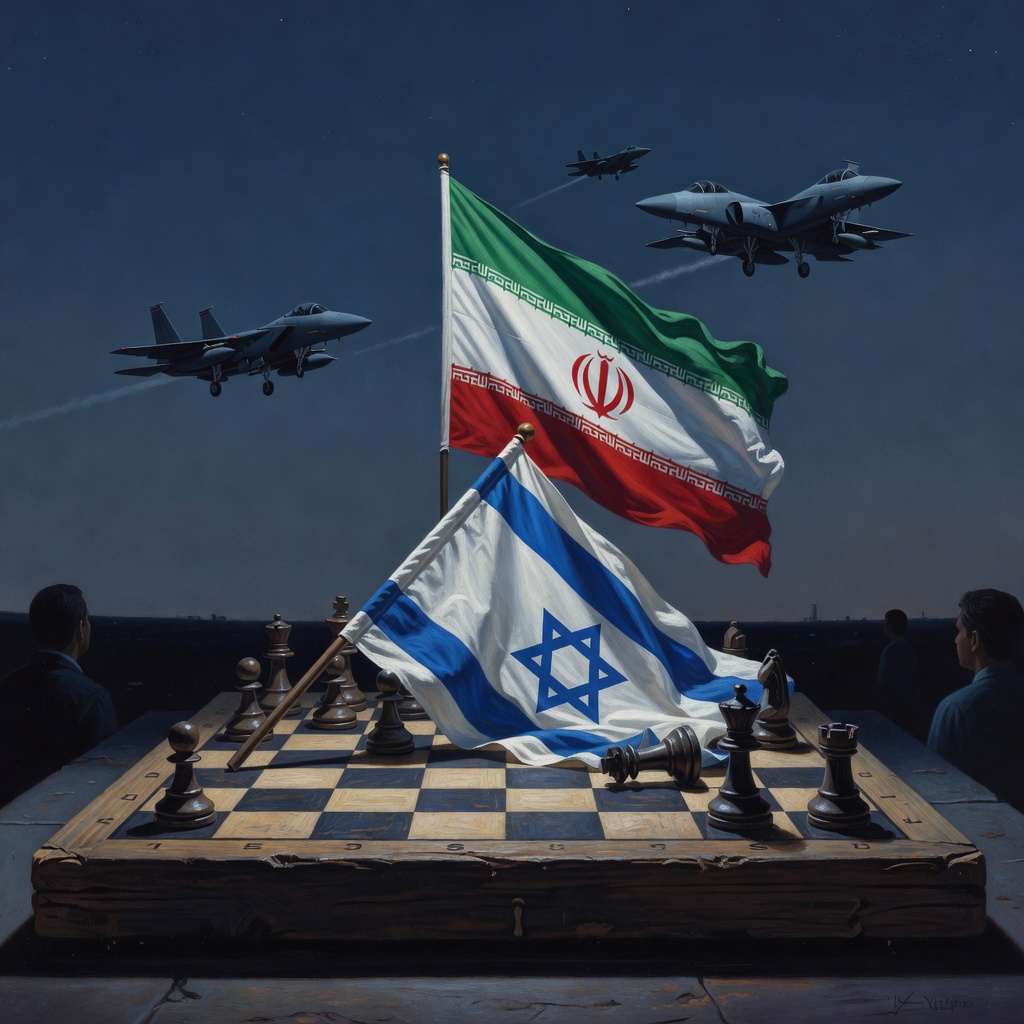
Dr. Nathan Hayes: Millions of Israelis spent nights in shelters. Approximately 1,000 Iranian drones, hundreds of ballistic missiles, dozens killed. That's the return on a war Netanyahu launched February 28th with Trump, with stated objectives — eliminate the nuclear program, destroy the missile arsenal, regime change conditions. Now map that against the actual outcome.
Maya Chen: Which is — Pakistan announces a ceasefire. Israel's not in the room.
Dr. Nathan Hayes: Correct.
Maya Chen: I mean — hmm. There's something almost, sort of vertiginous about that, right? You start a war with your most powerful ally and then he negotiates the ending without you. The Atlantic Council is saying the divergence between Washington and Jerusalem went from 'a gap to a chasm.' And Haaretz — Amos Harel is putting this second only to October 7 as Netanyahu's worst strategic setback. Yossi Verter is calling it a colossal strategic failure for the State of Israel.
Dr. Nathan Hayes: And Yediot Aharonot — 'Bad Deal.' Front page.
Maya Chen: Yeah. That's — that's not a complicated headline.
Dr. Nathan Hayes: But here's what I want to separate out — the condemnation being cross-spectrum, that's real, but it's not actually the new thing. Lapid, Golan, Ben-Gvir all condemning the deal on June 15th — yes. But those three agreeing on anything is almost structurally expected once there's a perceived national humiliation. The mechanism that's new is what happened earlier. Trump criticized Netanyahu over the Beirut strikes mid-negotiation. While the war was still live.
Maya Chen: Wait — during active combat?
Dr. Nathan Hayes: That's the moment. That's when you know your leverage has already collapsed. If your patron is publicly annoyed at you while you're still fighting, you are not — I mean, the negotiating position is gone before you ever get to the table. And Israel never got to the table.
Maya Chen: And then Lapid comes out saying ballistic missiles weren't even in the negotiations — not just excluded from the final text, not even in the room. That's — Netanyahu listed the missile arsenal as a casus belli in February. That's one of the three things he said this war was for.
Dr. Nathan Hayes: Which is structurally what alliance divergence actually means, not just diplomatically — the US wanted an exit, Netanyahu wanted elimination. Those objectives were never going to survive in the same endgame once Trump decided the deal mattered more than the war. And Lapid also flagged that Netanyahu didn't brief him as required by Knesset law.
Maya Chen: Ben-Gvir calling Israel 'not a banana republic' and Golan calling it 'the greatest strategic failure in Israel's history' — I mean, those two men don't share a worldview on almost anything. That's sort of — yeah, that's the signal.
Maya Chen: Hold on, though. Because I want to push back on something — Golan calling this 'the greatest strategic failure in Israel's history,' that's everywhere right now, people are treating it like it's settled. And I'm not sure we can say that yet.
Dr. Nathan Hayes: The finalization window.
Maya Chen: Sixty days. The deal framework deferred finalization sixty days, which means Iran's actual security obligations to Israel are — they're just unresolved. We don't have the document. Lapid saying ballistic missiles weren't addressed, that's a politician's claim, not a confirmed text. I mean, those might be the same thing in the end, but right now we're calling it a catastrophe based on a partial read.
Dr. Nathan Hayes: That's fair on the text. But — right, the structural failure doesn't require the final document. Israel was excluded from the room. Trump criticized Netanyahu publicly during active strikes. Those aren't interpretations of undisclosed terms, they already happened.
Maya Chen: Yeah, and — wait, actually, Netanyahu posted on X claiming Trump reaffirmed Israel's right to self-defense and that any final agreement must eliminate the nuclear danger. That's doing real work domestically. We can't just dismiss it when we haven't seen what the 60-day window produces.
Dr. Nathan Hayes: Amos Harel ranked it second only to October 7 — not first. Even the most damning assessment has a ceiling. Golan said 'greatest in history.' That's not the same claim. We're conflating them.
Dr. Nathan Hayes: Now, here's what actually keeps the question open for me. The 60-day finalization window — if Iran's nuclear program and ballistic missile program both come out unaddressed in the final text, then Israel began this war as a co-belligerent with Trump and ended it on the sidelines. That's not a framing — that's the Times of Israel's own characterization. And the human cost attached to that outcome is... I mean, dozens killed, millions in shelters, and Netanyahu's stated casus belli — the missiles — just... not in the deal. What does that cost get offset against?
Maya Chen: That's — yeah. That's the question underneath everything. Because there's a mother in Tel Aviv, February 2026, 2 AM, sirens, her kids in a shelter, and Netanyahu on her phone earlier that day saying 'we are winning.' Thirty-six hours later, Pakistan is announcing the ceasefire. And she's waiting, right now, sixty days, to find out if the deal that ended all of that even touched the ballistic missiles her children were hiding from.
Dr. Nathan Hayes: And the final text either answers that or it doesn't. We don't have it yet.