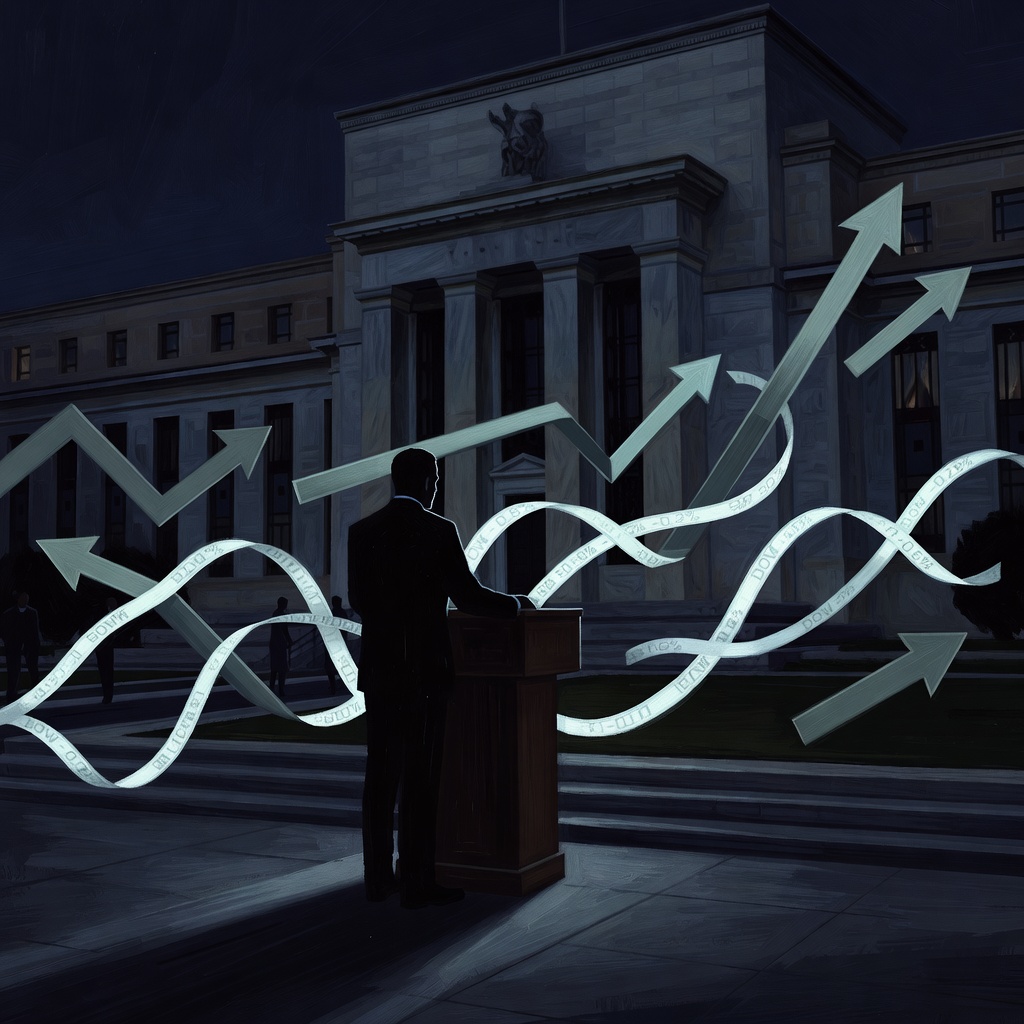
Megan Skiendel: I've been thinking about this since the presser dropped. Warsh — first meeting as Fed chair, June 17th — announces a sweeping operational review of the entire Federal Reserve. At a press conference. His first one.
David Sterling: That's the lead, frankly.
Megan Skiendel: It should be. But everyone's staring at the dot plot. Half the FOMC — nine of eighteen members — penciled in a hike before year-end. The easing-bias language is gone from the statement. And Warsh himself? Didn't submit a dot. No projection at all.
David Sterling: Here's the structure. The Fed's like a thermostat — it hikes when the economy runs hot. The committee just said it might need to go higher. Warsh said nothing. Those are two different signals coming out of one meeting.
Megan Skiendel: Meanwhile they held at 3.50 to 3.75 — unanimously. Inherited from that 75-basis-point cut in late 2025.
David Sterling: 4.2% CPI in May. 4.3% unemployment. Those two numbers don't usually sit next to each other. That's the data set Warsh walked in with.
Megan Skiendel: But here's what actually cuts through the noise. The rate hold was expected. The hawkish dots — Employ America's MacroSuite called that shift weeks ago, said members with a cutting bias had gone neutral, neutral members had gone hiking. Telegraphed. The non-dot, though? No modern Fed chair has refused to submit a projection. Not one. That's not a stylistic preference, that's Warsh betting he can move markets through ambiguity instead of clarity.
David Sterling: Isn't that just Powell without the press kit?
Megan Skiendel: No — actually, it's the opposite. Powell built his entire tenure around forward guidance. Pre-signal the path, collapse uncertainty, let markets price it in gradually. Warsh has said publicly the dot plot 'is not helpful in the conduct of policy.' That's a stated philosophical position. He announced a full communication review at that first presser. He's not tweaking Powell's regime, he's dismantling the machinery.
David Sterling: I mean — wait. The forward guidance framework took fifteen years to build. You're saying he walks in on day one and just... removes the anchor?
Megan Skiendel: That's exactly what the absence signals. Nine officials project a hike. The chair projects nothing. The committee speaks; the chair stays unreadable. That's a power move to hollow out the tool, not skip it once.
David Sterling: Which means the dot plot just became noise. Nine dots with no chair dot attached — the market can't weight that signal. Warsh made the whole instrument unreadable at the one meeting it needed to be legible.
Megan Skiendel: And that's the wrong take circulating right now. That this is a clean policy pivot. Data moved, committee responded, Warsh is the inflation hawk we needed. Neat story. Except — Trump nominated him wanting cuts. And his first meeting produces the most hawkish dot shift in years. That's not data-driven independence, that's credibility insurance.
David Sterling: The data doesn't even warrant hikes mechanically. 4.2% CPI — but the driver is Iran energy prices. That's a supply shock. You don't raise rates to fix a refinery.
Megan Skiendel: No. You don't. But inside those buildings, the reputational cost of looking soft on inflation always overrides the technical argument. Always.
David Sterling: Robin Brooks made this point — the 2013 taper tantrum precedent. The signal is the tool. You tighten financial conditions through communication, 2-year yields reprice, gold sells off — which happened — and you never actually hike.
Megan Skiendel: The bluff-as-policy reading. Yeah, I think that's closer.
David Sterling: Well — and here's where the timing gets uncomfortable. A tentative Iran ceasefire announced basically concurrent with the meeting. If energy prices cool in the next CPI read, those hawkish dots could look premature within weeks. The committee just moved hawkish on a shock that may already be fading.
Megan Skiendel: And Warsh — who submitted no dot — gets to say he never committed. That's not a coincidence. That's the hedge.
David Sterling: The hedge only holds until the next CPI print. If inflation cools — Iran ceasefire, energy prices drop — then nine dots said hike and nothing happened. Warsh gets cover because he submitted nothing. But the committee doesn't. They're exposed.
Megan Skiendel: The committee takes the reputational hit. Warsh walks away unreadable. That's — honestly, that's the cleaner power move than I initially gave him credit for.
David Sterling: And if inflation doesn't cool? If the next read comes in above 4.2%? Then the dots weren't a bluff — they were a commitment the chair never personally made. He either follows through on the hawkish signal the committee built, or he cuts anyway and — I mean, that's when the credibility question stops being theoretical.
Megan Skiendel: Nick Timiraos called this the patience-versus-pivot question. And he's not wrong — but I think the framing undersells it. It's not patience. It's a chair who structurally cannot be pinned down by his own institution's primary forecasting tool.
David Sterling: Which is — wait, that's a stagflation problem too. Gayed's read on the June SEP. If the committee is quietly admitting stagflation and Warsh stays ambiguous, markets eventually force the clarification anyway. You can't taper-tantrum your way out of a sustained supply shock.
Megan Skiendel: So the real question isn't whether Warsh is hawkish or bluffing. It's whether — when that clarification comes, and it will — he's built enough ambiguity to absorb it, or whether he's just deferred the credibility reckoning by one quarter.