Megan Skiendel: Name the scandal. Not the crash — the thing that happened after the crash.
David Sterling: Elluswamy.
Megan Skiendel: Ashok Elluswamy, Tesla's head of self-driving, disputes publicly that Autopilot was active — while the Harris County Sheriff's Office is on record saying Michael Butler told investigators it was. NHTSA opens a formal Special Crash Investigation on June 22nd. The inquiry isn't closed. And Tesla's already contesting the premise.
David Sterling: Before any findings.
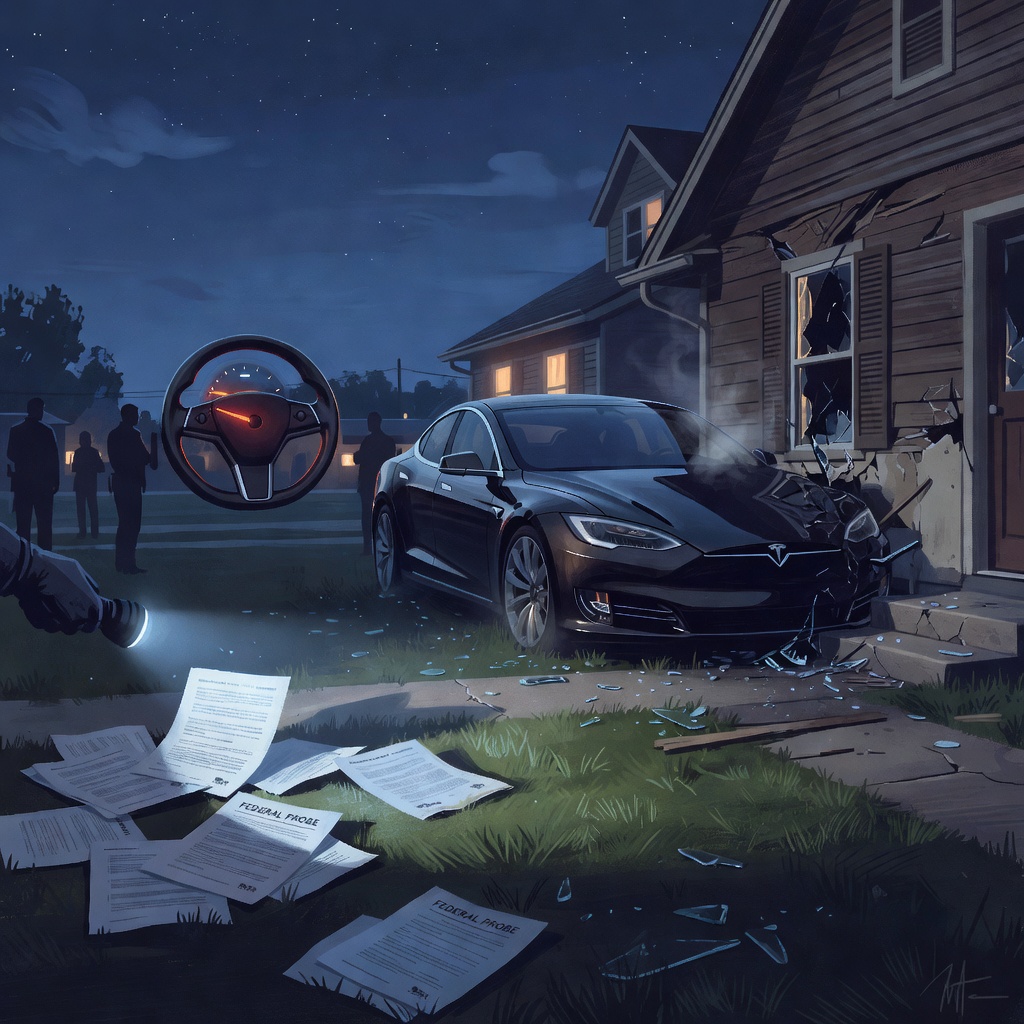
Megan Skiendel: A 76-year-old woman — Martha Avila — is in her front room on Blooming Park Lane when a Model 3 comes through the wall. She's airlifted to Memorial Hermann. She dies. And the week's dominant question becomes whether Autopilot was technically engaged. Not how this happened.
David Sterling: That reframe — is that strategic incompetence or actually sophisticated?
Megan Skiendel: Oh, it's sophisticated. I've watched that exact move work before. You don't need to win the argument. You just need to create the argument.
David Sterling: Right, but let me pump the brakes on that for a second. Because the Elluswamy move is interesting — it is — but it's not the load-bearing fact. The load-bearing fact is that NHTSA has opened nearly 50 Special Crash Investigations into Tesla Autopilot incidents since 2016. Roughly 24 deaths across those cases. No systemic recall. Think of it like a fire inspector who keeps filing reports on the same building — different folder every time, owner disputes every finding, building stays open. That's the pattern. Elluswamy is one more dispute in a decade of disputes.
Megan Skiendel: Fifty investigations.
David Sterling: Nearly fifty. And here's the point — this crash doesn't arrive as a standalone trigger. NHTSA had already escalated a separate, broader probe in March 2026. Three months before Katy. That probe covers 3.2 million Tesla vehicles running Full Self-Driving. So the regulatory posture was already stressed before this Model 3 went through Martha Avila's wall.
Megan Skiendel: Wait — so FSD and Autopilot are actually two different investigations.
David Sterling: Yes. Autopilot is the system in those fifty crash files. Tesla Full Self-Driving is the separate March probe — 3.2 million vehicles, hazard detection in poor visibility. Two tracks. The Texas crash lands inside the Autopilot track, not the FSD track. Though frankly, I think that distinction collapses under litigation eventually.
Megan Skiendel: So the narrative question — Autopilot on or off — it's almost beside the point, structurally. Because the investigation was already live before Michael Butler said a word to the Harris County Sheriff.
Megan Skiendel: And that's where I want to push, because — okay, the regulatory track record, you're right. But Tesla's '7x safer' claim. That's both their shield and, honestly, I think it's the thing that eventually breaks them. Because the methodology — they're excluding Autopilot data. The system that shows up in every single one of those fifty crash files. They're benchmarking against average human drivers, not highway driving. That's not a stats quibble. That's Tesla being the only person in the room writing the rules.
David Sterling: For years. No regulatory counterweight forcing a different methodology.
Megan Skiendel: Right. So when that number gets challenged — and it will, in discovery — the evidentiary ground they've been standing on collapses. That's not anecdotal.
David Sterling: I'll take that. The methodology flaw is real. That's actually the stronger liability angle than the Elluswamy dispute. What about the location — Martha Avila dying inside her home. Does that move legislators, or is that purely optics?
Megan Skiendel: It moves them. Listen — a highway fatality, legislators can abstract that. Distance themselves. But a 76-year-old woman in her front room in Katy, Texas? That's somebody's constituent's mother. The car came through the wall. That image — I don't think NHTSA's process changes, but the political pressure on legislators to demand answers from NHTSA? That's different calculus entirely.
David Sterling: The process stays the same. The pressure on the process changes. I'll grant that.
David Sterling: Fine. I'll give you the home optic — it's real, it lands differently with a legislator than a highway fatality does. But here's the point: NHTSA had 3.2 million Tesla vehicles under an escalated FSD probe before Martha Avila died in her living room. That's the predicate. That already existed. So the question isn't whether this crash is the one that forces action. The question — and I don't think anyone's answered it — is what would ever be sufficient. If that probe doesn't produce a recall or a design mandate before Tesla's FSD monetization reaches critical mass, I mean — what is the bar? Actually, I'm not sure there is one.
Megan Skiendel: And Elluswamy's denial is sitting inside that unanswered question. NHTSA's Special Crash Investigation has to resolve who made that call — to go public before findings. That's not a footnote.
David Sterling: We'll know by end of 2026 whether the existing investigation produces anything. Or whether file number 51 just opens.