Marcus Vale: Martha Avila Mantill. That's the name everyone should know coming into this.
Ben Okonkwo: Oh — yeah. Seventy-six years old. Inside her own home.
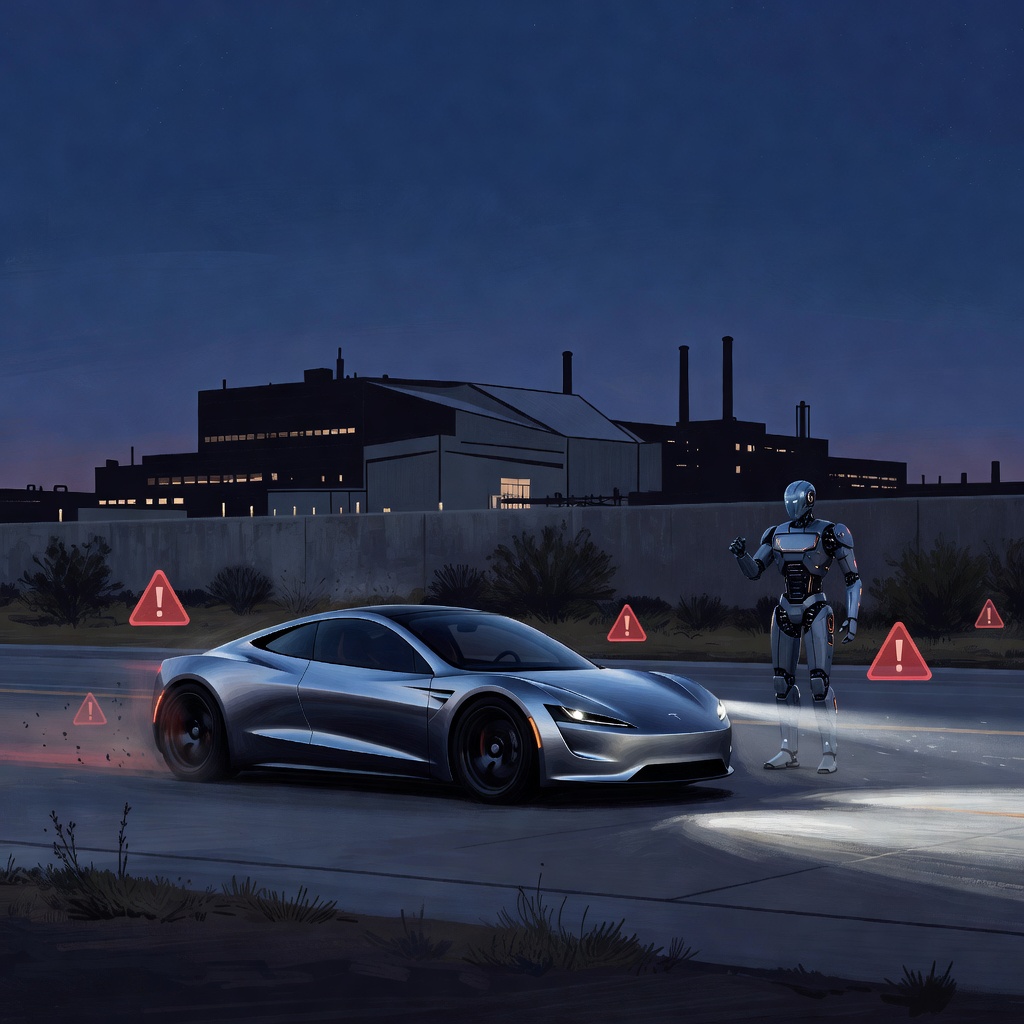
Marcus Vale: A Tesla Model 3 leaves the road in Katy, Texas — June 19th — crosses a yard, goes through a brick house. Driver tells Harris County Sheriff's Office he was running an automated driving feature. Someone's home security camera gets the whole thing and it ends up online. That's your trigger. NHTSA escalates to engineering analysis the next procedural step before a formal recall demand. Covers 3.2 million vehicles — every FSD-equipped Model S, Model X, Model 3, Model Y, Cybertruck.
Ben Okonkwo: Now — engineering analysis is interesting, right, because NHTSA at that stage is asking a structural question. Not just did the software glitch, but can this sensor architecture actually guarantee the failure mode gets detected.
Marcus Vale: Nine crashes linked to FSD low-visibility. One fatality. And Tesla's stock drops five percent — same week they're setting up Giga Texas for August. Roadster, Optimus, the whole show.
Ben Okonkwo: That timing is — yeah, that's uncomfortable.
Ben Okonkwo: Think of it like a dashboard warning light. It's not just that your brakes are wearing out — it's that the light never turned on to tell you. That's the actual charge. NHTSA isn't saying cameras can't see in fog. Every camera fails in fog. The question is whether Tesla Vision notified the driver that it was failing.
Marcus Vale: Silent degradation.
Ben Okonkwo: Right. And that's — okay, that's what makes this escalation different from every prior inquiry. NHTSA at engineering analysis can compel a recall. Of 3.2 million FSD-equipped vehicles. That's not a PR problem, that's a hardware question. And the hardware in question is Tesla Vision specifically — the camera-only architecture Tesla moved to when they pulled radar in mid-2021.
Marcus Vale: Which was supposed to be the flex. 'Radar is a crutch, we're beyond that.' Now NHTSA is probing the exact failure mode radar would've caught.
Ben Okonkwo: Exactly — and then layer the Musk Q1 call on top. He said it's literally impossible to predict Optimus and Cybercab scaling timelines, revenue impact pushed to 2027. Then Tesla is framing August Austin launches as momentum. But — and this matters — those Optimus Gen 3 units at Fremont and Giga Texas? Over a thousand of them deployed, but they're in a learning and data-collection phase. Not shipping product.
Marcus Vale: So the signal is more specific than the headline. NHTSA's probe isn't 'FSD bad.' It's 'can camera-only architecturally guarantee the driver knows when the system is blind.' That's a different question entirely.
Ben Okonkwo: The take I keep seeing — and I think it's wrong — is that the five percent drop is just sentiment. Analysts framing it as temporary pressure on the AI narrative, something long-term holders should buy through. But that logic only works if the problem is firmware. If NHTSA's engineering analysis concludes that Tesla Vision architecturally cannot guarantee detection of degradation in low-visibility — not a bad update, not a tuning issue, the camera-only structure itself — you're not patching that. You're in a hardware recall cycle. That's years, not quarters.
Marcus Vale: And Cybercab runs on the same stack.
Ben Okonkwo: Exactly. FSD and Cybercab are the same underlying technology. A forced rollback doesn't delay the robotaxi thesis — it collapses it. The $1.2 trillion valuation is pricing in that commercial story.
Marcus Vale: Tesla's counter is always the safety statistics — system is safer than a human driver, full stop. Does that actually refute NHTSA's pattern, or does it just... reframe around it?
Ben Okonkwo: That's the right question. Because — wait, actually — the issue is whether low-visibility edge cases are specifically excluded from the data Tesla submits to regulators. If those nine crashes aren't in the denominator, the statistic doesn't address the failure mode at all. It's answering a different question.
Marcus Vale: And BYD's taking automotive share while this drags. Auto revenue already down ten percent in 2025. xAI's Digital Optimus collaboration — Grok technology, real-time actions — the commercial timeline on that is just as murky. The regulatory window keeps narrowing and the moat keeps shrinking.
Marcus Vale: The August Austin launch. That's the thing I can't square. If Musk knows NHTSA's engineering analysis is coming — and he has to know — staging a Roadster and Optimus demonstration at Giga Texas either means he's confident the probe goes nowhere, or he's burning runway he doesn't actually have.
Ben Okonkwo: Or — wait, actually — it's not confidence, it's sequencing. The launch happens before the engineering analysis concludes. So the narrative is momentum, and by the time NHTSA rules, the launch is already in the rearview.
Marcus Vale: That's a bet on timing. And the Cybercab commercial thesis doesn't survive a hardware finding — not a two-quarter delay, a structural unwind. That's what nobody's pricing.
Marcus Vale: Frankly — if NHTSA's engineering analysis lands on Tesla Vision as the structural problem, the question isn't whether FSD survives. It's whether Tesla can simultaneously execute a hardware redesign cycle and still be the company that ships Cybercab before anyone else does.
Ben Okonkwo: And the honest answer is — I don't know what experiment Tesla could run that would settle it before the regulator does. So what actually happens to the Cybercab launch date if NHTSA's conclusion is that no camera-only system can structurally guarantee degradation detection?