Eleanor Crane: Long week — I've been staring at this Nvidia-Sega thing since Tuesday and I still don't know if it's a love story or a press strategy.
Ben Okonkwo: Interesting — why not both, is what I'd normally say, but here I'm actually not sure the two are compatible.
Eleanor Crane: Here's what actually happened. July 15th, Akihabara — and Akihabara matters, that's Tokyo's gaming and electronics district — Nvidia holds this event. Jensen Huang is there, Haruki Satomi, Shuji Utsumi, Yu Suzuki who created the original Virtua Fighter, and Shoichiro Irimajiri. The announcement: Sega games, including a new title called Virtua Fighter Crossroads, are coming to RTX Spark.
Ben Okonkwo: Sixth mainline Virtua Fighter entry. That's not a legacy port — that's a new game built to be the centerpiece of this.
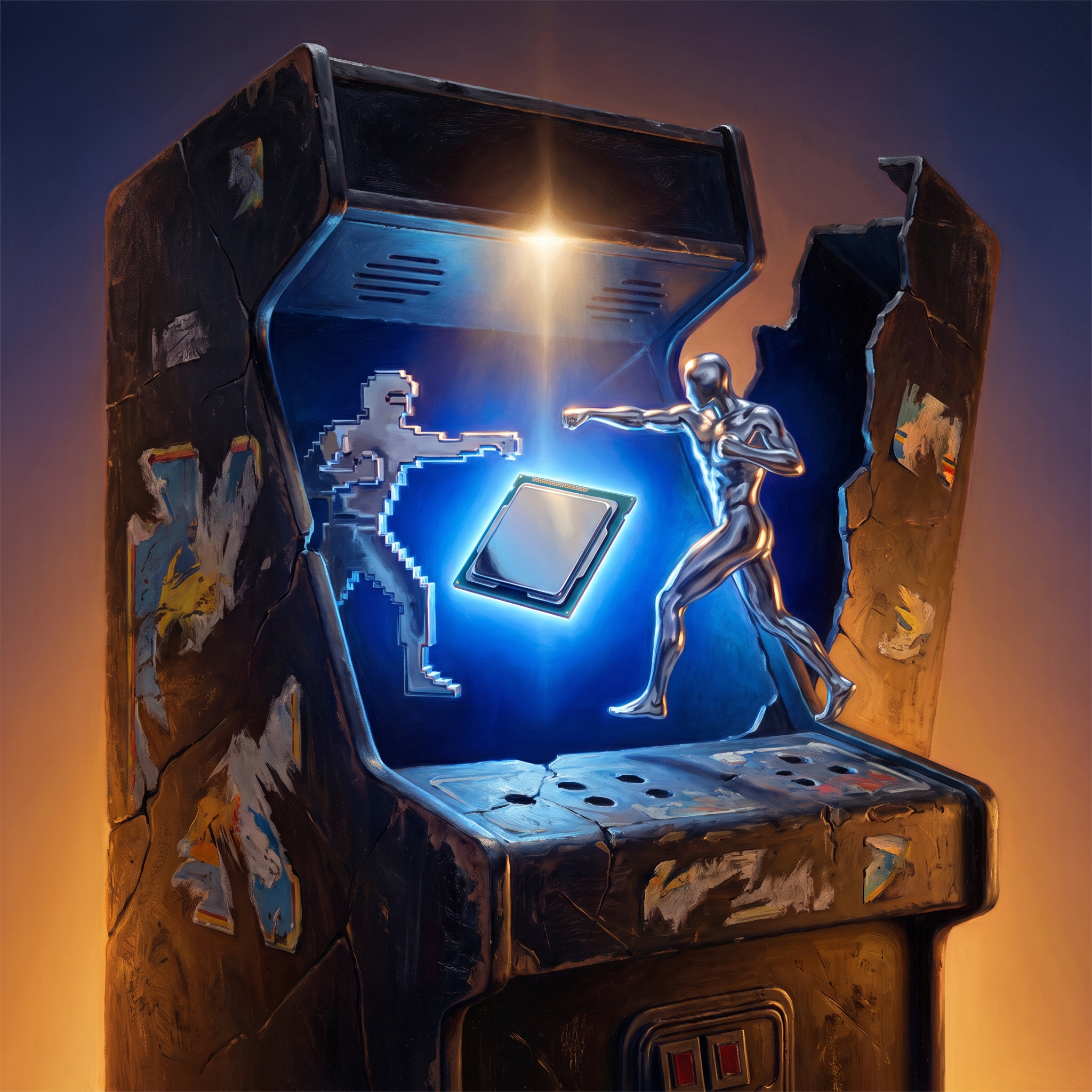
Eleanor Crane: And they're calling it a thirty-year reunion, which points back to the NV1 — Nvidia's first graphics chip, 1995, designed specifically so Sega Saturn games could be ported to PC. Irimajiri put in five million dollars when Nvidia was, by Huang's own account, weeks from going under.
Ben Okonkwo: Right — but here's what that reunion framing quietly obscures: in 1996, Sega wasn't a scrappy underdog taking a faith-based gamble. They were the dominant arcade and console company. That five million was not survival money for Sega. It was a choice.
Eleanor Crane: Which makes it — I don't know, more interesting, not less. And Irimajiri was there. In Akihabara. Thirty years later.
Ben Okonkwo: And Nvidia is now worth trillions. That's a very different room than the one where the check was written.
Eleanor Crane: But that room only exists because of a chip that — I mean, Jensen Huang himself called the NV1 fundamentally flawed. Not misunderstood. Not ahead of its time. Flawed.
Ben Okonkwo: Which is the thing the reunion narrative quietly buries. Think of it this way: imagine two different plug shapes. Nvidia built a plug for Sega's wall. Then the entire industry switched to a different wall. That's what happened. The NV1 used a different method for mapping textures onto geometry — and when Microsoft locked in the triangle standard with DirectX, Nvidia's approach was just... incompatible. Architecturally incompatible. Not close. Not fixable.
Eleanor Crane: And it was sold to actual consumers. The Diamond Edge 3D card — Diamond Multimedia put it in boxes on shelves in 1995.
Ben Okonkwo: Right — and those consumers had a card that couldn't run the games the whole industry was moving toward. The NV1 was designed specifically to port Sega Saturn games to PC. So when the Saturn started losing the console war, Nvidia's chip lost the PC war simultaneously. Two sinking ships, actually — wait, that's not quite right. One sinking ship pulling the other down.
Eleanor Crane: So what is actually being celebrated in Akihabara?
Ben Okonkwo: Survival despite the failure. Not because of the chip — the chip was a dead end. Because Sega's five million kept Nvidia alive long enough to build something different. The RIVA 128 comes later, and that one wins. But none of that exists without the money that came in on the back of a product both companies now quietly disown.
Eleanor Crane: Which is — I don't know, that's a stranger story than the one they're telling.
Ben Okonkwo: It's stranger and it's more honest. The NV1 isn't a founding legend. It's a founding mistake that got funded anyway. That's what Irimajiri actually bet on.
Eleanor Crane: And that's the take I keep seeing get it wrong — the 'reunion of equals' framing. That these were two companies who bet on each other. But Sega wasn't betting on a peer. Irimajiri was the president of the dominant arcade and console hardware company on earth, and he wrote a check to a startup building a chip he had to know was already losing.
Ben Okonkwo: Although — wait, is that faith, or is it pipeline protection? Sega had Saturn games. NV1 was literally engineered to port them to PC. Maybe Irimajiri was just buying a distribution channel.
Eleanor Crane: Maybe. But the chip was already incompatible with where the industry was going when he signed. A distribution channel that doesn't work isn't a distribution channel — it's a donation.
Ben Okonkwo: That's fair. And the number matters here — five million dollars, equity, not a licensing fee. Equity in a company Huang has said was weeks from going under. That's not vendor management.
Eleanor Crane: No, it isn't. And then the RIVA 128 comes out of that funding — the GPU that actually works, the one that wins — and everything Nvidia becomes traces back through that moment. Three trillion dollars, eventually. From a five million dollar check that didn't have to happen.
Ben Okonkwo: Right — but now in Akihabara it's fully inverted. Sega needs Nvidia's platform to matter. That's the part the 'reunion' framing just... smooths over.
Eleanor Crane: Which is why Irimajiri being in that room is the actual story. Not the announcement. He could have let thirty years pass quietly. He showed up.
Ben Okonkwo: Hm. The human fact, yeah. Though — and I'm flagging this because we haven't touched it yet — whether Virtua Fighter Crossroads actually runs natively on RTX Spark's Arm architecture, or whether Nvidia is dressing up a translation layer as a technical partnership, that changes everything about what Sega is actually offering here.
Eleanor Crane: And that's the question that sits underneath all of this — whether the thing being celebrated is a genuine technical commitment or a very elegant piece of marketing symmetry. We'll get there.
Ben Okonkwo: And that Arm question — that's actually the load-bearing part of all of this. RTX Spark isn't a gaming PC that also does AI. It's an AI machine — Grace CPU, Blackwell GPU, NVLink-C2C connecting them, roughly one petaflop of compute. That spec profile is built for inference workloads. Gaming legitimacy is the thing it needs from Sega, not the thing it offers.
Eleanor Crane: So Sega isn't a launch partner. They're a credibility prop.
Ben Okonkwo: A recruitment poster, more precisely. If Virtua Fighter Crossroads ships on RTX Spark, Nvidia can walk into any publisher's office and say — Sega came. The company that saved us is here. Now what are you doing? That's not a technical argument. That's social proof dressed as heritage.
Eleanor Crane: Which only holds if Virtua Fighter Crossroads is actually running native on Arm. Because if it's a translation layer — if it's emulation dressed as a port — then what Sega is actually offering is their name, not their code.
Ben Okonkwo: And the announcement doesn't confirm it. Virtua Fighter Crossroads will support DLSS, it'll run on GeForce RTX PCs and laptops — that much is stated. Whether it runs natively on RTX Spark's Arm architecture? Explicitly unconfirmed. That's not an oversight. That's a gap.
Eleanor Crane: Wait — explicitly unconfirmed, or just not mentioned?
Ben Okonkwo: Not mentioned, which at this stage of a platform launch is — I mean, that's the question every developer is going to ask before they commit porting resources. Windows on Arm native support has been patchy for years. If the answer were clean, you'd say it.
Eleanor Crane: So the thing to actually watch isn't whether more publishers follow Sega's announcement — it's whether Virtua Fighter Crossroads ships native before RTX Spark does. That's the proof of concept that either validates the whole story or quietly hollows it out.
Ben Okonkwo: Exactly that. And watch which publishers follow — not which ones announce. Because if the Sega recruitment strategy works, you'd expect native Arm ports from at least one major third-party before launch. If all you see is DLSS support and GeForce compatibility, the platform is still waiting for someone to actually build for it.
Eleanor Crane: And that's what matters. Not whether the announcement was real — Irimajiri showed up, Yu Suzuki showed up, the people who actually built the first chapter came to Akihabara to witness what came next. That's not something you manufacture. But whether it mattered — whether any of this mattered — that's entirely contingent on whether RTX Spark becomes somewhere people actually play games, or whether it just stays an AI appliance with Virtua Fighter Crossroads as a very expensive piece of wallpaper.
Ben Okonkwo: A thirty-year franchise returning as the flagship for a next-generation platform — that's either the opening line of a real story or the most expensive footnote Sega has ever written. And I genuinely don't know which.
Eleanor Crane: The question I'm left with — and I don't have an answer — is whether Irimajiri knew that when he walked into that room. Whether he understood that the reunion itself might be the whole story, and what comes after is just... contingent.
Ben Okonkwo: Hm. Yeah. I think that might be the right place to stop.