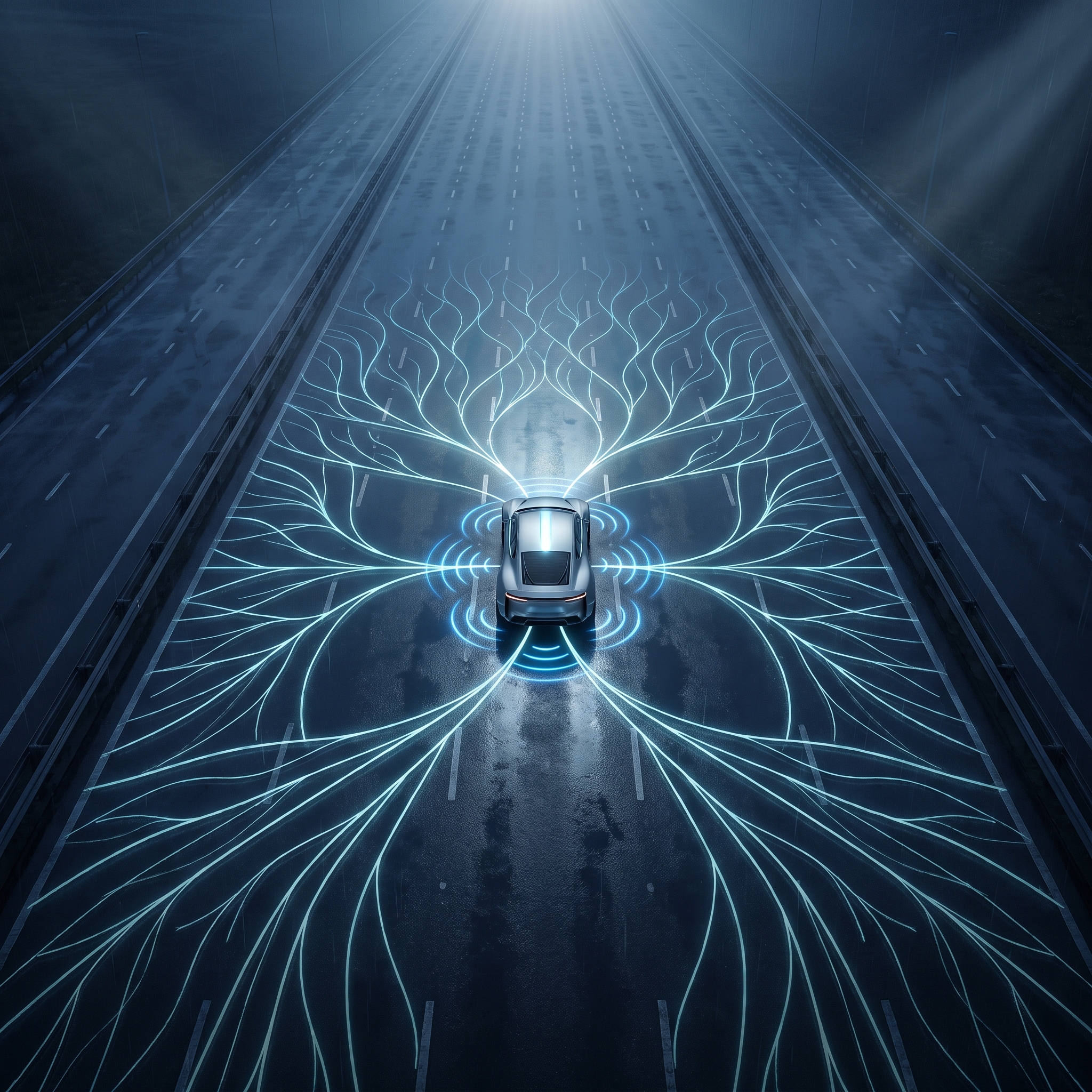
Michael C. Vincent: Waymo put cars on a Phoenix freeway this morning — first time since early June.
Michael C. Vincent: Two months. A documented priority-conflict failure. NHTSA Part 573, report 26E035, 3,871 units of the 5th Generation Automated Driving System. That's what the pause looked like on paper.
Michael C. Vincent: And the morning Waymo gets back on the highway — that SAME morning — NVIDIA releases Alpamayo 2 Super.
Michael C. Vincent: Not unveils. Releases.
Michael C. Vincent: Jensen Huang posted on X. The weights are on Hugging Face. The license — OpenMDW-1.1, Linux Foundation — permits fine-tuning, derivatives, commercial redistribution. That distinction matters, honestly. The unveiling was May 31st at GTC Taipei. Today is the commercial gate opening. Those are different events, and I think they get collapsed when people write about this.
Michael C. Vincent: What they're releasing is a 34-billion-parameter open reasoning VLA model. Vision, language, action. Built on Cosmos 3 Super Reasoner — 32 billion parameters of language-reasoning backbone — with a 2-billion-parameter Action Expert on top. That's the architecture. That's where the number comes from.
Michael C. Vincent: The Alpamayo family — not just this model, the whole family — has cleared 500,000 downloads on Hugging Face. Most-adopted open AV reasoning model on the platform. And that's before today. Before the commercial license even dropped.
Michael C. Vincent: So here's the scene you're walking into.
Michael C. Vincent: On one side of the ledger: NVIDIA, Jensen Huang, a model that half a million people have already pulled, now open for commercial use. On the other: Waymo, cautiously back on a freeway, fresh off a federal recall filing and two months of introspection.
Michael C. Vincent: One story is about potential. The other is about what happens when potential meets pavement — and what the gap between those two things actually costs.
Michael C. Vincent: Now, NVIDIA's answer to all of this — to the regulators, to the skeptics, to anyone watching Waymo file Part 573 paperwork — is a thing called Chain-of-Causation reasoning traces.
Michael C. Vincent: The idea is that Alpamayo 2 Super doesn't just act. It outputs an auditable rationale for why it acted. A trace. You can inspect it.
Michael C. Vincent: That's the inspectability bet.
Michael C. Vincent: And it's a genuinely interesting bet. I mean, if you believe the core problem with AV failures is opacity — that engineers can't reconstruct why a car did what it did — then a model that narrates its own reasoning before acting is… well, it's a different kind of tool.
Michael C. Vincent: Then let me tell you about June 20th in Las Vegas.
Michael C. Vincent: A Zoox robotaxi drove into heavy smoke from an active fire scene. Not toward the smoke. Into it. Braked hard. Stopped. Went nowhere.
Michael C. Vincent: A human teleoperator had to reverse it out.
Michael C. Vincent: No injuries. But sit with that image for a second — a vehicle that passed every test, deployed on public streets, meeting smoke, and just… stopping. The system had no useful answer for that moment.
Michael C. Vincent: July 8th, Zoox recalled all 105 of its robotaxis. Every one. Pushed an OTA software update specifically to improve heavy-smoke detection. And NHTSA made its position clear: emergency-scene failures are not acceptable edge cases.
Michael C. Vincent: Not edge cases. That word choice matters.
Michael C. Vincent: Now cut to Tesla's July earnings call. Elon Musk, optimistic framing, forward momentum, the whole architecture of confidence. Meanwhile the actual numbers showed flat mileage and a shrinking fleet. Those two things were in the same call.
Michael C. Vincent: Which brings me to the structural problem with Alpamayo 2 Super — and this is the one I keep turning over.
Michael C. Vincent: OpenMDW-1.1 — Linux Foundation — permissive by design. Anyone can fine-tune it, build a derivative, redistribute it commercially. NVIDIA cannot control what those derivatives encounter before they're deployed. There's no validation gate in the license. There isn't one.
Michael C. Vincent: AlpaGym gives you closed-loop RL training in simulation. Cosmos-Dreams generates rare scenarios. That's the pipeline NVIDIA built. But simulation is still simulation.
Michael C. Vincent: At WAIC 2026 in Shanghai, UCL professor Wang Jun said it plainly — most embodied RL claims rely on distillation, not genuine real-robot training. And there are no third-party evaluation standards. None that mean anything.
Michael C. Vincent: So the honest question — and I mean honest — is whether Chain-of-Causation traces are real causal understanding, or post-hoc rationalization dressed up as transparency.
Michael C. Vincent: A trace that says "I braked because I detected an obstacle" is useful. A trace that says "I braked because I detected an obstacle" — and the obstacle was smoke, and the car stopped dead in a fire scene — that's a very articulate failure.
Michael C. Vincent: That gap — between a model that can explain itself and a vehicle that actually handles the world — is exactly the gap nobody has closed. And today, with weights live on Hugging Face and an OpenMDW-1.1 license that permits everything, that gap just got a very large distribution network.
Michael C. Vincent: This is the part that's still open, still moving.
Michael C. Vincent: Picture a mid-tier AV supplier. Not Waymo, not a name you'd recognize at a dinner table. They pull Alpamayo 2 Super from Hugging Face today — legal, clean, OpenMDW-1.1 says go ahead — and they fine-tune it on their proprietary dataset. Maybe two years of dashcam footage from a regional market. Maybe less. They run it through AlpaGym, NVIDIA's closed-loop RL framework, log the Chain-of-Causation traces, and their internal review team looks at those traces and says: coherent, consistent, ship it.
Michael C. Vincent: And that last part is the problem.
Michael C. Vincent: Internally coherent is not the same as externally validated. A trace that reads cleanly against your own training data tells you almost nothing about what the model does when it meets smoke at an active fire scene — a scenario it never saw, because Cosmos-Dreams can generate it in photorealistic simulation, but only if someone thought to ask for it, only if someone at NVIDIA or your company actually built that scenario into the pipeline. That's not a third-party evaluation regime. That's NVIDIA's toolchain doing what NVIDIA's toolchain does.
Michael C. Vincent: Wang Jun's point at WAIC 2026 — no third-party evaluation standards — that wasn't a theoretical concern. That's the regulatory vacuum this derivative lands in.
Michael C. Vincent: Waymo had to file Part 573 with NHTSA. Report 26E035. 3,871 units. A named failure mode, a federal record, a paper trail. That disclosure requirement exists because Waymo's vehicles are on public roads under a known regulatory framework. What's the equivalent obligation for a company that builds on OpenMDW-1.1 and ships a derivative? There isn't one. Not yet.
Michael C. Vincent: That question is genuinely open.
Michael C. Vincent: The Linux Foundation governs the license. NHTSA governs the vehicles — in theory. But the space between a model weight on Hugging Face and a vehicle on a public road… that space has no mandatory disclosure requirement attached to it. No Part 573 equivalent. No third-party stress test that has to happen before a derivative ships.
Michael C. Vincent: So that's what I'm watching. Not whether Alpamayo 2 Super works. It may well work — the architecture is serious, the download numbers were serious before the commercial gate even opened. What I'm watching is whether any regulatory body, any standards organization, moves to require independent validation for open model derivatives before they reach pavement. Because right now, the only thing standing between a coherent trace and a car stopped dead in a fire scene is the judgment of the company that trained it.
Michael C. Vincent: OpenMDW-1.1 makes the reasoning visible. That's real. That's not nothing. A Chain-of-Causation trace is more than most deployed systems have ever offered — more than anything Waymo filed in report 26E035, more than Zoox had on June 20th when that car stopped dead in the smoke and waited for a human to come get it. The architecture is serious, the inspectability bet is serious, and I'm not dismissing it.
But visible is not the same as tested.
The license that lets you inspect every derivative is the same license that has no mechanism — none — for knowing whether any given derivative has ever encountered the scenario that would break it. OpenMDW-1.1 opens the reasoning. It doesn't close the deployment gap.
Michael C. Vincent: The weights are on Hugging Face right now.