Max Rivera: There's a question I can't fully answer yet — and honestly it's the reason I wanted to do this in the first place: when does physical AI stop being a marketing term and start being a real thing?
Max Rivera: Because July 16, 2026 — something happened that might actually be the answer.
Max Rivera: Kawasaki Heavy Industries and Nvidia announced they're co-developing a next-generation AI-powered digital shipyard. At Sakaide Works, in Kagawa Prefecture, Japan.
Max Rivera: Physical AI — Nvidia's own term, by the way — means AI built to run in the real world. On robots, on edge hardware, inside environments that do not care how elegant your model is. Not in a cloud. Not answering prompts. Actually doing things.
Max Rivera: And a shipyard is about as real-world as it gets.
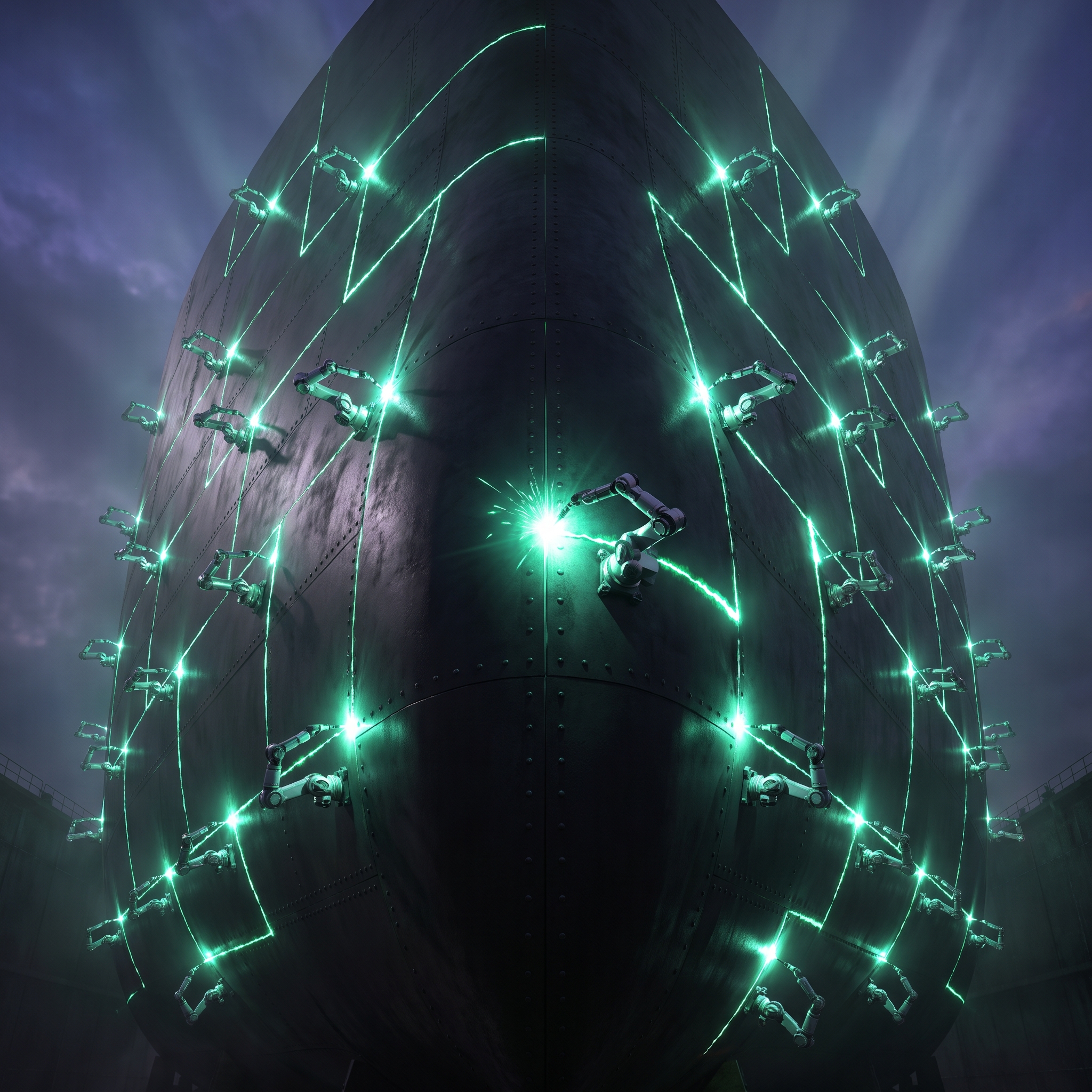
Max Rivera: Welding. Painting. Inspection. Material handling. Those are the tasks this partnership is targeting — the core physical work of building a ship, the stuff that still requires skilled human bodies because the environment is too variable, too loud, too physically punishing for most automation to stick.
Max Rivera: Kawasaki's there because Japan has a structural labor problem — a shrinking workforce that's hitting heavy industry hardest. That's the stated driver. The why-now.
Max Rivera: Nvidia's bringing — wait, let me just say this plainly — the full stack. Cosmos, Omniverse, Isaac, Metropolis, Jetson. Every platform they have for industrial physical AI, into one project.
Max Rivera: That's not a partnership where one company lends some software.
Max Rivera: And Kawasaki isn't just a client — they're bringing operational data, process expertise, existing robotics capabilities that Nvidia simply doesn't have. This is genuinely bilateral.
Max Rivera: So back to that question: when does physical AI become real? Maybe when someone puts the whole bet on a shipyard in Kagawa Prefecture and dares it to work.
Max Rivera: That's where we're starting.
Max Rivera: Japan's working-age population isn't shrinking in a slow, manageable way. It's in structural decline. And heavy industry — shipbuilding especially — is where that hits hardest.
Max Rivera: Because welding the interior of a ship hull, painting inside a confined ballast tank, doing precision inspection on curved steel — these aren't jobs you fill with a general-purpose temp worker. These are skilled trades. Years to build.
Max Rivera: And those workers are aging out.
Max Rivera: So when Kawasaki says the labor shortage is the primary driver here — that's not PR language. That's a company watching a real capability gap open up in real time and deciding the only way through is automation. Not eventually. Now.
Max Rivera: Which is why the digital shipyard concept matters so much. The ambition isn't just 'robots instead of people.' It's a fully integrated production system — design, procurement, construction, inspection, quality management — all feeding into a single data flow.
Max Rivera: Powered by digital twins.
Max Rivera: Nvidia Omniverse is the foundation for that — a real-time virtual replica of the entire Sakaide Works facility. Every crane, every hull section, every weld path, mirrored in simulation. You test things in the twin before you run them on steel.
Max Rivera: Isaac handles robot training — you teach the robot in simulation, then deploy it. Cosmos gives you the underlying physics, the world models that let the simulation actually resemble — or try to resemble — the real environment. Metropolis handles vision AI, inspection, monitoring. And Jetson runs inference right on the edge, on the actual hardware at the shipyard floor.
Max Rivera: On paper? That's a complete stack.
Max Rivera: And this is where I genuinely don't know the answer — none of that has been stress-tested against an actual working shipyard.
Max Rivera: Picture a robot assigned to weld inside a curved hull section that no simulation fully anticipated. The geometry's slightly off from the model. There's residual heat warping the steel. The light is wrong, the space is tight, and the surface has mill scale on it that wasn't in the digital twin.
Max Rivera: What does Isaac do with that? What does Cosmos do with the gap between the simulated world and THAT?
Max Rivera: That's not a theoretical edge case. That's Tuesday at Sakaide Works.
Max Rivera: The entire bet — Nvidia's stack, Kawasaki's data, the digital twin architecture — all of it comes down to whether simulation-trained AI can survive contact with an environment that simply does not care how elegant the model is. That's the gap. And nobody's closed it yet.
Max Rivera: But here's what nobody's actually telling you about this deal.
Max Rivera: No financial terms have been disclosed. None. No dollar figure, no equity split, no licensing structure — nothing that would tell you how serious either side's skin-in-the-game actually is.
Max Rivera: And no operational timeline. No milestone. No announced date when the first AI robot is supposed to strike an arc at Sakaide Works.
Max Rivera: Which — look, that matters. Because the coverage window here was July 29 through August 2, 2026, and if you read five different outlets reporting on this deal, you were largely reading the same press release repackaged. It's really hard to separate genuine development from announcement momentum when the sourcing is that thin.
Max Rivera: The financial analysis that did run — the investor-facing stuff — framed it as Nvidia chasing new end markets. Beyond cloud, beyond data centers. Physical AI and industrial robotics as the next growth vector. Which is probably true. But that framing is about Nvidia's strategy, not about whether a robot welds anything at Sakaide Works.
Max Rivera: Those are two very different questions.
Max Rivera: So the test I want to focus on — and I want to be specific, because vague forward-looking statements are exactly the problem here. The window is roughly two years. Call it 2028.
Max Rivera: By then, Sakaide Works should have operational AI robots doing at least one of the announced tasks — welding, painting, inspection, or material handling — at production scale. Not a pilot pen. Not a demo bay. Actual throughput, with measurable efficiency data they're willing to publish.
Max Rivera: If that happens? Physical AI as a category gets real evidence it can survive a working industrial environment. Kawasaki gets a replicable model for the labor problem that's already eating their industry. And Nvidia gets a flagship proof point that Omniverse and Isaac aren't just demo-ware.
Max Rivera: If nothing operational emerges by 2028 … then this deal functions primarily as a mutual credibility boost. Both companies got headlines. Neither had to prove anything yet. And the real question — whether physical AI can actually close the gap between the simulation and that curved hull section in Kagawa Prefecture — stays open. That's the thing to watch.
Max Rivera: And look — that's what keeps this from being just another tech announcement story. Sakaide Works isn't a concept. It's a real yard, real steel, real constraints that don't negotiate with your simulation parameters.
Max Rivera: Physical AI is what's actually on trial here. Not Nvidia's roadmap. Not Kawasaki's credibility in the market. The whole CATEGORY — the idea that you can train something in a digital twin and then trust it to close a weld in a confined tank at Sakaide Works — that either works or it doesn't.
Max Rivera: By 2028, we'll know which one it is.