Max Rivera: Clara, hey — you ever walk past a construction site for like two years, see the crane, see the scaffolding, and then one day realize nobody's actually going in or out of the building? Like it exists but it's not... staffed?
Clara Bennett: I know where this is going.
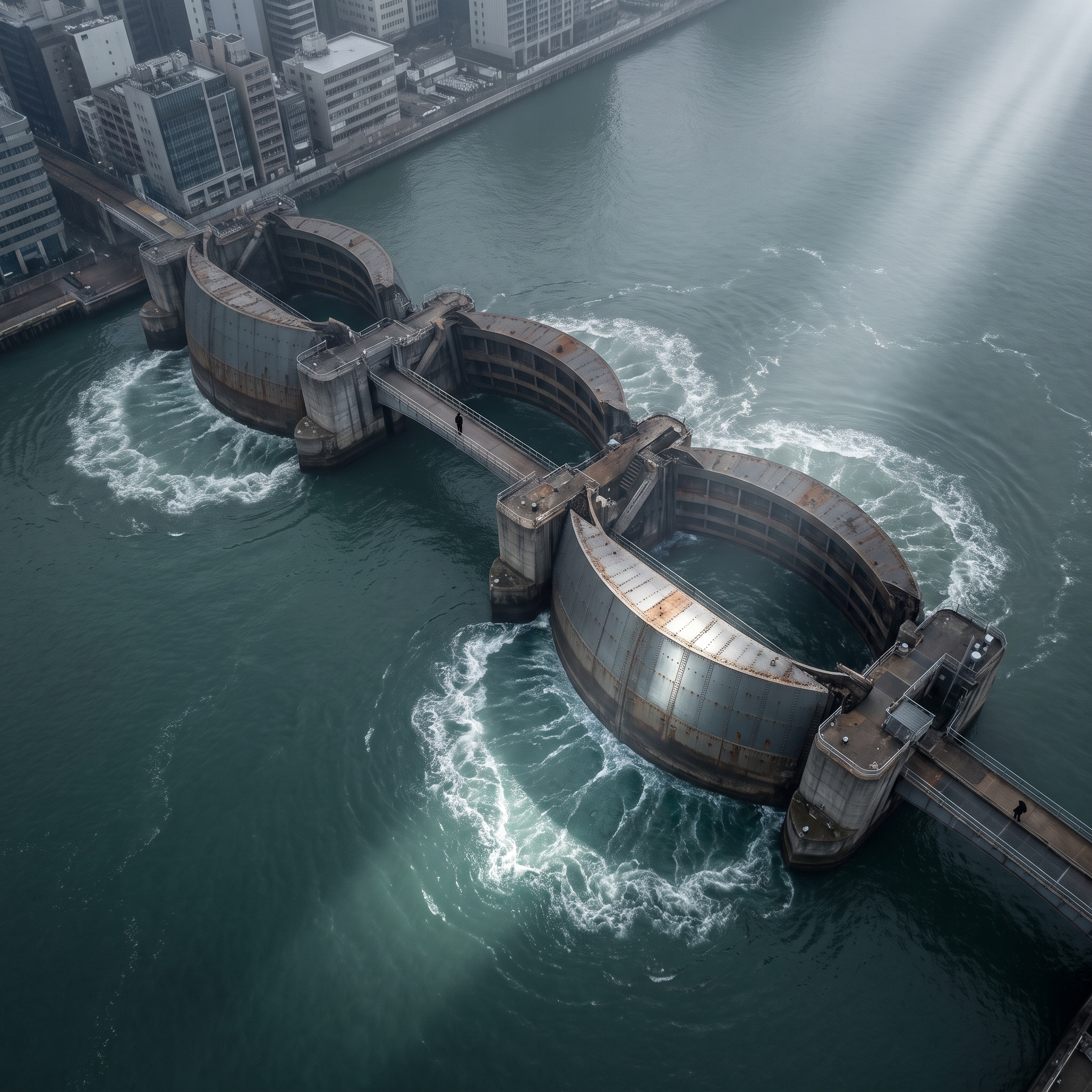
Max Rivera: The Bureau of Coastal Resilience. Created in 2023, inside the DEP. Six people. Roughly a million dollars. Tasked with overseeing the East Side Coastal Resilience Project — a $1.45 billion system, over a hundred flood gates along South Street, going operational in 2027.
Clara Bennett: And on July 24, 2026, Mayor Mamdani and Commissioner Lisa Garcia announced $43.2 million to fix exactly that — BCR goes from 6 to 75 staff. So my first instinct is: the city saw the problem and moved.
Max Rivera: Right — but moved three years late? I mean, they created the BCR knowing those gates were coming. That wasn't a surprise.
Clara Bennett: Now, in practice, this is a pattern — governments fund capital projects because they're visible, they're cuttable ribbons. Operations are invisible until the system fails. That's not unique to New York.
Max Rivera: Yeah, and — actually, that's the thing that gets me. Two men died in flooded basements, Brooklyn and Manhattan, October 30, 2025. And then suddenly there's $43.2 million. That timeline is not a coincidence.
Clara Bennett: It isn't. The question is whether the 69 new hires — engineers, field crews, planners, flood specialists — can actually get to operational readiness before that first major storm hits those gates. That's the real clock.
Max Rivera: But that clock — I mean, the clock was already ticking in 2023. Six people managing 15 active infrastructure projects, borrowing crew from the DEP because they had nobody else. That's not an oversight, that's — I don't know how you call that anything other than negligence.
Clara Bennett: I'd call it structural failure, and there's a difference. Negligence implies someone knew and chose to ignore it. What actually happened is the city built the capital project funding pipeline — the $1.45 billion — and never built a parallel operations pipeline. Those are two entirely separate bureaucratic tracks.
Max Rivera: Two men died in flooded basements on October 30, 2025. Flash flood warnings across nearly all of New York City. And at that moment the BCR had six people.
Clara Bennett: Yes. And that's exactly my point — not against it. The deaths happened because the operations side was hollow. But the city didn't make it hollow on purpose; it made capital projects the priority because capital projects have ribbon-cuttings. Operations don't. That's the design flaw.
Max Rivera: No, I don't buy that.
Clara Bennett: The August 2025 flooding — passengers wading through the 7th Avenue Brooklyn station, it goes viral — and even after that the BCR isn't expanded. The expansion comes in July 2026. That gap tells you the city responds to political pressure, not operational logic.
Max Rivera: Okay but — wait, that actually makes it worse? Like, viral videos in August, deaths in October, and the $43.2 million announcement lands in July the following year. That's eleven months. The South Street gates go live in 2027. You're hiring 69 specialists now for gates that open in months.
Clara Bennett: Which is exactly why I'd call it structural. A negligent city ignores the problem. This city funded the gates and starved the agency meant to run them — simultaneously. That's not carelessness, that's a broken model for how capital projects and operations get budgeted.
Max Rivera: Broken model, fine — but here's what that model actually looks like on the ground. It's September 15, 2027. First major storm since the South Street gates came online. A flood specialist hired eighteen months ago, trained for nine, is at the gate control station. The gates open. Fifteen minutes in, the system throws a fault. That person has been on the job for a year and a half. What happens?
Clara Bennett: That's the right question. And the MTA's subway yard program is actually — in practice, it's evidence that phased operational buildouts can work under pressure. They identified 13 of 24 yards vulnerable to surge, hardened the two largest first, have the eastern Bronx yard scheduled next. That's a sequence, not a sprint.
Max Rivera: Wait — the two largest. Two. Out of thirteen vulnerable yards. That's not a sequence, that's a down payment.
Clara Bennett: It's phased. The point is the MTA built the operational muscle progressively, not all at once.
Max Rivera: Okay but — the Second Avenue Subway. Nearly a century. That project was first proposed in the 1920s. If that's the city's track record on executing big infrastructure, I mean — why do we think 69 hires in under a year lands differently?
Clara Bennett: The Second Avenue Subway is capital construction. Hiring specialists is — those are not the same bureaucratic problem. One requires digging tunnels under a functioning city. The other requires HR pipelines and training schedules. I'm not saying it's easy, but the comparison isn't apples to apples.
Max Rivera: And the New York State Climate Assessment projects precipitation up four to eleven percent by the 2050s. So even if the 69 hires land perfectly — which, I'm skeptical — the system they're training on is already being designed for a wetter future that's actually going to be wetter than that future.
Clara Bennett: That's real. And honestly — that's where the $43.2 million framing gets uncomfortable for me too. 'Jump-start' is doing a lot of work in that announcement. We'll get to whether this is a meaningful investment or just a down payment on something that doesn't have a price tag yet.
Max Rivera: Yeah — because right now, nobody actually knows what 520 miles of coastline costs to staff. And the deadline isn't the 2050s. It's 2027.
Clara Bennett: And that's exactly the narrow point I'll give you — the $43.2 million is not a plan. It funds a roadmap study for all 520 miles of coastline. The study hasn't finished. Which means the city literally cannot tell you what the full marathon costs right now.
Max Rivera: Wait — the roadmap study is part of the $43 million? So they're spending the money to figure out how much money they need?
Clara Bennett: In practice, yes. The East Side Coastal Resilience Project alone is $1.45 billion — one project, one stretch of coastline. The BCR now oversees 15 active infrastructure projects. And no source anywhere specifies a total long-term funding commitment for full coastline protection. That number doesn't exist yet.
Max Rivera: Okay but — I mean, that's actually what I've been pushing on this whole time, and you're — yeah, you're confirming it. So the concession is real. But then where I won't let you off is this: Superstorm Sandy was 2012. The BCR wasn't even created until 2023. That's eleven years to design the agency, and when it arrived it had six people and a million-dollar budget. If the roadmap study still isn't done in 2026, what makes anyone think the operational funding follows faster than the capital funding did?
Clara Bennett: That's — fair. And I'm not dropping the broader point: the July 24th announcement is a genuine correction of a real failure. Going from six staff to 75, from roughly a million in budget to over ten million annually — that's not optics. But you're right that it doesn't resolve the scale mismatch.
Max Rivera: The gap stays real.
Clara Bennett: The gap stays real. The announcement corrects the staffing failure. It does not close the funding unknown. Those are two different things, and conflating them is — that's where the 'jump-start' framing becomes dishonest.
Max Rivera: And the gates open in 2027. Whatever the full number turns out to be — nobody knows it yet, and the clock doesn't care.
Clara Bennett: The South Street flood gates come online in 2027. That part is happening. The BCR goes from six people to seventy-five — that correction is real. And I'll hold that. But Coney Island is still sitting at up to six feet of water in a major hurricane scenario, and there is no gate for that.
Max Rivera: Six feet. That's not — I mean, that's not a worst case, that's a named scenario. And we're landing the closing beat on a city that just figured out it needs to staff the agency it built three years ago.
Clara Bennett: Which is either a cautionary tale or proof the correction can happen before the deadline. I genuinely don't know which one this is yet. And I think that's — honestly, that's where we actually are.
Max Rivera: Yeah. The gates open in 2027. The next storm doesn't check whether the new hires finished their training.
Clara Bennett: No, it doesn't. Good talk today.