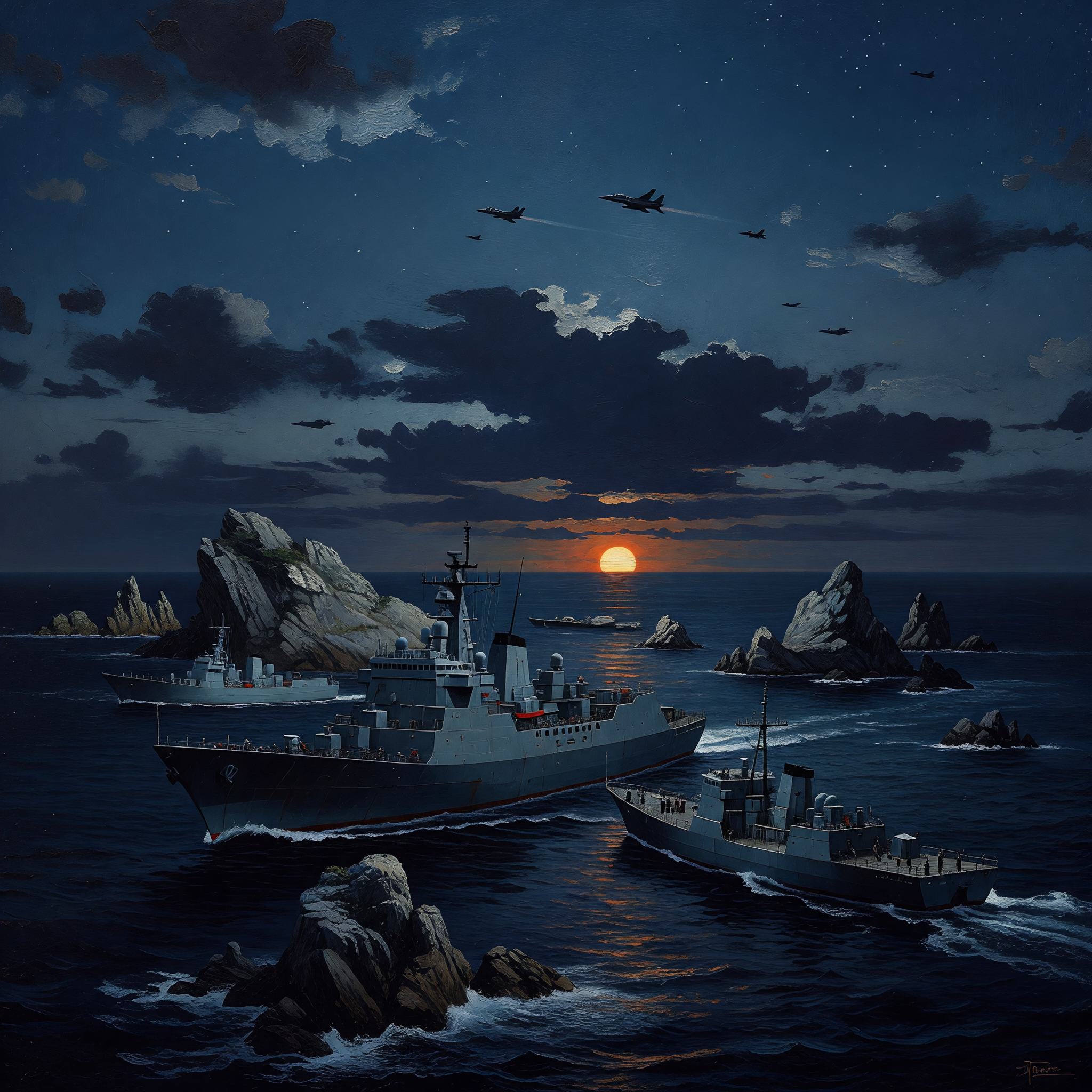
Michael C. Vincent: You were texting me last night at eleven with nothing but a question mark. I assume that is what today is about.
Hope Sterling: Okay in my defense — in my defense — I had just read both coast guard statements side by side and my brain kind of short-circuited, because like, Japan's Coast Guard says they expelled two Chinese vessels from near the Zuihou Maru, done by 9:20 a.m. on July 7th. And China's Coast Guard — same day, same waters near the Senkaku Islands — says they warned and expelled the Zuihou Maru for intruding into Chinese territory. Both sides claim they expelled the other. That's not spin, that's just — two realities?
Michael C. Vincent: Two governments, one stretch of the East China Sea, and each insisting the other was the intruder. You see, that is not a dispute about facts. That is a dispute about which facts are permitted to exist.
Hope Sterling: And Beijing the same day issues — literally — 'those who play with fire will perish by it.' On July 7th. Which is the 89th anniversary of Lugou Bridge, the thing that started the war in 1937. I mean, that timing is doing SO much work.
Michael C. Vincent: I'd be careful about assuming all of that is purely orchestrated — but yes, the symbolism is not accidental. The Lugou Bridge Incident began, you see, with a missing soldier. A pretext. Possibly manufactured. Eighty-nine years later, a fishing boat named the Zuihou Maru becomes the pretext.
Hope Sterling: Wait — so the Zuihou Maru is like, the 2026 version of the missing soldier?
Michael C. Vincent: That is the question worth sitting with.
Hope Sterling: Because there's an actual person on that boat who just wanted to — I don't know — catch fish? And now he's a geopolitical chess piece with two coast guards arguing over who expelled whom.
Michael C. Vincent: And that's exactly where it gets structurally strange — not just politically messy. Imagine two neighbors both call 911 at the same second. Each one tells the dispatcher they just kicked the other off their property. The police show up. Both accounts are official. There is no neutral tape. Who do you believe?
Hope Sterling: Okay but — isn't one of them just lying? Like, one coast guard is lying, right?
Michael C. Vincent: That's the intuition click — it doesn't matter. The structure is the weapon. Japan's Coast Guard says China's presence near the Zuihou Maru was a violation of international law. China's Coast Guard says it took necessary measures to warn and expel the Zuihou Maru for intruding into Chinese-claimed waters. Both statements are official government records. Both feed a domestic audience a clean victory. And now there is no shared factual baseline — not because someone is lying, but because the system is designed so one never forms.
Hope Sterling: Wait — so it's not even about who's right. The narrative IS the battlefield.
Michael C. Vincent: Precisely. And both governments win domestically regardless of what actually happened twelve miles off the Senkaku Islands. That is what's genuinely new here — not that two sides disagree, countries always disagree. It's that the architecture of simultaneous official contradiction makes an objective record structurally impossible to establish.
Hope Sterling: That's — I mean, that's actually more unsettling than if someone was just, like, blatantly lying? Because lying you can at least fact-check? But this — both accounts just exist, both are real, both are official — how do you even — where do you go with that?
Michael C. Vincent: You see, that is where China's Coast Guard — running operations near the Senkakus 353 days a year before this incident — you start to understand the long game. Not one confrontation. Hundreds. Each one generating a competing record. Over time, the accumulated weight of those records starts to look like history.
Hope Sterling: 353 days — that's not a dispute, that's like, a slow rewrite. Of reality.
Michael C. Vincent: A slow rewrite — and that framing is exactly the take I want to push on, because it's circulating everywhere right now and I think it skips a step. Everyone is saying Beijing obviously planned this for July 7th. Deliberate operation, timed to the anniversary. And maybe. But the coast guard deployment? China has ships near the Senkakus 353 days a year. They don't need to plan for the date — the ships are already there.
Hope Sterling: Wait, so you're saying — the date didn't move the ships, the ships just — were already there and someone went 'oh, it's July 7th, useful'?
Michael C. Vincent: Possibly. And that distinction matters enormously. Operationally planned versus opportunistically framed after the fact — those are different things.
Hope Sterling: Okay but — no, hold on — because the submarine missile test. July 6th. One day before. A nuclear-powered submarine launches a long-range ballistic missile in the South Pacific. That's not a coast guard vessel that was already on routine patrol, that's a — that's a deliberate military signal, right? You can't just accidentally schedule that.
Michael C. Vincent: That I'll grant you. The July 6th test is harder to call coincidental.
Hope Sterling: It doesn't matter which it is. Like, operationally planned versus opportunistically framed? The 1937 charge lands either way. Lugou Bridge, Wanping, the missing soldier, shots fired — and by July 29th, 1937, Beiping had fallen and more than ten thousand civilians were dead or missing. That history is so loaded that just invoking July 7th does the work. The symbolism doesn't need the operational intent.
Michael C. Vincent: Now that is the sharper point. And Beijing's 'play with fire' warning fused both — the coast guard confrontation and the 89th anniversary commemoration — in a single statement. The historical charge amplifies nationalist emotion on both sides and makes each side more certain of the other's bad faith. Whether or not it was planned.
Hope Sterling: So the bad take is 'Beijing obviously planned this' — because that's actually the wrong question. The question is what the anniversary does once it's in the room, regardless of who put it there.
Michael C. Vincent: Exactly so. And what it does to Japan's options — that's where the coast guard piece gets structurally sinister in a way we haven't gotten to yet.
Hope Sterling: Okay but — sinister how, exactly? Because I feel like I'm picturing a slow drip and not quite seeing what the drip is actually doing to the pipes.
Michael C. Vincent: The China Coast Guard is not a civilian agency. It operates as a layer inside a system that includes the People's Liberation Army Navy — the PLAN. Analyst Pratnashree Basu called it a grey-zone coercion playbook: stay below the military threshold, keep it technically coast guard, so Japan's Self-Defense Forces have no clean legal authority to respond in kind.
Hope Sterling: Wait — so the CCG is basically the PLAN in a different jacket?
Michael C. Vincent: Functionally integrated. And that creates Japan's trap. Escalate — actually respond with military force — and Tokyo risks fracturing the U.S. mutual defense treaty, because Washington decides whether a grey-zone coast guard incident triggers Article 5. Absorb it, do nothing, and the Senkakus become disputed in fact even if Japan never concedes them in law. There is no third door.
Hope Sterling: And — wait, because Taiwan also claims the islands? As Diaoyutai? So it's not even a two-party standoff, there's a third claimant just — sitting there?
Michael C. Vincent: Three claimants. And the legal roots go back to 1894 — Japan incorporated the Senkakus into Okinawa Prefecture during the First Sino-Japanese War. Then the United States held them post-WWII and returned administrative control to Japan in 1972. China and Taiwan both said that transfer was illegitimate on sovereignty grounds. So the foundation was contested before a single coast guard vessel ever showed up.
Hope Sterling: So the U.S. — I mean, the U.S. hands Japan the keys and China immediately goes 'those weren't your keys to give.' And now America's treaty credibility is, like, on the line every single time one of these incidents just — passes without a response?
Michael C. Vincent: Every time. The obligation is only as strong as the last time it was tested. Picture a PLAN naval officer tracking the Zuihou Maru's position on a screen somewhere while the CCG handles the surface contact — two layers of the same machine, each with plausible distance from the other. That's the architecture.
Hope Sterling: And the captain of the Zuihou Maru is just — he didn't volunteer to test the U.S.-Japan alliance. He was fishing. I can't shake that about this whole thing.
Michael C. Vincent: And that's the question I can't answer. The CCG was already there 353 days a year. Neither the missile test nor the coast guard standoff crossed the formal threshold that compels a U.S. alliance response. So at what point does the accumulation of non-crises just — become the new map?
Hope Sterling: Like, does Japan wake up one day and they've accepted the Senkakus are disputed — not officially, they'd never say it out loud — but just, in practice, on the water?
Michael C. Vincent: I genuinely don't know. And I'm not sure Tokyo does either.
Hope Sterling: That's — yeah. That's where I'm stuck too. Thanks for sitting in it with me.