Lila Soto: Iris, hey — okay, something happened to me this week and I cannot stop thinking about it.
Lila Soto: So I was at my grandmother's, right, and she's got this shoebox — old photos, some letters, a couple receipts from like the forties. And I realized that shoebox is basically her entire archive. That's it. That's everything that survived. And then I thought — okay, but she's lucky. Most people didn't even get a shoebox. Most people got nothing, or they got a line on a tax roll, and that was their whole life documented.
Iris Holm: That's the number. Roughly 85 to 90 percent of people who ever lived left no written trace at all — and that's not an accident. Clergy, rulers, merchants — they controlled writing, they controlled record-keeping. Everyone else either didn't appear or appeared as an object in someone else's document.
Lila Soto: As an object — what do you mean?
Iris Holm: Roman enslaved people. They surface in legal texts almost entirely as property valuations — purchase prices, inheritance clauses. We know what they cost. We have almost no record of what they ate, what they believed, how they organized. The archive has prices where the people should be.
Lila Soto: That's — I mean, that's not a gap. That's a replacement. The person got swapped out for a number.
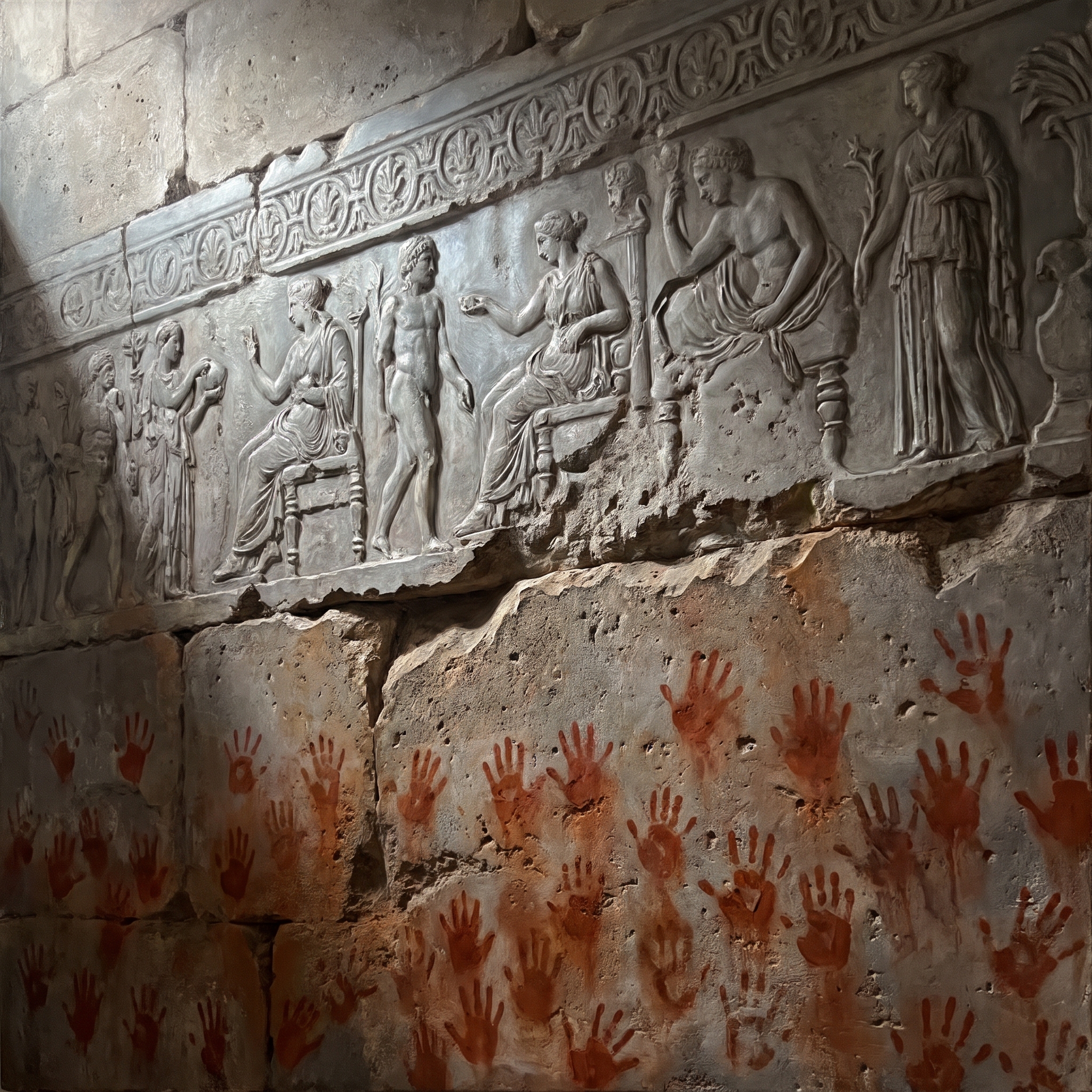
Iris Holm: Which is exactly why archaeologists digging up a medieval subfloor pit — pottery shards, animal bones, a single corroded iron tool — can contradict an entire set of manorial records about what peasants ate. The ground kept the secret the document didn't.
Lila Soto: And that's the part that keeps nagging at me — like, the ground kept the secret, sure, but most historians aren't digging up floors. Most of them are still in the archive. So is this just a limitation they can partially correct, or does it go all the way down?
Iris Holm: All the way down. The bias isn't a gap to fill — it's a feature of the record itself. Medieval European literacy was 10 to 15 percent, clustered in clergy and merchants. That's not a sampling error. That's the design.
Lila Soto: Designed by — who, exactly? Like, consciously?
Iris Holm: Not always consciously. That's actually the sharper point. Take a peasant woman in England, 1320s. She shows up once — a name on a tax roll. Her husband gets two entries in the manorial court records: used the lord's mill without permission, then some dispute over a fence line. That's it. Two transactions. No thought, no voice, no illness, no child's name. The archive isn't hiding her maliciously — it was never built to hold her. The epistemic conventions of historiography, what counts as a document worth keeping, were set by institutions that had no interest in her interiority.
Lila Soto: Epistemic conventions — meaning, like, the rules historians inherited about what even counts as evidence?
Iris Holm: Exactly that. Written archives, institutional documentation, elite authorship — those get treated as the default signal. Everything else is noise, or inference. Scholars call the result structured silences. The quiet isn't random. It has a shape, and the shape follows power.
Lila Soto: Structured silences — that phrase is doing a lot of work. Because it means the silence itself is information, right? About who controlled the record.
Iris Holm: It's what the politics of historical knowledge production actually means — decisions about whose sources count aren't neutral. They reproduce the same hierarchy that excluded her in the first place. That's the loop historians who do history from below are trying to break. The question is whether the tools are strong enough.
Lila Soto: But here's what I keep bumping into — historians did try to break that loop. Around 1975, four books come out almost simultaneously, and it's like a recognized crack in the wall. Montaillou, Whigs and Hunters, The Cheese and the Worms, Natalie Zemon Davis on early modern France. All at once.
Iris Holm: A paradigm shift with a catch.
Lila Soto: Right — what's the catch? Because Carlo Ginzburg reconstructing a sixteenth-century miller's cosmology from an Inquisition transcript feels like a genuine breakthrough. You're inside this person's mind.
Iris Holm: That's the problem. The Inquisition transcript is a coercive document. It was never designed to preserve what Menocchio actually believed — it was designed to extract a confession. Ginzburg is reading it against its own stated purpose to surface peasant consciousness. That's the method. But ask yourself: how much of what you're hearing is Menocchio, and how much is what torture-adjacent interrogation produced?
Lila Soto: Oh. So the most coercive document imaginable becomes the window into the subaltern.
Iris Holm: That's exactly what Ranajit Guha and the Subaltern Studies collective formalized — early 1980s, they're repositioning around autonomous experiences of subordinate groups, peasants, colonial subjects, women. And Guha's specific argument is that peasant-insurgency archives are products of elite counterinsurgency. You have to read them against the grain to find subaltern consciousness underneath.
Lila Soto: But Ann Laura Stoler has the warning, right? That reading only against the grain — you end up finding what you went in looking for.
Iris Holm: She draws the line precisely. Reading along the grain means you let the archive speak on its own terms — you study the archive's logic, its conventions, what it was built to do. Reading against the grain is where the distortion risk lives. If you're determined to surface subaltern consciousness, you'll surface it. Even if you're projecting it.
Lila Soto: So the solution to projection is — more projection, just in the opposite direction?
Iris Holm: That's the unresolved tension. Microhistory illuminates one person brilliantly — E.P. Thompson reading how law crushed the rural poor in Whigs and Hunters, that's real and specific. But Thompson's also making a political commitment, history from below as deliberate scholarly stance. The inference from one miller's trial to anything general about sixteenth-century peasant belief? That inferential cost is enormous and mostly unacknowledged.
Lila Soto: And the archaeology angle — material evidence, oral tradition — I mean, that might look like the fix, but I have a feeling it comes with its own costs we haven't touched yet.
Iris Holm: Significantly its own costs. That's the next problem.
Lila Soto: And those costs — I mean, archaeology gives you the buttons and the bones, but it can't tell you what Sarah thought when she picked up that button. So what does it actually recover?
Iris Holm: Material fact. Settlement patterns, food remains, burials — that's what bypasses textual mediation entirely. A subfloor pit with cattle bones contradicts a manorial record claiming peasants ate almost no meat. The ground wins that argument. But it doesn't give you interiority. It gives you a corrective.
Lila Soto: A corrective — not a replacement.
Iris Holm: Never a replacement. Take the Sarah scenario — payroll ledger, mud-found buttons, a family story about scarred hands. None of those contradict each other. But none of them speak for Sarah. You have wages, you have cloth scraps, you have inherited pain. You still don't have her.
Lila Soto: And oral tradition — I keep thinking that feels like the fix, but actually, hm. The more rigorous the methodology gets, the more it might just be documenting what the community wanted to remember at the moment of recording. Not what happened.
Iris Holm: That's the real trap. Dismiss oral tradition entirely and you re-enact the original erasure — you're just doing the archive's work for it. But treat it as equivalent to a contemporaneous document? The error rate is unknown and probably enormous. The Balliol College transatlantic slavery project, published 2026, threads this directly — they treat the archival gaps themselves as analytical problems, foregrounding Black people's role in abolition rather than defaulting to what the documents volunteer.
Lila Soto: Oh — so the gap becomes the question, not the dead end.
Iris Holm: And that's where the deepest danger lives. Absence of evidence is not evidence of absence. The moment you infer a life from silence in an elite record, you risk projecting — your theory, your politics, your present moment — onto someone who left no rebuttal. That's the failure mode none of the tools fully solve.
Lila Soto: I think what clicked for me today is — it's not a methods problem. Like, there's no better version of microhistory or oral tradition or archaeology that makes the silence go away. It's just a permanent condition. And the honest move is naming how much weight you're placing on inference when you fill it.
Iris Holm: That's the thing the field resists saying plainly. We're not recovering the past. We're making the best-informed argument we can about it. And that distinction — once you name it — changes whose stories get taken seriously. Because suddenly the question isn't 'do you have a document,' it's 'are you honest about what your document actually proves.'
Lila Soto: The written record is a structural artifact of elite power. That's just — that's what it is. Not a window. A wall with some cracks in it.
Iris Holm: And we keep peering through the cracks and calling it a view. Yeah. Good place to stop.