Hope Sterling: Long week doesn't even — I've been watching evacuation numbers update in real time and it's like, every hour the headline changes, and I genuinely don't know where to start.
Michael C. Vincent: Start with Spain. Because that's the detail that floored me this morning.
Hope Sterling: The national emergency.
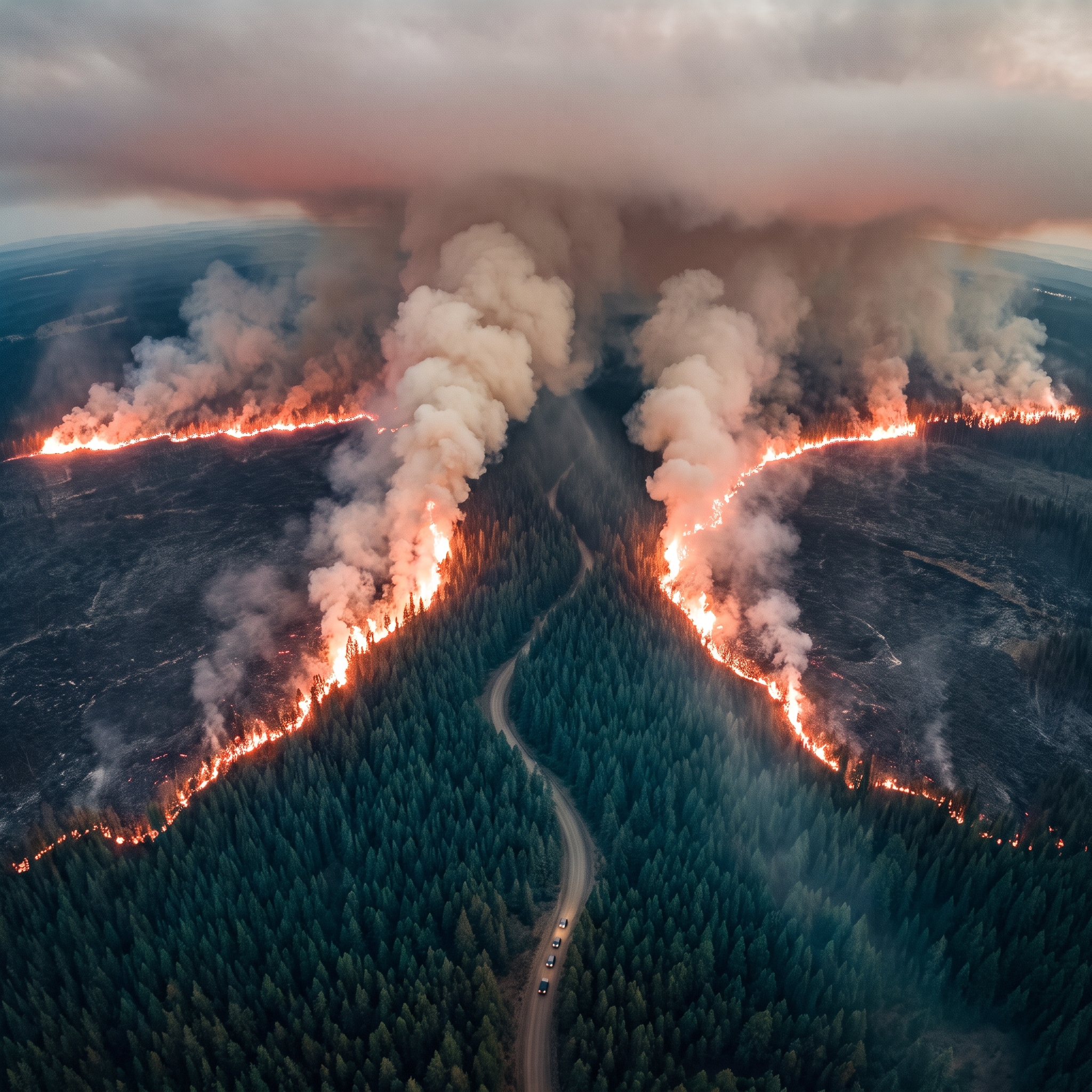
Michael C. Vincent: First time in Spanish history. Wildfires near Madrid merged — multiple fires became one — and 20,000 people were evacuated in the Madrid region alone. Spain has never declared a national emergency over fire before.
Hope Sterling: Okay that specific fact — first time in the country's history — that's the one that like, reframes everything else, because France meanwhile had Laurent Nunez announcing 167,000 evacuations, and that's just France, and Gironde plus Landes together were 141,000 of those people, and I'm — when you add it all up across both countries it's over a quarter-million people who had to leave.
Michael C. Vincent: And Macron mobilized the French Army. Not figuratively — physically deployed troops, then called in the EU Civil Protection Mechanism for foreign aerial support.
Hope Sterling: While Cap Ferret — 40,000 people, one road — some of them literally got on boats to leave. Like, that's the image I cannot shake.
Michael C. Vincent: And the Gironde fire itself — the reported size went from 10,000 hectares to 19,000 depending on which day's reporting you trust. That's the story within the story.
Hope Sterling: But wait — 10,000 to 19,000, like, is that journalism failing to keep up or did the fire actually nearly double while people were reporting it?
Michael C. Vincent: That's the exact right question. And here is the answer: think of a wildfire like a debt that compounds. Every hour of dry wind and heat is interest. By the time any reporter lands the number, the balance has already grown. The fire was literally larger by the time the measurement reached print.
Hope Sterling: So 10,000 was true — just true on Tuesday, and by Thursday you're at 19,000 and both numbers were accurate at the moment someone wrote them down.
Michael C. Vincent: Exactly so. And when you lose the ability to measure a fire accurately in real time, you have also lost the narrative thread. Listeners cannot picture what they cannot measure. Now — Sébastien Lecornu called it unprecedented scale. He was not overstating it. The Bordeaux suburbs — Le Haillan, Eysines, Merignac — those are not rural villages. That's a major metro area being told to leave.
Hope Sterling: And then there's a whole separate fire — Ille-sur-Têt, in the Pyrenees foothills — 4,600 hectares, 10,000 more people evacuated — and that one barely broke through the noise because Gironde was just so much bigger.
Michael C. Vincent: Which brings me to the detail I think genuinely changes the frame of this story. France and Spain dominated every headline. But Sicily — Agrigento province specifically — was burning at the exact same 72-hour window. Three countries, simultaneously.
Hope Sterling: Stop. Italy too? During the same heatwave?
Michael C. Vincent: The research flags it almost in passing — I want to be honest that we shouldn't overstate what we know about scale there. But the pattern is worth naming. Three countries burning at once isn't a crisis. That is a pattern establishing itself.
Hope Sterling: And that's — okay, that's the thing that the headline completely buries, because when it's France and Spain it sounds like two bad weeks, but France and Spain and Sicily at the same time is like, no, this is the summer now, this is what European July looks like going forward.
Michael C. Vincent: But that 'pattern establishing itself' framing — that's actually where the wrong take lives right now. Because the coverage keeps treating France's climate emergency and Spain's national emergency as the same instrument. They are not.
Hope Sterling: Wait — like, legally different or just different in name?
Michael C. Vincent: Legally distinct, politically distinct. Spain's national emergency was the first in its history over wildfires — a specific constitutional instrument. France's was framed as a climate emergency, explicitly connecting the fires to structural policy failure. The coverage has flattened that into 'two countries both declared emergencies.' That's not the same sentence.
Hope Sterling: Okay but — did France's climate emergency declaration actually unlock anything? Like, Macron had already activated the EU Civil Protection Mechanism, the A400M was already being configured to drop flame retardants, the French Army was already moving. So the declaration came... after all of that?
Michael C. Vincent: That is the precise tension. The mobilization preceded the declaration, or ran alongside it — the sourcing here is genuinely thin, I want to be careful — but the sequence suggests the declaration named what was already necessary rather than unlocking it.
Hope Sterling: So it's like — political comfort? I mean, I don't want to be cynical about it, because the climate framing matters for the policy conversation that comes after, but if Sophie Brocas is already confirming suburb evacuation orders and the A400M is already in the air, then the declaration is just... catching up rhetorically?
Michael C. Vincent: That's the honest version. And Bayar et al. — Earth System Dynamics, July 2026 — found strong intensification of extreme fire weather under three degrees of warming versus two. The scientific grounding for the climate framing is real. What we can't say confidently is whether the declaration changed a single operational decision.
Hope Sterling: Oh, and then there's the tractor driver near Madrid — like, Spanish police accused someone of sparking one of those fires, and I saw people immediately using that to dismiss the climate angle, which is — no. Drought and heat are why a spark becomes 20,000 evacuations.
Michael C. Vincent: The ignition source and the underlying amplifier are two different questions. Now — the real test of all of this, the declarations and the infrastructure and what actually held — Cap Ferret is where we need to go next, because that boat evacuation is either proof of system or proof of improvisation, and the answer to that matters enormously if this becomes an annual event rather than a once-in-a-generation one.
Hope Sterling: Okay but — proof of system or proof of improvisation, those might actually be the same thing at Cap Ferret, and that's what's messing with my head, because like — someone, at some point, looked at that peninsula and said the one road will not hold 40,000 people, so we need boats on standby. That's not improvisation. That's admitting the primary plan was already broken before the fire started.
Michael C. Vincent: And that is the most unsettling kind of competence. You planned around your own failure. The boats worked. But they worked because someone pre-admitted the road would jam.
Hope Sterling: Which means — wait — the road actually did jam, right? Like that wasn't hypothetical.
Michael C. Vincent: Picture a ferry dock at two in the morning. A tourist — she came to Cap Ferret for a long weekend, bags still half-unpacked — and the road behind her is already stopped. She has a dog. The boat takes people, not cars. That is the actual decision happening at the edge of that peninsula. Nunez announced the total number: 167,000. Laurent Nunez said the fight would be long and very difficult. That phrase — long and very difficult — is doing enormous work. It means this does not end when the fire slows.
Hope Sterling: Stop — 'long and very difficult' from the Interior Minister, that's not reassurance language. That's preparation language.
Michael C. Vincent: Exactly so. And Carlos Novillo was warning about erratic winds near Madrid at the same moment. Two countries, two officials, same 48-hour window, both using language that points forward, not backward.
Hope Sterling: And the thing that nobody's saying out loud is — Cap Ferret doesn't get a second road built before next July. Like, the Landes department had another 23,000 people evacuating right next door, and the infrastructure question for all of them is the same: what do you do the second summer when the boats are expected, not improvised?
Michael C. Vincent: You scale a lifeboat you never meant to rely on annually. That is the watch item. Sophie Brocas confirming suburb evacuation orders — Bordeaux suburbs — that threshold being crossed means the planning perimeter has to expand permanently, not just for a peninsula.
Hope Sterling: I mean — the boat worked once. Does it work when everybody already knows the road will jam and shows up at the dock first?
Michael C. Vincent: That's the question nobody has a clean answer to. A quarter-million people displaced — if that becomes the baseline for next July, not the exception, the boats are now load-bearing infrastructure for a system that was never designed to carry annual weight.
Hope Sterling: And the EU Civil Protection Mechanism, the A400M, all of it — it held this time, for something everyone's calling unprecedented. But like... 'unprecedented' has a shelf life, and I genuinely don't know what happens when it expires.
Michael C. Vincent: No. Neither do I.