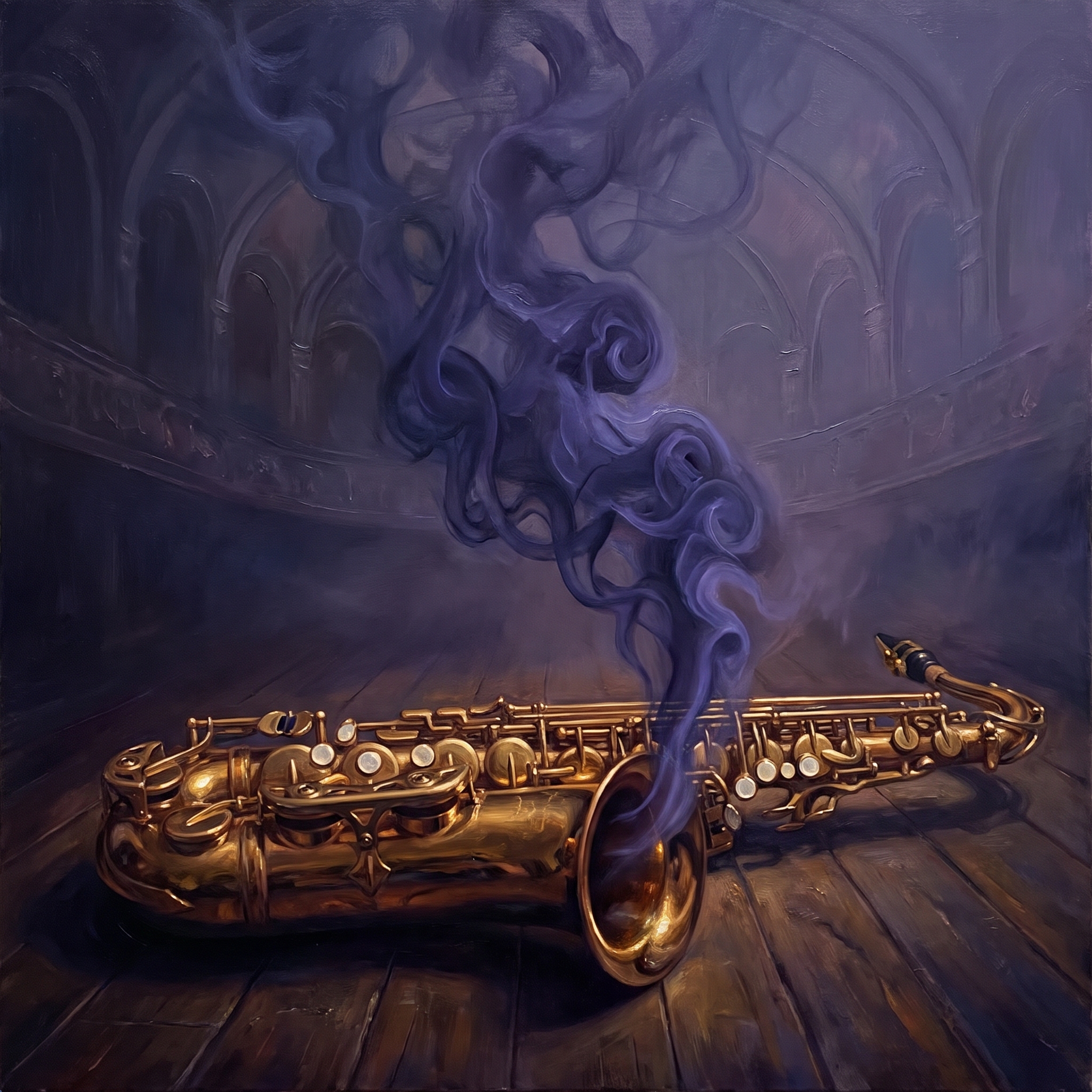
Max Rivera: Philadelphia got to claim John Coltrane — and then spent sixty years barely reckoning with the last time he played there.
Max Rivera: That's the uncomfortable part of this, and I want to be honest about it before we get anywhere near the celebration.
Max Rivera: November 11, 1966. Mitten Hall, Temple University. Coltrane performs — WRTI broadcasts it live, roughly 700 people in the room.
Max Rivera: It is — though nobody there knows this yet — his final concert in Philadelphia.
Max Rivera: He dies in July 1967. Nine months later.
Max Rivera: And the recording of that night? Doesn't get an official release until 2014 — it comes out as Offering: Live at Temple University — after circulating as a bootleg for nearly five decades.
Max Rivera: Five. Decades. As a bootleg.
Max Rivera: That's the bootleg-to-official-release pipeline in full view — jazz history preserved informally, passed around outside of institutions, until 2014 when someone finally put an authorized album out. Forty-eight years after the performance.
Max Rivera: So when I say Philadelphia is only now reckoning with this — that's not rhetorical.
Max Rivera: November 11, 2026. The 2026 Jazz Philadelphia Summit: Offering Edition is held in Mitten Hall — that same room — on the exact anniversary, sixty years on.
Max Rivera: Jazz Philadelphia and Temple University's Charles L. Blockson Afro-American Collection co-organized it.
Max Rivera: Dr. Steven Knoblauch — saxophonist, was on that stage in '66 — is there. Robert Kenyatta, the percussionist who was also on that stage, is there. And Nate Chinen, WRTI host and jazz journalist, moderating the whole conversation.
Max Rivera: And Ravi Coltrane — John's son — is scheduled to lead a tribute performance at Temple as part of the 60th anniversary commemoration.
Max Rivera: All of it sits inside Coltrane 100 Philly — the citywide series marking what would have been Coltrane's hundredth birthday.
Max Rivera: Now — do you understand what was actually happening in Mitten Hall in 1966? Because it wasn't a greatest-hits set.
Max Rivera: Coltrane's late period — 1965 through '67 — was his most spiritually intense, most avant-garde stretch. Extended improvisation. Free jazz elements. A deeply personal spiritual quest that was actively alienating audiences who'd loved him five years earlier.
Max Rivera: Pitchfork and the Philadelphia Inquirer both describe Offering as revealing just how FAR Coltrane was pushing — right to the outer edge of what his music could hold. This is not a minor document.
Max Rivera: It almost didn't survive officially at all. And Philadelphia waited sixty years to stand in that room and say so.
Max Rivera: Here's what keeps pulling at me, though.
Max Rivera: Strawberry Mansion — the neighborhood where Coltrane actually lived during his formative years — is about two miles from Mitten Hall. Two miles. And on November 11, 1966, he walks into that room and plays what turns out to be his final concert in the city he came up in… and then it circulates as a bootleg for forty-eight years.
Max Rivera: Not a minor concert. Not a warmup.
Max Rivera: Pitchfork called it a document of exactly how far Coltrane was stretching at the end of his life. The Philadelphia Inquirer said the same. This is a recording that shows you the outer edge — the late spiritual period in full force, the free jazz elements, the extended improvisation that was actively losing him some of the audiences who'd loved A Love Supreme two years earlier.
Max Rivera: And it sat in a drawer. Officially, anyway.
Max Rivera: That's not an accident. That's a decision — or a whole series of non-decisions — by institutions that didn't know what to do with radical art in real time. Coltrane's late period was not comfortable. It was not an easy sell. And the gap between 1966 and 2014 is basically a record of how long it takes for the culture to catch up with what an artist was doing before the culture was ready.
Max Rivera: Forty-eight years to get there.
Max Rivera: And look — I want to be careful with one thing. The claim that November 11, 1966 was definitively his FINAL concert in Philadelphia — there's some ambiguity there. We don't have exhaustive documentation of every performance he may have given in or around the city in his last months. So I'm not going to oversell the absolute finality of it. The sources don't fully close that door.
Max Rivera: But it doesn't really change the weight of what happened.
Max Rivera: Whether it was definitively the last or just one of the last — this was Coltrane, two miles from where he grew up, playing the most searching music of his life, to roughly 700 people, broadcast live on WRTI… and then largely forgotten by the official record for nearly five decades.
Max Rivera: While a San Francisco congregation was literally treating him as a saint.
Max Rivera: That tension — Coltrane as global icon and Coltrane as local story Philadelphia barely tended — that's real and it hasn't fully resolved. The Afro-Orthodox congregation in San Francisco built a whole spiritual practice around him. Pitchfork critics found Offering: Live at Temple University before Philadelphia's own institutions made it easy to find. That's the uncomfortable math.
Max Rivera: He belongs to everyone now. But he started two miles from Mitten Hall.
Max Rivera: So when Dr. Steven Knoblauch and Robert Kenyatta walk back into that same room on November 11, 2026 — sixty years later, same venue — that's not nostalgia. That's evidence. Living, breathing evidence that something happened there that mattered, and that the city is finally — finally — standing in front of it and saying so.
Max Rivera: These are men who were on that stage. They played alongside Coltrane that night.
Max Rivera: And Nate Chinen is moderating — the WRTI voice, the journalist — in the same building where WRTI broadcast the original concert. That's a closed loop that someone actually thought hard about closing. That's curatorial intention, not coincidence.
Max Rivera: The whole thing sits inside Coltrane 100 Philly — the citywide series for his centennial — and Ravi Coltrane is scheduled to perform there as part of the commemoration. John's son. In that room.
Max Rivera: A commemoration like that is simultaneously a celebration and a confession. The city is saying we were here, this happened here, this mattered. But the forty-eight-year gap between the performance and Offering: Live at Temple University getting an official release says the quiet part too. That we didn't know what we had. Or we did, and we weren't ready to defend it.
Max Rivera: And now the part that's still moving.
Max Rivera: Ravi Coltrane is scheduled to perform at Temple as part of this commemoration — and that performance hasn't happened yet as I'm putting this together. That's the live test. Not the summit conversation, not the archive panel, not the Nate Chinen moderation — the actual sound in that room.
Max Rivera: John's son. In Mitten Hall. Where John played the last time he played Philadelphia.
Max Rivera: That's either going to be one of those rare moments where the curatorial intention actually translates into something you feel — or it's going to feel like ceremony. And I genuinely don't know which. Nobody does yet.
Max Rivera: Which is kind of the point, right? It's still ahead of us.
Max Rivera: But here's the question that actually keeps me up — if the Mitten Hall concert took forty-eight years to get an official release, what else is still out there? What other recordings from Coltrane's late period are still circulating as bootlegs, passed hand to hand, not because the music isn't important but because no institution has decided it's time yet?
Max Rivera: And who controls that timeline?
Max Rivera: Because the bootleg-to-official-release pipeline — the whole arc from the WRTI broadcast in '66 to Offering: Live at Temple University in 2014 — that wasn't a system working correctly. That was a near-miss. A recording that almost stayed informal forever.
Max Rivera: And we just got lucky that someone decided 2014 was the moment.
Max Rivera: Meanwhile — Branford Marsalis and Dianne Reeves performed a centennial tribute to the 1963 Coltrane–Hartman album. In Budapest. That's the global scale of what Coltrane 100 looks like from the outside. Someone in Budapest is honoring that album while Philadelphia is trying to hold the local claim.
Max Rivera: He belongs to Budapest now too. That's just true.
Max Rivera: Which puts real pressure on what Coltrane 100 Philly is actually doing — because if the centennial energy is global, then a city-specific series has to be more than a date on a calendar. It has to become infrastructure. It has to build something that's still there in 2027, 2030, that makes it easier for the NEXT recording to surface in forty-eight months instead of forty-eight years.
Max Rivera: And I genuinely don't know if that's what's happening here.
Max Rivera: Jazz Philadelphia and the Charles L. Blockson Afro-American Collection co-organizing this — that's real institutional weight. But one summit, one room, one anniversary does not capture a full jazz ecosystem. It doesn't even try to. There are venues, there are contexts, there are communities that weren't in Mitten Hall and aren't being centered here.
Max Rivera: That matters.
Max Rivera: So the honest thing to watch isn't just whether Ravi Coltrane's tribute performance lands — though I'll be watching that — it's whether Coltrane 100 Philly becomes the kind of thing that builds forward or the kind of thing that closes a chapter and locks the door.
Max Rivera: Because marking a centennial and building a city's relationship to its own jazz heritage are two completely different projects. One ends November 11, 2026. The other one… doesn't have a closing date.
Max Rivera: Strawberry Mansion is still two miles from Mitten Hall. That distance hasn't changed. What changes is whether the city keeps walking it.
Max Rivera: But I keep getting snagged on one thing. Not the summit, not the archive, not whether Ravi Coltrane's performance lands. Something quieter than all of that.
Max Rivera: John Coltrane died in July 1967. Nine months after Mitten Hall. Nine months after WRTI broadcast that concert live to Philadelphia, after roughly 700 people sat in that room and heard him push his music to whatever edge he was reaching for that night. And in those nine months — not one institution had decided what to do with it. Not one. The recording was already loose in the world, already passing hand to hand, already becoming a bootleg. And Coltrane was still alive. He was still searching. The music on that tape wasn't a document yet — it was just where he was. Just the next thing he was doing. And then he was gone, and suddenly it was a document, and suddenly institutions had a problem they hadn't solved, and forty-eight years went by before Offering: Live at Temple University got an official release. But that's not actually the part that lands hardest for me.
Max Rivera: The part that lands hardest is that the music was still moving when he stopped. His late period — the extended improvisation, the free jazz elements, that intensely personal spiritual quest that was costing him audiences — none of that had resolved. He wasn't at the end of a chapter. He was mid-sentence. Whatever he was reaching for in that room, two miles from Strawberry Mansion, on November 11, 1966 — he never got to tell us if he found it. The search just… stopped. And we've spent sixty years making it mean something, building summits around it, pressing it into vinyl, sending Ravi back into that room to play. All of it is us trying to close something Coltrane left open.
Max Rivera: He didn't finish.