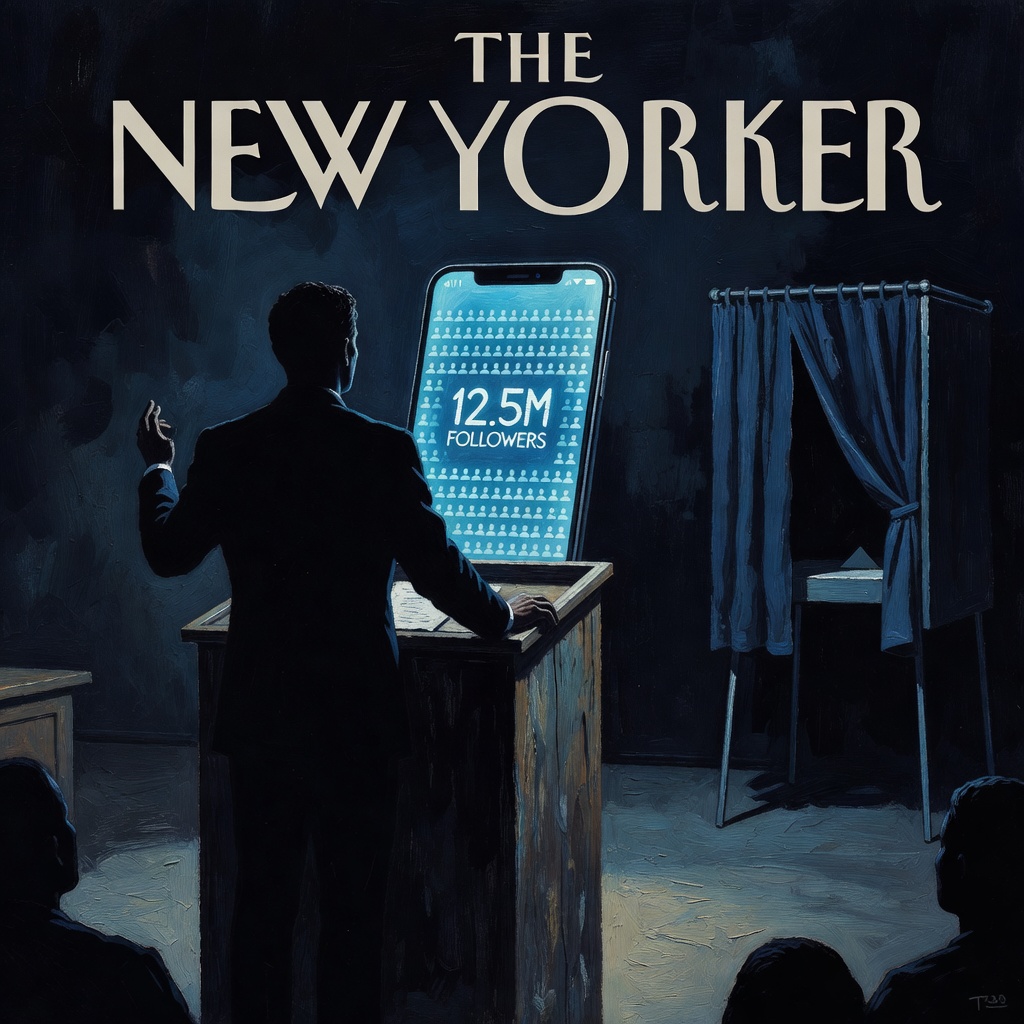
Cole Bryant: Okay I need to start with the Joe Rogan thing because everyone — every strategist, every pundit — is pointing at Trump on that podcast as the proof that this whole influencer strategy works. And I believe it mattered. I do. But I mean — wait, actually, do we actually know it moved votes? Or do we just know young male voters went to Trump and Rogan was there?
Jonathan Ingles: Correlation with a megaphone is still correlation.
Cole Bryant: Right? And meanwhile NPR's reporting that both Democratic and Republican campaigns in 2024 built formal outreach teams — like, dedicated staff — for TikTok and Instagram and Twitch. That's not a side experiment anymore, that's a budget line.
Jonathan Ingles: And there's a field experiment — arXiv, 2024 cycle — where they actually got 18-to-45-year-olds to follow progressive creators on Instagram, TikTok, YouTube. Increased consumption. No measurable change in political behavior.
Cole Bryant: Stop. They watched more content and still did nothing differently?
Jonathan Ingles: Vanity metrics versus electoral impact. That's the gap nobody in a campaign war room wants to name out loud.
Jonathan Ingles: And that gap — that's not new. What's new is that the deception infrastructure is now documented. Like, on the record. The Shade Room — 28 million Instagram followers — posted paid content for Tom Steyer's California gubernatorial campaign. No disclosure. None. The only reason we know is California's disclosure regime surfaced it.
Cole Bryant: Wait — 28 million followers and no disclosure?
Jonathan Ingles: That's more reach than most cable news programs on a given night. And it's just... sitting there. Unlabeled.
Cole Bryant: Bro, and then there's — okay, this is the part that actually broke my brain a little — an LA influencer, Alexis Rose Hinkley, 1.1 million TikTok followers, she sent a campaign a formal pitch. Like a deck. Two thousand dollars a month for six months. And the pitch explicitly called the content — I mean, wait — she called it 'authentic' strategic messaging. That's in the pitch document.
Jonathan Ingles: Paid. Authentic. In the same sentence. Frankly, that's not a contradiction to her — that's a product description.
Cole Bryant: So Mark Takano introduces the PAID Act in June 2026 — disclaimers on paid political influencer content, same logic as 'I approve this message' on TV. Does that actually fix it or is that just — I don't know, is that theater?
Jonathan Ingles: Broadcast disclosure law has existed for decades. The gap here isn't accidental — it's structural. Nobody extended the rules because nobody wanted to. Eric Wilson called social media a blunt force object. The campaigns know it's blunt. They just haven't built anything to measure whether it's hitting anything real.
Jonathan Ingles: But look — the Rogan thing. That's the one everyone keeps reaching for as proof. And I want to name the bad take directly: campaigns are treating that podcast appearance as a model. Like, Trump did Rogan, young men moved, therefore influencers move votes. That's not a finding. That's a story they retrofitted onto a correlation.
Cole Bryant: No but — something happened there, right? Like you can't just say nothing moved.
Jonathan Ingles: Young men were already drifting toward Trump. Rogan didn't cause that — he gave it a megaphone. Those are different things. The drift precedes the appearance.
Cole Bryant: Okay that's — yeah. That actually lands. And then — wait, because the Polymarket thing is where the incentive structure just gets completely exposed, right? Shayne Coplan in 2024 is literally calling his platform a 'global truth machine.' And then by 2026 Polymarket is paying Benny Johnson to post content questioning why Spencer Pratt lost the LA mayoral race. Like — Spencer Pratt. And then they quietly cut ties when it gets scrutiny. Kalshi does the same thing. They just scatter.
Jonathan Ingles: That's not a glitch. The incentive logic is — influencer gets paid to drive engagement, prediction market gets trading volume, nobody in that chain is structurally required to care what's true. It worked exactly as designed.
Cole Bryant: Truth machine. Paying someone to spread conspiracy theories about a reality TV star's election loss. Dude.
Cole Bryant: And that's — I mean, that's the thing I keep getting stuck on. Not the Benny Johnson post, not even the Shade Room disclosure thing — it's that campaigns built formal influencer teams, Democratic and Republican, both of them, like NPR documented this as a budget line for 2024 and now heading into 2026. And the Nature Human Behaviour study drops — sixty thousand users, removed political ads entirely, zero detectable effect on turnout or polarization — and the spend goes up. So who is actually being sold to here? Like who is the customer? Because I'm starting to think it's not voters.
Jonathan Ingles: It's donors. It's the political press. It's a 55-year-old operative telling a room full of bundlers he's taking TikTok seriously. Nobody in that room has an incentive to commission the study that proves them wrong. Social Currant, Double Tap Democracy — they're publicly arguing campaigns need to get past vanity metrics. That argument exists because the customers are still buying vanity metrics.
Cole Bryant: And nobody runs the experiment that answers it. That's — wait, does anyone actually want to know?