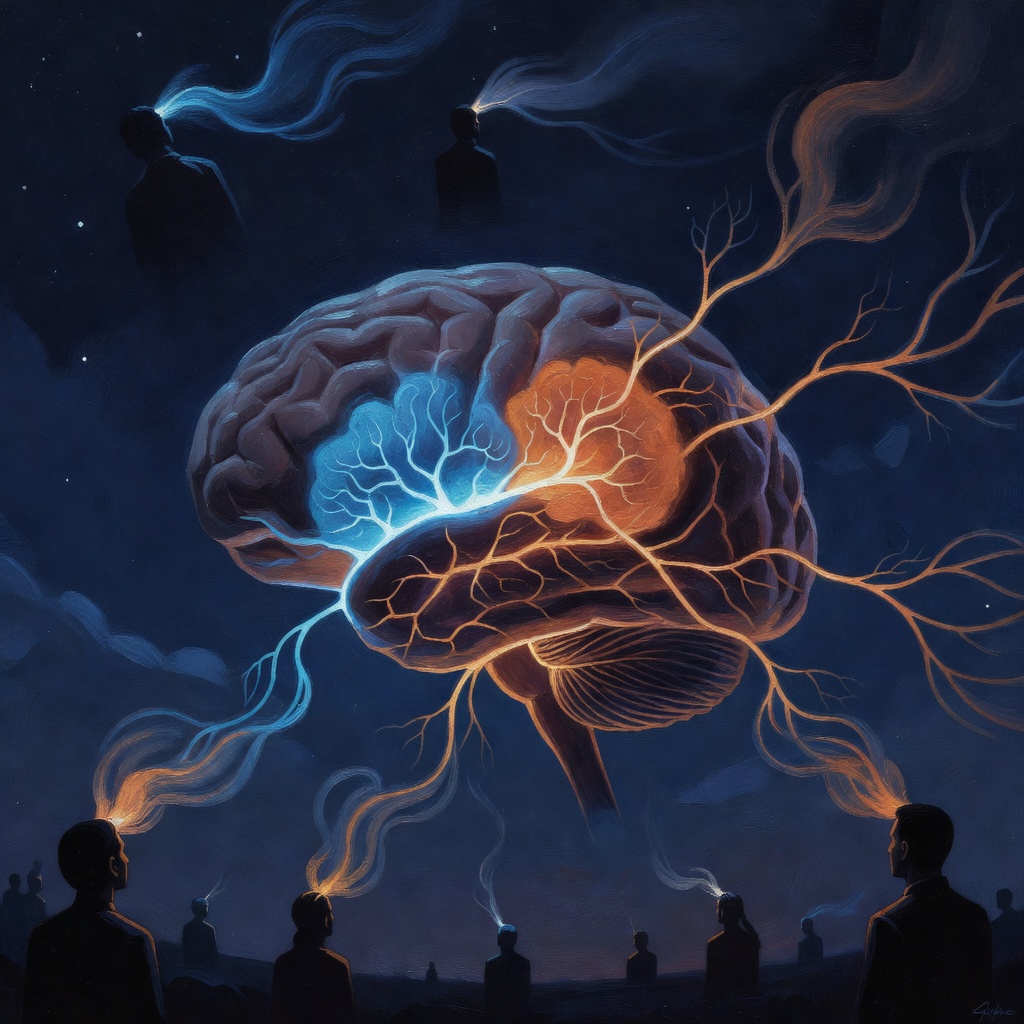
Jonathan Ingles: 940 kids. 549 mice. And the mice figured it out first.
Ben Okonkwo: Hi — yeah, that's — that's not the usual order, is it.
Jonathan Ingles: The study — Nature Neuroscience, this year — Alessandro Gozzi at IIT in Rovereto, Adriana Di Martino at the Child Mind Institute. They run resting-state fMRI on 20 genetically distinct mouse models, find two connectivity clusters. Then they check the humans and — same two clusters. Hypoconnectivity, hyperconnectivity. Opposite patterns.
Ben Okonkwo: And both subtypes present with — what looks behaviorally like the same autism diagnosis.
Jonathan Ingles: Frankly, that's the thing that should stop people cold. Not the biology. The fact that you can't see this from the outside.
Ben Okonkwo: Right — and that's where I want to slow down, because the question isn't just whether two patterns exist. It's whether they represent genuinely separable biological categories or just — clustering around two peaks in one continuous distribution. Those are very different claims.
Ben Okonkwo: And here's what I think the headlines are missing — Lorna Wing, when she coined the spectrum concept in the 1980s, she was describing behavioral presentation. She wasn't — I mean, she wasn't making a claim about a single biological substrate. That claim never existed.
Jonathan Ingles: Hold on. Then what exactly got overthrown?
Ben Okonkwo: That's — yeah. That's the problem. The cross-species methodology is genuinely new — running resting-state fMRI through 549 mice across 20 distinct models, finding the two-cluster pattern, then validating it in 940 humans — that architecture is novel. But the existence of heterogeneity? The field already knew that.
Jonathan Ingles: There's actually a 2026 paper in Progress in Neuro-Psychopharmacology and Biological Psychiatry doing synergistic-redundant dysfunction frameworks for exactly this question. The heterogeneity problem was already live before Gozzi and Di Martino published.
Ben Okonkwo: Right. So then why did Ronnie Cane publish a commentary on June 9th defending the archetype framing — arguing the new evidence vindicates it rather than dismantles it? You don't write that piece unless you're worried the finding is being overclaimed.
Jonathan Ingles: The field hedging before the implications land. And then the expert quoted in The Independent on June 11th says the spectrum term is itself misleading. Same week. Two opposite signals.
Ben Okonkwo: So — the signal is real. The translational methodology, the two connectivity signatures replicating across species. That's solid. The 'shatters everything' framing is not.
Jonathan Ingles: And here's what nobody's actually saying out loud — if hypoconnectivity and hyperconnectivity require different treatment protocols, the 'autism spectrum disorder' coalition fractures. You don't have one big political bloc anymore. You have two smaller groups competing for the same school services, the same legal protections, the same funding pool.
Ben Okonkwo: Hm. That's — I mean, that's a real concern, but wait — are you saying Gozzi and Di Martino should have sat on this?
Jonathan Ingles: I'm saying they own the downstream. You publish in Nature Neuroscience, multi-institution — IIT, Child Mind Institute, University of Trento — it lands on both sides of the Atlantic simultaneously. That's not a lab curiosity.
Ben Okonkwo: No, that's — actually, no. The evidence question and the policy question are separate problems. Conflating them corrupts both.
Jonathan Ingles: The broader the diagnosis, the more political power. That's the prisoner's dilemma nobody wants to name.
Ben Okonkwo: But here's what makes this almost — I mean, this is the part that cuts through the politics. Right now you cannot detect these subtypes clinically. You need resting-state fMRI. That eight-year-old getting diagnosed today? Stimming, language delay, social communication profile — behavioral presentation, exactly as it was before. The biological subtypes don't map onto any legal protection or school service that actually exists.
Jonathan Ingles: Which means the fracture risk is real the moment the imaging infrastructure catches up. And wealthy families get there first.
Ben Okonkwo: And that's — I mean, that's where it lands for me. The next three to five years are basically the whole question. Whether hypoconnectivity and hyperconnectivity subtype membership — which right now only resting-state fMRI can detect — whether that actually translates into different treatment outcomes for specific people. Not cleaner taxonomy. Better lives. Those are not the same thing. Gozzi and Di Martino found the two signatures. The gene-expression work links hypoconnectivity to synaptic dysfunction pathways specifically. That's real. But knowing the molecular substrate and knowing what to do about it — there's a gap there that the paper can't close.
Jonathan Ingles: Elegance and usefulness. Different things.
Ben Okonkwo: Right. And nobody's answered the actual question — does fragmenting the diagnostic category into biologically grounded subtypes make autistic people's lives better, or does it just hand researchers a cleaner map while the political coalition that fought for legal protections gets thinner? I don't know. I genuinely don't know.