Nina Park: Hey, Walt — I have been sitting on this one since yesterday and I genuinely don't know if it's the most exciting thing I've read this month or the most overhyped.
Walt Garner: Now that is a promising setup. Go on.
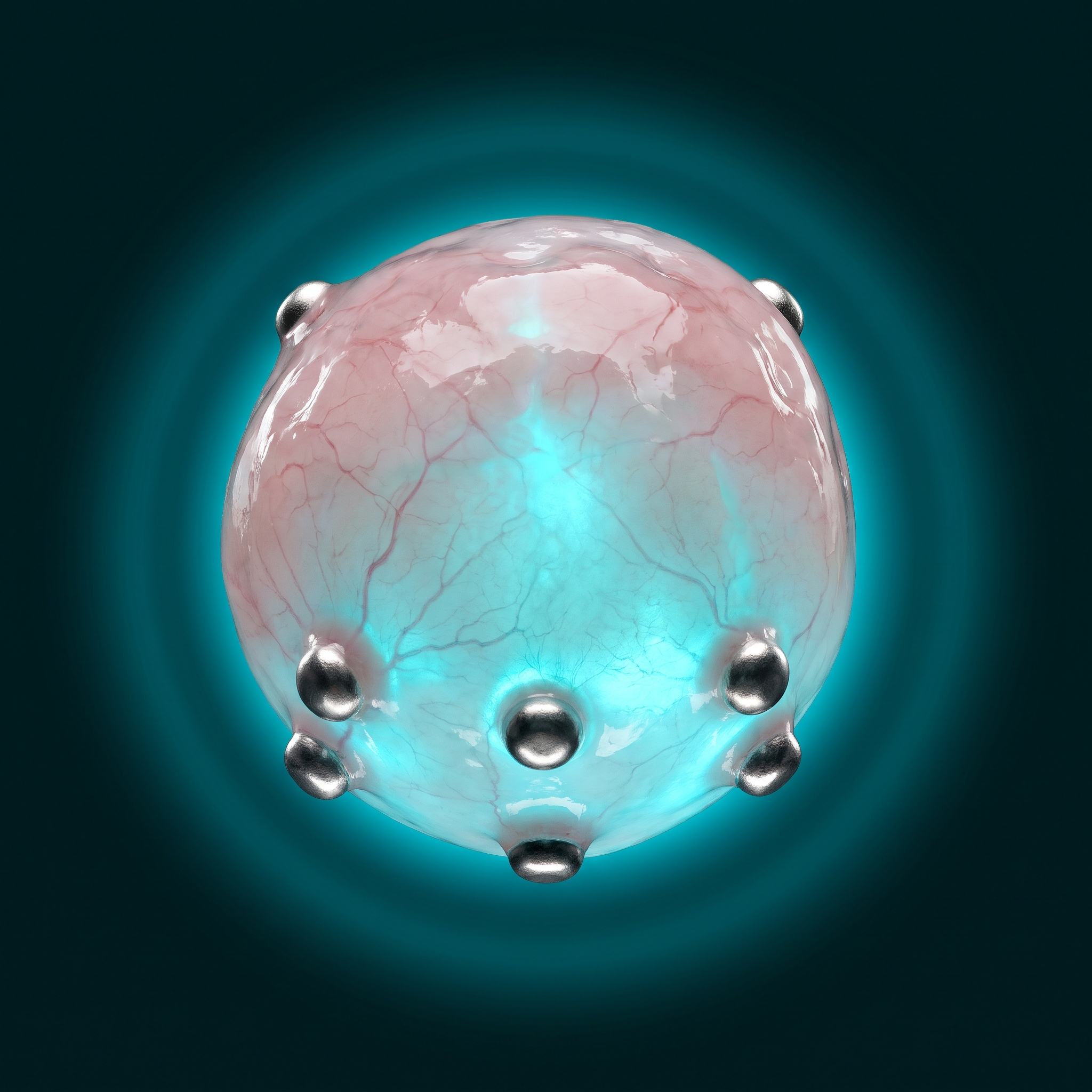
Nina Park: Picture this — a lab at the University of Bristol, two researchers, Dr. Benjamin Ward-Cherrier and a PhD student named Tianyi Liu, and sitting in a dish in front of them are a few tiny, tiny clusters of human brain cells. Each one about the size of a sesame seed. And they've wired these things up to a sensor that's pressing against raised Braille dots.
Walt Garner: Human neural tissue. Grown in a lab.
Nina Park: Grown in a lab, yeah — these are what researchers call brain organoids, sometimes 'mini brains,' and the study came out in October 2026 in a journal called Frontiers in Artificial Intelligence. And the headline everywhere was 'mini brains read Braille.' Which sounds insane. But the actual thing that happened is... weirder and also less dramatic than that, at the same time.
Walt Garner: Wait — the tissue isn't doing the interpreting?
Nina Park: That's exactly it. Think about pressing your fingertip against a bumpy surface — you feel the pattern, but your fingertip isn't deciding what letter it is. Something higher up does that. The organoid is the fingertip. It just vibrates in response to whatever shape the sensor recorded, and then a completely separate computer — a basic machine learning algorithm — figures out which Braille letter that pattern corresponded to. The organoid never 'read' anything. It just... responded.
Walt Garner: So the biological tissue is a transducer, essentially. The interpretation lives downstream.
Nina Park: Right — but the transducer framing makes it sound cleaner than it was. Because one organoid on its own? Sixty-one percent. Across all twenty-six Braille letters. That's not great.
Walt Garner: Below the threshold you'd trust for anything practical, yes. And yet — three organoids together, decoded by the same Support Vector Machine, the same SVM, suddenly you're at eighty-three percent. BioTechniques ran that number on October twenty-seventh, 2026, under the headline 'a new era of biohybrid computing.' Which is, you see, a rather large flag to plant on a rather unresolved result.
Nina Park: Okay but that jump — sixty-one to eighty-three — that's the part that's actually doing all the headline work, and I'm not sure anyone knows why it happens.
Walt Garner: That is precisely the tension Ward-Cherrier's own paper leaves open. Now, what we have here is essentially an ensemble voting problem — three noisy signals, and the SVM is averaging across them, suppressing random baseline firing. The gain isn't the organoids getting smarter. It's noise reduction. But — genuinely, we don't have a clean mechanistic account of why the noise floor drops at that rate.
Nina Park: That sounds exactly like something that would get a startup a Series A.
Walt Garner: Well, actually — yes. And there's a more uncomfortable detail buried in the paper itself. The researchers stated explicitly that the tissue did not learn anything. Not across trials, not over time. The organoid isn't improving. The SVM is doing all the classificatory work. The biological tissue is, in a strict sense, a very expensive signal source.
Nina Park: Wait — they said that? In the paper?
Walt Garner: Their own caveat. Which is — I'll give them credit — unusually candid for a field that tends to let the headline run.
Nina Park: So 'mini brains read Braille' is really 'mini brains fired, and a fairly basic algorithm made sense of the firing, and it got better when there were more brains to average across' — and nobody quite knows the mechanism behind that last part.
Walt Garner: And that summary you just gave is actually more honest than the journal framing — which is worth sitting with for a moment. Because the word 'reading' is doing an enormous amount of cultural work here, and I don't think it's accidental.
Nina Park: The word 'reading' is — yeah, I keep snagging on that. Because imagine a retired teacher, Maria, lost her sight at sixty, spent two full years learning Braille through her fingertips. The texture of the dots, the mistakes, the patience. And then someone tells her that a cluster of cells in a dish 'read' the same alphabet. What would that even mean to her?
Walt Garner: That's the precise problem. Braille was designed for fingertips — for embodied learning, for a body that has history with touch. The organoids have no body, no fingers, no accumulated experience of texture whatsoever. What actually happened is that an SVM — a Support Vector Machine, a fairly basic classifier — matched a neural firing pattern to a label. There is no reader. There is no comprehension. There is neural activity, and then there is a machine deciding what that activity resembles.
Nina Park: So the metaphor isn't just imprecise — it imports a whole theory of mind the experiment never even tried to test.
Walt Garner: Precisely. And Ward-Cherrier's team — to their credit — explicitly said this is not a Braille-reading device. That caveat is in the paper. The press release, well, took a different path.
Nina Park: Okay but — I want to push back slightly, actually, because the metaphor also gets the field funded. Biohybrid computing — integrating living tissue with electronic hardware to exploit neural efficiency, not to build a mind — that is a genuinely hard sell to a general audience without a hook. 'Pattern classification via neural organoid ensemble' does not trend.
Walt Garner: No, and that tension is real. The metaphor makes an abstract classification result emotionally resonant. I won't deny its utility. What concerns me is the asymmetry — the headline scales, the caveat doesn't.
Nina Park: And the infrastructure piece is — I mean, we haven't even gotten to the part where FinalSpark's Neuroplatform is already live, offering cloud access to actual organoid processors, while the basic biology problems the field needs to solve are still wide open. That's the part that made me genuinely uneasy.
Walt Garner: And that's the detail that crystallizes everything, actually — FinalSpark already has the Neuroplatform running. Universities can log in, remotely, and route computation through actual human brain organoid processors right now. The delivery infrastructure exists. What doesn't exist is anything reliable to deliver.
Nina Park: So the field built the highway before anyone figured out where the cars are going.
Walt Garner: That's — well, yes. And here is where I want to be careful, because the sourcing on what I'm about to say is a PMC perspective piece, not a landmark trial, so take it at that weight. But a paper flagged vascularization, maturation, measurement, and reproducibility as the four unsolved problems constraining any real translational value. Vascularization specifically — organoids can't grow blood vessels, which means they can't scale past a certain size before the tissue in the center simply dies from lack of nutrients. The Bristol result doesn't touch any of that.
Nina Park: Wait — so the organoids physically cannot get bigger?
Walt Garner: Not without solving vascularization, no. And reproducibility is almost equally thorny — you can't guarantee that two organoids grown from the same stem cell line will fire in remotely comparable patterns. Which means every result is, to some degree, this organoid, this day.
Nina Park: Okay that — I mean, imagine a researcher, say a neuropharmacologist testing a drug compound on a patient's own organoid cells, trying to reproduce the baseline firing signature Monday versus Thursday. If the tissue itself isn't stable, what exactly are you measuring?
Walt Garner: And that's actually where the narrower use case lives — a May 2026 PMC review suggested the real near-term value is precisely there: drug discovery and brain-function research, not general computation. Not a chip replacement. There's also neuromorphic computing already doing part of this work — silicon chips architecturally designed to emulate biological neural networks. That's an intermediate step. Biohybrid systems are a longer, narrower bet on top of that.
Nina Park: So is that a failure? The narrowness?
Walt Garner: No — but it requires the field to stop narrating every proof-of-concept as a watershed. The 83% number is above noise, yes. It is nowhere near a reliability threshold for practical computation. Ward-Cherrier said so. The field knows. The press release, apparently, didn't get the memo.
Nina Park: I keep thinking about the organoids themselves. Right now, in Bristol, they're still in their incubator. Still firing. And one of those firing patterns got classified as the letter 'H' or 'R' by an SVM somewhere, and the tissue has — I mean, it has absolutely no idea. It never will.
Walt Garner: That's the image that stays, yes. And the actual challenge — the one that will determine whether biohybrid computing amounts to anything — isn't the biology. The biology is patient. It's whether the people writing the press releases can resist calling pattern-matching 'reading' long enough for the real engineering to catch up.
Nina Park: Eighty-three percent across twenty-six letters, decoded by a support vector machine, caveat included by Ward-Cherrier himself. That's the honest version. That's what we've got.