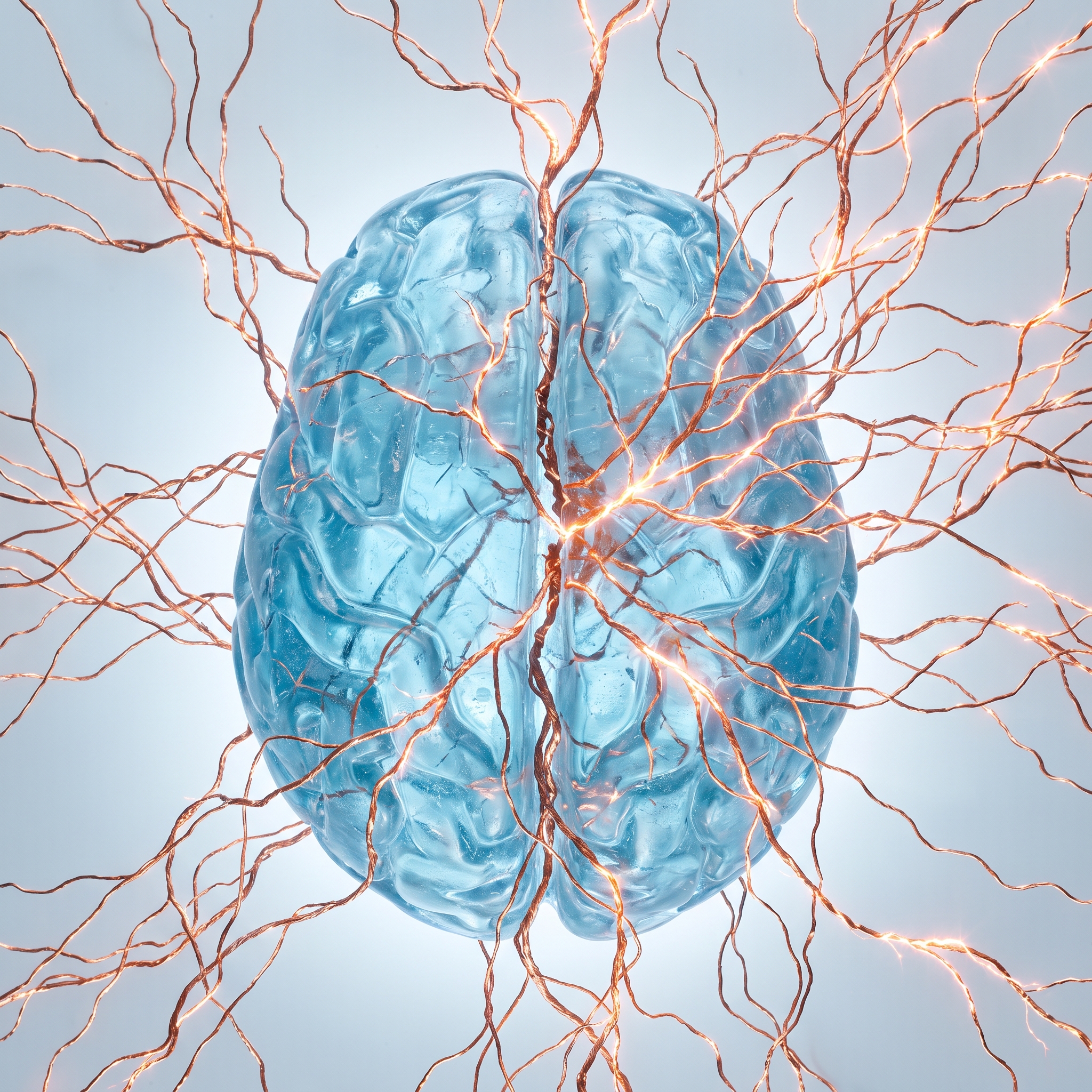
Lila Soto: Iris, quick question before we start — do you think you're a rational person?
Iris Holm: Mm, define rational.
Lila Soto: That's kind of the whole problem, actually — because I spent this week reading about a patient who had amygdala surgery, lost all their anxiety, and then couldn't decide anything. Couldn't make advantageous choices. Couldn't recognize a snake or feel why a cliff edge should concern them. And that patient would have called themselves rational. They were calm. Logical. Completely unmoored.
Iris Holm: Wait — the surgery worked. The anxiety was gone. And the decision system still broke?
Lila Soto: Completely. And that's the thing — the old story, Paul MacLean's triune brain model, says the brain evolved in three hierarchical layers. Reptilian core at the bottom, limbic emotional middle, rational neocortex on top. Separate systems. So if you quiet the emotional layer, reason should win, right? That's the whole premise.
Iris Holm: And the case is a direct empirical contradiction of that premise.
Lila Soto: Think of it like removing the warning lights from your dashboard. The engine doesn't run better — it just runs blind. That's what happens when the fear response is gone. Not liberation. Blindness.
Iris Holm: The specific image that lands for me: a person at the edge of a cliff. Calm. No elevated heart rate, no hesitation. No idea why that should matter.
Lila Soto: And that image is exactly what MacLean was selling — but how did it get so big, so fast, so permanently?
Iris Holm: Carl Sagan. That's the answer. MacLean spent thirty years building the model — 1960s through the 1990s, the full book didn't land until 1990. But Sagan, in 1977, writes The Dragons of Eden. Wins the Pulitzer. And Sagan was an astronomer. Not a neuroscientist. He made MacLean's model gorgeous, and gorgeous travels.
Lila Soto: So Sagan's book did more damage than MacLean's original paper?
Iris Holm: In terms of cultural footprint? Yes. By an order of magnitude. And here's the part that actually gets under my skin — comparative neuroscientists were already raising their hands against the triune model in the 1970s. Almost simultaneously with Sagan's Pulitzer.
Lila Soto: Wait — the same decade?
Iris Holm: Same decade. The science was being dismantled at almost the exact moment it became common sense. And by the early 2000s it was largely abandoned in academic neuroscience. So the rejection window is — I mean, call it 1970s to 2000. That's the gap. Thirty years of academic pushback that went, culturally, nowhere.
Lila Soto: And now it's — what, old self-help books? That would almost be fine.
Iris Holm: No — that's the active part. It's in current thrillers. Management seminars running right now. Therapy workbooks published this decade. The lizard brain isn't a fossil. It's load-bearing vocabulary in frameworks people use every Tuesday morning in performance reviews.
Lila Soto: So it's not lag anymore. It's something else — it's the myth actually working harder than the science ever did.
Iris Holm: Which is exactly when the actual architecture of the thing starts to matter. Because the myth working isn't just a communications failure — it's pointing at a real gap in what the replacement model can do for you.
Lila Soto: Walk me through what the brain actually does. Like — if it's not three layers, what is it?
Iris Holm: Bidirectional circuits. Overlapping. Cortical and subcortical structures firing in both directions simultaneously — not a clean hierarchy, not one region handing off to the next. More like... a dense mesh where cognition and emotion emerge from the same activity at the same time.
Lila Soto: So the limbic system — that whole category — what happens to it?
Iris Holm: Joseph LeDoux and Nabil Imam — Imam's at Georgia Tech's Institute for Neuroscience, Neurotechnology, and Society — they basically argued it should be retired. The limbic system is, in their framing, scientifically incoherent. The amygdala does emotional regulation. The hippocampus handles memory and spatial navigation. The hypothalamus manages basic regulation — temperature, hunger. Those aren't one system. Calling them 'the emotional brain' is — I mean, it's like calling the post office, a fire station, and a library 'downtown services' and expecting them to share a mission.
Lila Soto: And there's no agreed boundary for it either, right? Like, the map of what counts as 'limbic' kept shifting?
Iris Holm: No agreed boundary, no unified function. And then the evolutionary story collapses underneath it too — reptiles and birds have complex forebrains. The subcortical structures aren't some unchanged primitive layer sitting below a human rational overlay. That whole framing was wrong at the biology level, not just the psychology level.
Lila Soto: Huh. So Lisa Feldman Barrett — her constructed emotion framework — that's where this lands? Emotions aren't pre-wired reactions, they're built in real time by the same networks doing everything else? A surgeon reading a scan, noticing their gut tighten before they consciously register what's wrong — that's not a separate emotional alarm, that's one process.
Iris Holm: Exactly that. And there's a piece to Damásio's work that actually makes the stakes concrete — we'll get there in a minute, the prefrontal patients who couldn't decide, what it tells you about emotion as signal rather than noise. But the map was wrong. The question is what map replaces it.
Lila Soto: But the prefrontal patients — that's the part I keep getting stuck on. Like, what actually happened to them?
Iris Holm: Damásio laid it out in Descartes' Error — 1994. Patients with damage to the orbital and medial prefrontal cortex. The parts that connect emotional processing to action. Their logical reasoning tested completely intact. They could analyze options, describe trade-offs, rank criteria. And then they could not decide. An hour — deciding where to eat lunch.
Lila Soto: An hour. On lunch.
Iris Holm: Because every option was equivalent to them. Nothing had weight. The somatic marker — Damásio's term — is the felt physiological signal that tags an option as better or worse before you finish reasoning through it. Gone. So the reasoning loops. It just keeps going.
Lila Soto: So what does that look like with an actual high-stakes call — like, not lunch?
Iris Holm: Think about a surgeon — two treatment plans, both equally evidence-supported, both defensible. Logic cannot break that tie. It genuinely can't. But the surgeon, knowing this specific patient said quality of life over longevity, feels one option sit differently in their chest. That feeling — that's not corruption of the reasoning. That's the somatic marker doing actual cognitive work. It's encoding the patient's values as signal.
Lila Soto: And Damásio's whole argument is that calling that a bias — or noise — is actually the Descartes mistake. The dualism. Treating reason and emotion as things that can even be separated.
Iris Holm: Exactly — and Barrett gets there too, different mechanism, constructed emotion versus somatic marker, but they converge on the same structural finding. You cannot route around the emotional signal and get better decisions. You get paralysis, or you get decisions that are technically coherent and completely wrong for the person.
Iris Holm: The myth said emotion corrupts reason. The evidence says emotion is the thing that makes reason land somewhere.
Lila Soto: And that's where the whole thing flips for me. Because if the brain is a prediction machine — building what you feel from memory and belief and prior context, not just receiving signals from outside — then the question you'd ask yourself is completely different. Not 'how do I stop the lizard brain from hijacking the meeting.' More like... are the beliefs I'm running on actually mine? Are they calibrated to what I want right now, or are they calibrated to something that happened ten years ago?
Iris Holm: And the institutions still teaching the three-brain model — therapy protocols designed around suppressing emotional response, management training built on 'don't let your feelings drive the bus' — they're training people to fight an enemy that was never there.
Lila Soto: I mean — that's the part that just kind of sits with me. It's not even a villain. MacLean, Sagan, the curricula that never updated. Nobody was lying. The myth just did something nobody had language for yet, and now we have better language and the institutions haven't caught up and people are still in sessions learning to suppress the exact signals Damásio spent a career proving are load-bearing.
Iris Holm: That's probably the honest place this one ends. Not with a fix. Just — wrong map, real cost, and the new map hasn't been handed out yet.