Cyrus Reed: Iris, hey — okay, did you sleep badly this week at all, because I genuinely could not stop thinking about something.
Iris Holm: Every week, different reason. What did you do to yourself this time?
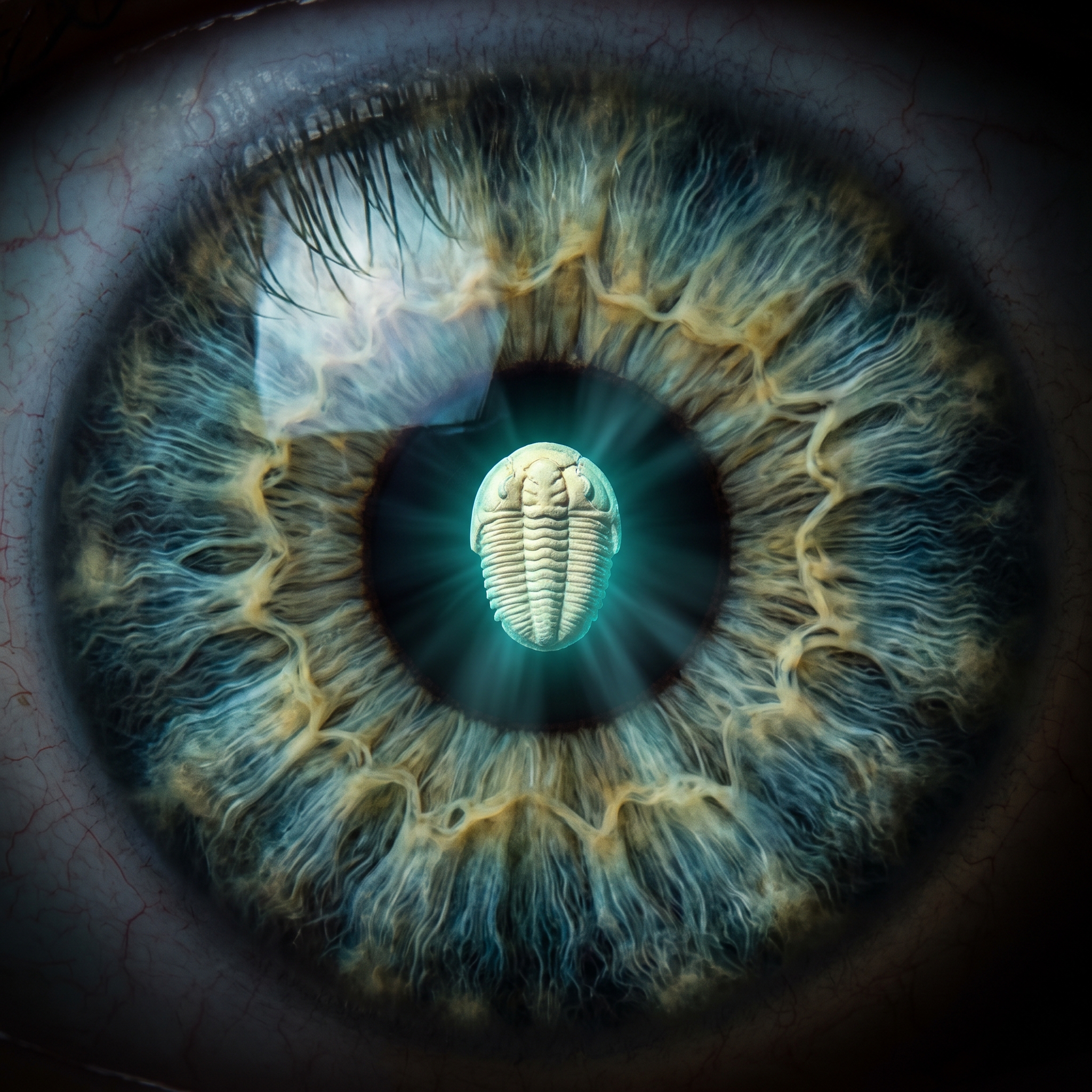
Cyrus Reed: I read this paper and I — wait, no, I'm starting wrong. The thing that got me is: you know how your pineal gland controls when you wake up? Like melatonin, circadian rhythm, all of that? There's a paper in Current Biology from February 2026 that is basically arguing that gland is a fossilized eye. Like, an actual ancient eye sitting in your skull, still doing its original job.
Iris Holm: Hold on. Fossilized how — structurally, or functionally?
Cyrus Reed: Both, maybe? So the paper — it's led by Dan-Eric Nilsson, he's a professor emeritus of sensory biology at Lund University — and the core claim is that vertebrate paired eyes were not built from scratch. They were repurposed from a single ancestral median eye. A cyclops eye. On a worm-like creature living 560 to 600 million years ago.
Iris Holm: Repurposed. That's the word I want to press on.
Cyrus Reed: Yeah — and Nilsson's quote, the one that's everywhere now, is that the findings 'turn our understanding of the evolution of the eye and the brain upside down.' The paper is in Current Biology, co-authored with George Kafetzis at the University of Sussex, Michael J. Bok also at Lund, and Tom Baden, also Sussex. So this is a two-institution thing, Sweden and UK.
Iris Holm: Four authors, two institutions, peer-reviewed journal. And the claim is: your eyes are recycled.
Cyrus Reed: But wait — recycled is actually the key word, because the paper isn't saying we found a cyclops fossil. There is no cyclops fossil. What Kafetzis and Nilsson did is survey 36 major groups of living bilateral animals, map where their eyes sit and what photoreceptor types they use, and then run that backwards onto an evolutionary tree. The ancestor is inferred. It's — okay, think of it like this: you find a Swiss Army knife corkscrew, and you figure out it was originally designed as a drill. No original drill exists. But the shape of the tool tells you what job it used to do.
Iris Holm: That's the click. The tool changed jobs; the underlying piece is the same.
Cyrus Reed: Exactly — and Ars Technica actually named it explicitly: they called the paper 'a new theoretical synthesis.' Not a fossil find. The cyclops ancestor is inferred, not observed.
Iris Holm: So what's actually new? Because median eye homology — biologists have suspected something like this for a while.
Cyrus Reed: Yeah, and I think the answer is the rigor of the mapping. 36 groups, systematically, eye locations and photoreceptor types plotted together. That's not someone saying 'I have a hunch.' That's — wait, actually that's what makes Nilsson's claim about vertebrate eyes representing a separate evolutionary origin even land at all. He said vertebrate eyes are so fundamentally different from the lateral eyes of other animal groups that they couldn't have come from those lateral eyes directly.
Iris Holm: Paradigm shift or formalization. That's the gap I want to hold.
Cyrus Reed: How do you draw that line, though?
Iris Holm: The mapping is the new thing. The hunch existed. The systematic survey of 36 groups, feeding that into a tree — that's what promotes a suspicion into a publishable claim in Current Biology. The rigor is the contribution. Calling it a radical reinterpretation is the press release version.
Cyrus Reed: Right — but the part that doesn't fit is ScienceDaily running it in July as if it just happened. The paper was February 25th, Lund University press release and everything. Five months later it's framed as a fresh discovery. That's not on the researchers.
Iris Holm: The ScienceDaily thing is a separate problem — one we'll need to come back to, because the timing gap between February and July tells you something specific about how scientific claims travel. But the overclaim I want to name right now is closer in. Headlines are calling it 'you have a cyclops eye in your brain.' As confirmed fact.
Cyrus Reed: Wait — is that actually wrong, though? Because the pineal gland literally contains light-sensitive cells. Not metaphorically. It actually detects light. That's been sitting in the literature for decades.
Iris Holm: It does. That part's real. What isn't settled is the mechanistic pathway — how you get from that ancestral median eye's photoreceptive tissue to a modern neuroendocrine gland. That chain is active inference, not confirmed biology.
Cyrus Reed: So the 'remnant' framing — that's the paper's hypothesis, not its finding.
Iris Holm: Exactly. Think about a long-haul flight, no windows, blindfolded. Your pineal gland is still doing something — still responding to light absence, still modulating melatonin, still running a system that may trace back 600 million years to a worm on the Cambrian seafloor. That's real. The word 'may' is doing heavy lifting there.
Cyrus Reed: Okay but — wait, a handful of living vertebrates still have a visible median eye on top of their head right now. Like, a physical structure. That's not inference, that's present-day anatomy.
Iris Holm: Consistent with the hypothesis. Not proof of the pathway.
Cyrus Reed: No, I — yeah, I get the distinction. It's just, even as hypothesis, it's still the most interesting thing in the paper. The pineal gland as an ancient photoreceptor with a direct functional line to a Cambrian ancestor — even if unproven, that reframes what we think the gland is for.
Iris Holm: The hypothesis is interesting. Calling it a confirmed eye in your skull is the overclaim. Those are different things.
Cyrus Reed: Which — okay, that overclaim problem, that's actually where the ScienceDaily thing stops being just an annoyance. July 26th, five months after Current Biology published, ScienceDaily runs it as fresh. And that's not a typo or a mix-up, that's — wait, that's the whole mechanism, right? Because by July, the reader has zero context that Ars Technica already analyzed it in March, that Kafetzis and Nilsson wrote their own explainer for The Conversation on April 4th. You receive it as breaking.
Iris Holm: Primed for maximum surprise, no antibodies.
Cyrus Reed: Exactly. And the scientific community had five months to push back, add nuance, contextualize the 'theoretical synthesis' framing — all of that happened. None of it travels with the July headline.
Iris Holm: The NYT piece ran February 23rd — two days before Lund University's own press release. They cited 560 million years. Every aggregator after July uses 600 million. That's not a rounding difference. That's an unsettled number, and the delay flattens it into false precision.
Cyrus Reed: Wait — the NYT was ahead of the press release?
Iris Holm: February 23rd versus February 25th. Someone talked to the Times before Lund issued anything official. So two versions of the same number enter the world two days apart, and then five months later ScienceDaily picks one — 600 million — and that's just the number now.
Cyrus Reed: So imagine someone — a marine biologist, say, finishing a night shift, checks their feed at 6 a.m. on July 27th, sees 'ancient cyclops ancestor gave us our eyes,' thinks it just dropped. They have no idea Dan-Eric Nilsson said 'turns our understanding upside down' to journalists back in February. The claim hits them at full force, uncut.
Iris Holm: And that's the structural problem. Press release timing is now part of the epistemology. The Lund release on February 25th, the ScienceDaily lag to July 26th — that gap doesn't just change *when* people hear it. It changes what they think the confidence level is.
Cyrus Reed: So what do you actually watch for? Like — is there a fix, or do you just learn to check the publication date on Current Biology before you believe the 'breaking' label?
Iris Holm: Check the date. That's the whole fix — it's unsexy but it's real. If ScienceDaily says July and Current Biology says February, the lag is information. It tells you the claim has been loose in the world long enough to pick up noise.
Cyrus Reed: But wait — okay, that's the media hygiene answer, but it doesn't actually touch what gets me, which is — Dan-Eric Nilsson and George Kafetzis built this whole synthesis on evolutionary tinkering. Existing parts, new jobs. The median eye didn't disappear, it got reassigned. And if that's true for eyes, I genuinely don't know where that stops. Like — what else in us is a 600-million-year-old tool that we're just... calling something modern?
Iris Holm: That's the question the paper actually opens. And it's bigger than eyes.
Cyrus Reed: Yeah. I don't have an answer for it.
Iris Holm: Neither do they. Worth something, that they said so.