Hope Sterling: Okay, I have to tell you — I was getting coffee this morning and my phone buzzed with a SpaceX alert and I genuinely spilled it, like, on my sleeve, because the notification said 'SpaceX targets 1 gigawatt of compute in orbit by 2027' and I just stood there in my kitchen being like — I'm sorry, orbit?
Juniper Vale: The Starmind announcement — yeah, I had the same moment. Because that's not a concept anymore, they have a satellite, AI1, with specs attached to it.
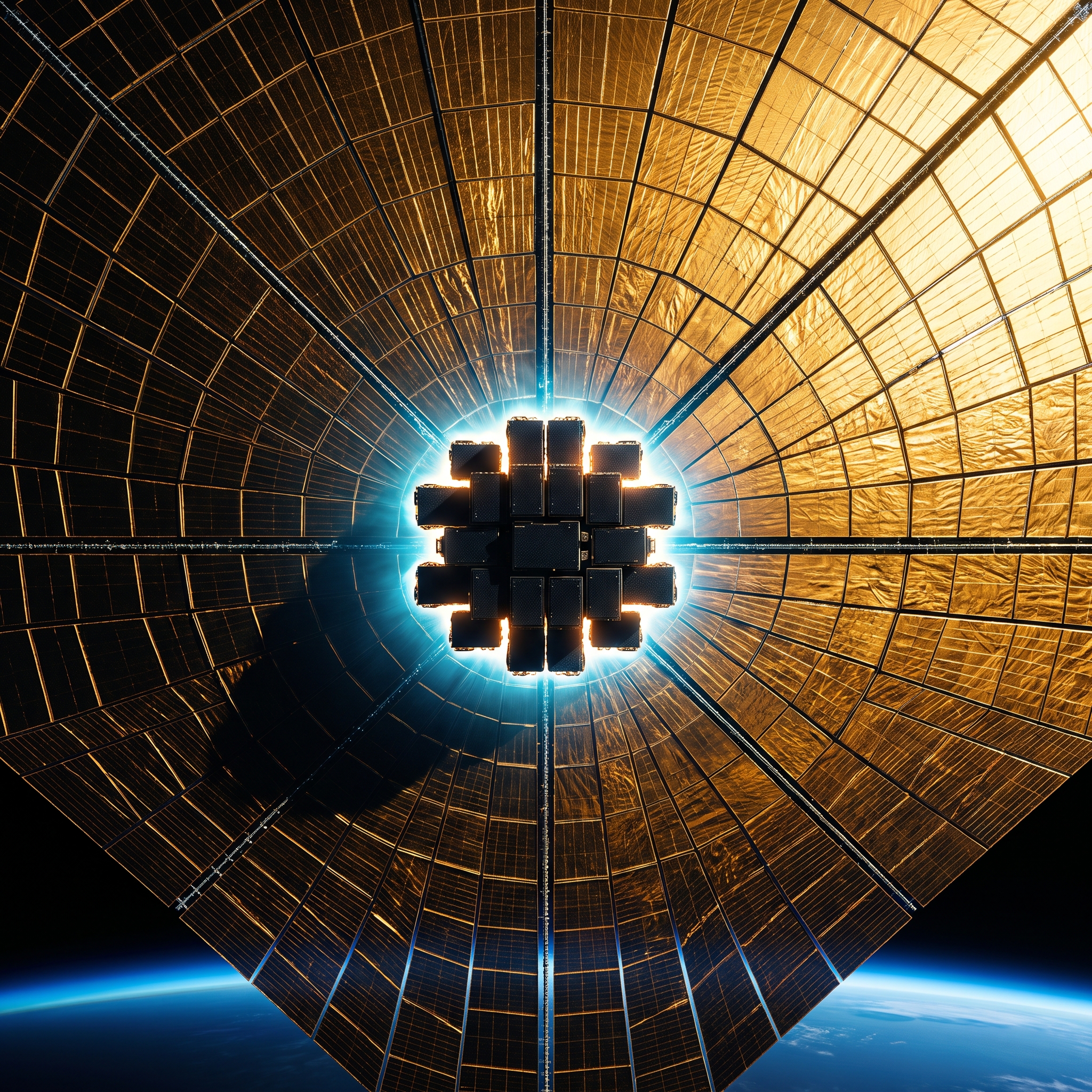
Hope Sterling: Seventy-meter wingspan — which, I didn't have context for that until I looked it up and it's like the span of a commercial jet — and 150 kilowatts peak payload. And they're going to mass-produce these things at the Gigasat factory in Bastrop, Texas, eleven million square feet, which they announced June 8th, 2026.
Juniper Vale: And manufacturing doesn't even begin until 2027. So the window between first production and hitting one gigawatt is — it's tight in a way that doesn't fully compute to me yet.
Hope Sterling: Nine months, maybe? Like — wait, that's the part that's insane to me. But then Musk gets up on July 6th and just says it: space is the only way to scale AI. Not the best way. The only way.
Juniper Vale: And that claim is what today is really about — whether that's engineering reality or whether it's a pitch. Because the context matters: SpaceX-xAI just sold all of Colossus I's compute to Anthropic for $1.25 billion per month, and now they're out here saying Earth is full.
Hope Sterling: Okay but the xAI-SpaceX merger was February 2026 — so now it's SpaceXAI — and Musk is simultaneously Anthropic's landlord, their satellite vendor, and running the AI company that competes with them. That conflict is what I literally cannot stop thinking about.
Juniper Vale: Which is exactly the question we need to pull apart — because whether space is really the only way to scale, or whether that's a line that benefits one specific person, those are very different answers.
Hope Sterling: But wait — before we get into whether that pitch holds, I keep getting stuck on something more basic. Like, okay, you put a giant solar-collecting satellite in orbit, great, but what happens to all the heat those computers make?
Juniper Vale: That's actually the whole thing. On Earth your laptop has a fan. The fan pushes heat into air. In space there is no air — so the only way a satellite sheds heat is by glowing it away, infrared light radiating off physical panels. Like a stovetop cooling in a dark room.
Hope Sterling: Oh — so it's not venting, it's just... glowing the heat off?
Juniper Vale: Exactly. And AI1's thermal radiators are rated at approximately 1,400 watts per square meter. Which sounds like a lot until you realize — that number means you need a huge dedicated surface area just to dump waste heat. Not to catch sunlight. Just to get rid of what the computers make.
Hope Sterling: So chunks of that 70-meter wingspan aren't even doing the solar thing, they're just — radiating?
Juniper Vale: Right — and IEEE Spectrum actually named this. They published a piece called 'The Space-based Data Center Hype Machine Is Already in Orbit,' and their argument was, I mean, it wasn't gentle — they said the thermal radiator engineering might end up harder and more fragile than the solar arrays themselves. Nobody in the hype cycle is leading with that.
Hope Sterling: Okay that's — wait, harder than building 70 meters of solar panels? The cooling is the ceiling, not the power?
Juniper Vale: That's the counterintuitive part. The hard part isn't plugging into the sun — space is genuinely great for that. The hard part is getting rid of the heat your computers make once you're running inference at scale with nowhere for it to go.
Hope Sterling: And that's what makes the terrestrial argument actually land for me — like, it's not just that space is cool, it's that ground-based compute is genuinely running into walls. SpaceX's own IPO S-1 disclosed $12.7 billion in AI capital expenditures for 2025. Twelve point seven. That's more than three times whatever the prior benchmark was.
Juniper Vale: Three times over in one year.
Hope Sterling: And then — okay, so Anthropic is already paying $1.25 billion a month for Colossus I, right, we said that. But they also separately signed a $19 billion, twenty-year data center lease with TeraWulf in Kentucky. That's not hedging. That is a company buying every available compute option they can physically find.
Juniper Vale: That's actually the part that matters — they're not choosing between Earth and space, they're doing both because neither one is enough alone.
Hope Sterling: Right — but like, picture an Anthropic researcher at 3 AM, their local inference queue is backed up, and they're pulling results back via laser link from AI1, which is in sun-synchronous orbit, bouncing down through the Starlink constellation. That's not— I mean, that's not a concept anymore, that's the actual AI1 architecture.
Juniper Vale: And SpaceX is claiming commercial TSMC N3/N5 chips — the same silicon in your phone, basically — can survive LEO without radiation hardening. Which, if true, that undercuts the entire rad-hard semiconductor industry. Unproven at scale, but that's the claim they filed with the FCC.
Hope Sterling: Wait, so not even specialized space chips? Just — off the shelf?
Juniper Vale: That's what they're saying. And that's what would make the economics actually work at scale — because rad-hard chips are expensive and slow. The demand is real, I'll give you that. The TeraWulf lease, the S-1 capex number — those aren't hype, those are contracts. The thermodynamics don't care about contracts, but the demand side? Yeah, that's genuine.
Hope Sterling: And there's a whole other layer to this we haven't even gotten to yet — like, what happens when the company selling Anthropic orbital compute slots is also racing its own AI models on that same infrastructure. That part gets complicated fast.
Juniper Vale: And that's the part that actually doesn't have a clean answer — because the February 2026 merger means xAI and SpaceX are now the same entity. So the company offering Anthropic orbital compute slots is also running Grok on the same infrastructure roadmap. There's no wall between those two.
Hope Sterling: Wait — there's no disclosed auditing mechanism? Like, nobody outside SpaceXAI can actually verify whether Anthropic's workloads get the same slot priority as xAI's own training runs?
Juniper Vale: Nothing disclosed. That's the actual gap. And it's not theoretical — if xAI needs a big Grok training run and Anthropic's inference queue is competing for the same Starmind allocation, who decides? We don't know. There's no public mechanism.
Hope Sterling: Okay that is — I mean, that's the governance nightmare nobody's writing about because it's easier to write about the 70-meter wingspan.
Juniper Vale: And then layer on the timeline problem — because the Gigasat factory doesn't start manufacturing until 2027, and the target is 1 GW by late 2027. I mean, that's — wait, actually, Starlink is the precedent everyone cites for SpaceX beating aggressive timelines. But Starlink was communications payloads. Proven hardware. AI1 is unproven compute surviving radiation, thermal cycling, all of that, at scale.
Hope Sterling: So maybe nine months from first production unit to a gigawatt of compute hardware operational in orbit. That's the number.
Juniper Vale: Nine months with zero iteration cycles. And the FCC filing adds regulatory approval risk on top. So here's what I'd actually defend: the 1 GW by 2027 claim is a market signal — it captures customers like Anthropic, it moved SpaceX's valuation to $2.1 trillion on Nasdaq, it forces capital toward this infrastructure bet. It might work even if the hardware slips.
Hope Sterling: So the pitch is doing real work even if the satellites aren't.
Juniper Vale: That's the calibrated version. The demand is genuine — Anthropic's TeraWulf lease proves they're running out of options. The conflict is structural and unaudited. And the timeline is, you know, aggressive in a way that the Starlink comparison doesn't actually cover. All three things are true simultaneously.
Hope Sterling: And maybe this is the wry version of the whole thing — space isn't the only way to scale AI. It's the only way to scale AI if you've already sold your data center to your biggest rival for a billion two fifty a month.
Juniper Vale: That's actually the most calibrated version of the Musk claim I've heard. The only way to scale — unless you can solve the heat.
Hope Sterling: And if SpaceX actually hits a gigawatt of orbital compute by late 2027 — like, genuinely does it — I don't think the question is whether Starmind works. It's whether the thermal radiators end up bigger than the solar arrays, and whether Anthropic ever finds out their slots went to Grok first.
Juniper Vale: Yeah. Those two questions don't have public answers right now. That's where we actually landed.
Hope Sterling: Genuinely loved thinking through this with you — my sleeve is still a little coffee-stained, for the record.