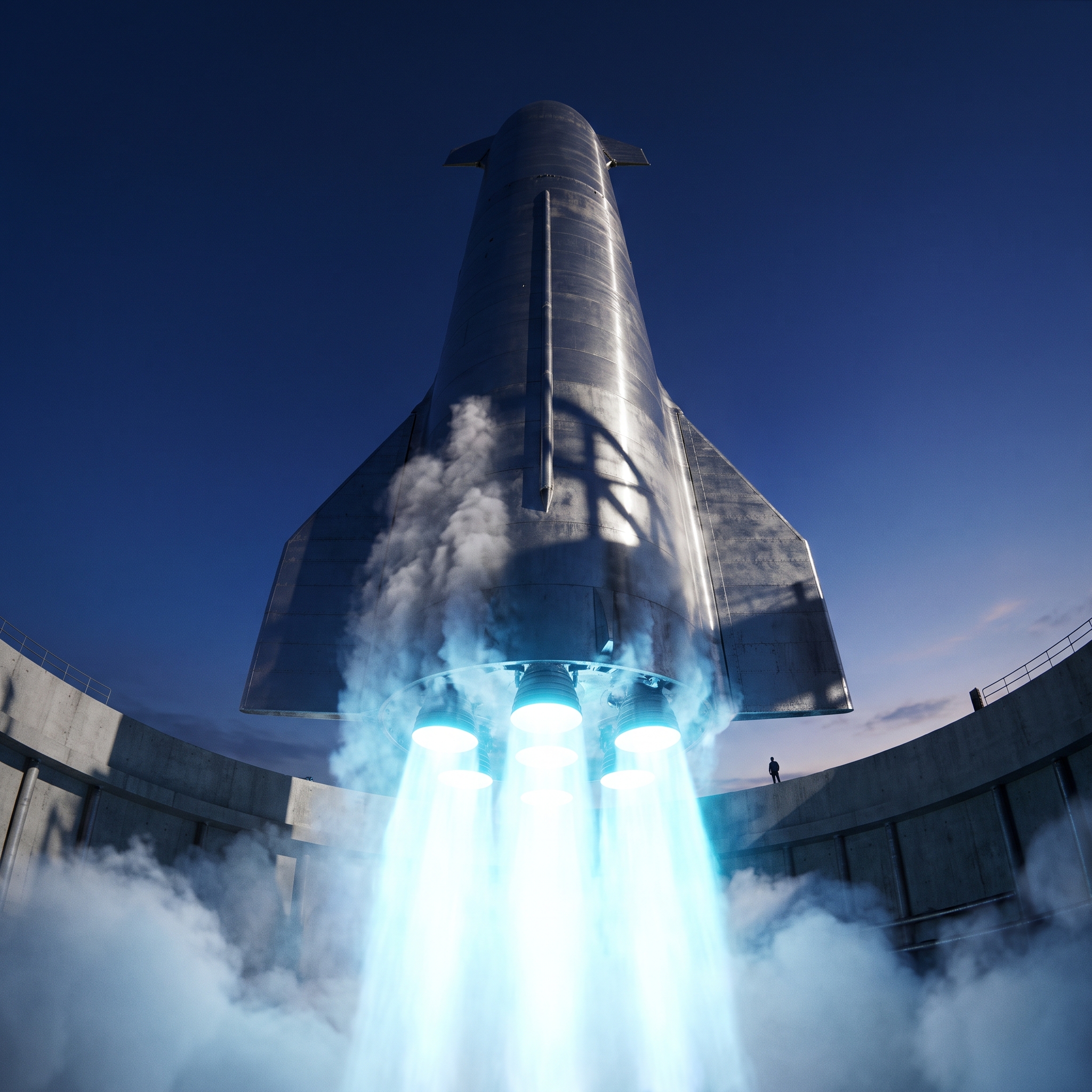
Hope Sterling: Okay, hey — so you know how sometimes a number just hits you wrong? I was reading the IFT-12 recap again this morning and I got stuck on this one detail: eight engines. Eight Raptor 3 engines failed during the boostback burn on May 22nd. On Super Heavy. And then I look over and it's July 2nd, SpaceX posts a video, Ship 40, six engines, sixty seconds, totally clean. Eight weeks.
Juniper Vale: Eight weeks between a booster hitting the Gulf of Mexico at fourteen hundred and fifty kilometers per hour and clearing a full six-engine static fire at the Massey test site. That timeline is — I mean, it's genuinely fast.
Hope Sterling: Fast is one word for it! But here's what's making me spiral a little — SpaceX hasn't actually said what caused the IFT-12 failure publicly. Like, the FAA grounded Starship for five days after the launch, and then... nothing? No official breakdown of why twenty of twenty-eight engines relit instead of all twenty-eight?
Juniper Vale: Not that I've seen, no.
Hope Sterling: Stop. Okay so that's the thing, that's the actual tension of today — because the video is gorgeous, all six Raptor 3s running simultaneously is a real milestone, I'm not dismissing that. But does it tell us anything about what went wrong in flight?
Juniper Vale: That's the right question. And it's not just SpaceX on the line here — NASA is counting on Starship as a lunar lander for Artemis, and this static fire is what's clearing the path toward IFT-13. So what the test proves — and what it doesn't — that actually matters.
Hope Sterling: And there's a whole other layer with Blue Origin that I'm kind of obsessed with bringing up — but first, walk me through what a static fire even tells you mechanically.
Juniper Vale: Yeah — let's start there, because I think it clears up a lot of the confusion about why SpaceX is calling this a milestone without it being the full answer.
Hope Sterling: Okay but wait — before you explain, I want to flag that they didn't just go straight to six engines. They fired one engine first, like a single Raptor 3, for ten to fifteen seconds on June 25th or 26th. And THEN six engines for sixty seconds. Isn't that like... methodical? Doesn't that mean they actually worked up to it carefully?
Juniper Vale: That is methodical — genuinely. But here's what a static fire actually clears: it's a garage inspection. The mechanic puts your car on a lift, spins the tires, checks that everything ignites. That's real. That's useful. But it's not a highway.
Hope Sterling: Oh — oh, okay. Say more.
Juniper Vale: IFT-12 failed during a boostback burn — so you're talking about engines relighting at altitude, at high velocity, with aerodynamic loads and vibration that the Massey test stand just... doesn't produce. The ground can't simulate that. So Ship 40's engines running clean for sixty seconds at Massey tells you: the engines start, they sustain, no obvious hardware failure at sea level. Full stop. It doesn't tell you what happens when those same Raptor 3s are asked to relight under the conditions that actually broke eight of them.
Hope Sterling: Wait — so the blowout happened on the highway and we're celebrating that the tires spin fine on the lift?
Juniper Vale: That's exactly it. And I want to be clear — passing the static fire is not nothing. It had to happen before IFT-13 could happen. But it's a narrow bar. SpaceX, as far as anyone publicly knows, has not confirmed what caused those eight engines to fail. Not to the FAA, not in any public statement.
Hope Sterling: Which means NASA is sitting there with Artemis III on the line, Starship is their lunar lander, and the best public signal they have is a sixty-second video from July 2nd with six engines going whoosh on the ground.
Juniper Vale: Yeah. And I mean — maybe SpaceX engineers know internally exactly what changed. Maybe it was a valve, maybe combustion instability, maybe thermal. But "we fixed it" and "we know what we fixed" are actually different confidence signals. One is empirical. The other is... you have to take their word for it.
Hope Sterling: So the headline is real, the milestone is real, but the gap between what the test proves and what actually needs to be proven — that gap is still just... open.
Juniper Vale: And that open gap is where the circulating take breaks down — you know, the one that's like, 'this is just SpaceX doing what SpaceX does, fail fast, seven of twelve worked, the static fire proves they're back.'
Hope Sterling: Oh I've seen that take everywhere. 'Five failures across twelve flights is fine, that's the learning curve.' But wait — Raptor 3 was specifically built to fix the reliability problem. Like, that wasn't just another engine iteration, that was the solution. And IFT-12 was its debut.
Juniper Vale: Right — and that's actually what breaks the 'normal data point' framing. When your fix fails catastrophically on its first real flight, that's not the learning curve continuing. That's a signal that the root cause might be deeper than what the fix assumed.
Hope Sterling: Stop. So Raptor 3 was supposed to be the answer and it's the thing that failed eight engines during boostback.
Juniper Vale: As far as we know publicly, yeah. And look, I want to be fair — IFT-12's booster loss was described as the worst failure since Flight 1. That's not a routine bad day. That's a regression on the vehicle that was supposed to be more reliable.
Hope Sterling: And the 'learn from each failure' model — like, that only works if you're actually transparent about what you learned. SpaceX hasn't given a public root cause statement. So the static fire isn't a vindication, it's just... a hope with six engines on it.
Juniper Vale: No, I'd — actually, I don't think I'd go quite that far. The FAA lifting the grounding, that means something. There's a review process. But you're right that 'we fired the engines and they worked' is not the same as 'we told you what we changed and why.' Those are genuinely different bars.
Hope Sterling: And honestly the part that comes later makes this even messier — because it's not just SpaceX in the equation. Artemis III needs two vehicles to pull this off, and the backup picture is... I'll just say it gets worse.
Juniper Vale: Yeah. Five failures in twelve total flights isn't disqualifying on its own. But when flight five is a catastrophic debut of the engine designed to stop the failures — you don't get to call that the playbook working.
Hope Sterling: And that backup picture — okay, this is the part that literally kept me up. New Glenn exploded on the pad. May 28th. Six days after IFT-12. Blue Origin's rocket, the one that's also contracted for Artemis III, just... gone.
Juniper Vale: And Artemis III needs both. Not Starship or Blue Origin's Mark 1 lander — both. The crew rendezvouses with both vehicles in Earth orbit during the mission.
Hope Sterling: So the redundancy is... two broken things.
Juniper Vale: That's the real exposure. And then Dave Limp — Blue Origin's CEO — announces June 30th that they're not even rebuilding the damaged Florida pad as it was. They're pivoting to some hybrid launch concept for New Glenn 9×4. Which, I mean — that's not a fast pivot. That's a significant infrastructure decision made under pressure with a root cause still unknown.
Hope Sterling: Wait, the root cause is still unknown? As of when?
Juniper Vale: Late June, yeah. No confirmed public statement on what caused the explosion.
Hope Sterling: No, imagine being Randy Bresnik. He's the Artemis III commander. Someone shows him the Ship 40 video from July 2nd, six Raptor 3s firing clean, and his boss goes, 'see, we're back on track.' And he knows: SpaceX hasn't confirmed what broke on IFT-12, Blue Origin literally doesn't have a pad anymore, and the FAA licensing timeline for IFT-13 isn't even publicly clear yet.
Juniper Vale: That's exactly the signal to watch. Not the video. Whether the FAA issues IFT-13 licensing before SpaceX puts out any public root-cause statement — that's the tell on how much transparency is actually happening here.
Hope Sterling: Because if the license drops with no explanation of what failed on May 22nd, that's — I mean, that's the gap between confidence and knowledge, right there in an official document.
Juniper Vale: And that's — I mean, that's what keeps hitting me. Not on the video. On the gap between what SpaceX knows internally about IFT-12 and what the FAA has on paper. Because thirteen integrated flight tests is a genuinely unprecedented pace. No program has moved like that. But five failures in twelve flights, and the fifth one being the worst since Flight 1 — that math only closes if the iteration is deliberate. If it's not deliberate, it's just... fast.
Hope Sterling: Right — but like, if IFT-13 sticks the boostback, nobody's going to ask that question. The Ship 40 static fire becomes a milestone, SpaceX looks vindicated, and whatever actually happened on May 22nd just kind of... dissolves into the win.
Juniper Vale: Yeah. And maybe it was a deliberate fix. Maybe they know exactly what valve or combustion condition broke eight Raptor 3s during that boostback burn. I genuinely don't know. But neither does anyone outside that building — and NASA's lunar timeline is riding on the answer.